Case Media
Case Notes
This page keeps the media, full prompt, and original source together so you can inspect the result first and decide whether the prompt is worth copying, saving, or comparing.
Case Insights
To make this page easier to search, cite, and reuse later, the case is also broken down into practical guidance about usage, visual cues, and prompt structure.
Best Fit Scenarios
- Use this as a ui & social screens benchmark when you need a fast style baseline before rewriting your own prompt.
- It is especially helpful if your target overlaps with Cinematic, Fashion, UI and you want to judge the image result before tuning wording.
- Keep it as a control sample when you compare nearby prompt variants one variable at a time.
Visual Signals To Notice
- The clearest style signals here are Cinematic, Fashion, UI, so those should usually stay in your first rewrite.
- The important layer is usually interface density, card hierarchy, and how the screen tells the story before you read small text.
- This case keeps 2 media outputs, which makes it easier to check whether the style remains stable across multiple results.
How The Prompt Is Structured
- The prompt reads as a long, highly specified prompt, which is useful when you want to judge how much specificity this direction needs.
- Its keyword cluster is centered on Cinematic, Fashion, UI, so you can usually keep that cluster while swapping subject, camera, layout, or copy details.
- A practical rewrite path is: keep the outcome, keep the strongest style cues, then replace only the subject and environment blocks.
Good Follow-up Questions
- What changes first if you keep Cinematic, Fashion, UI but switch the subject matter?
- Which part of the result comes from section-level structure (UI & Social Screens) versus tag-level style cues?
- Which related cases in the same section give you a cleaner or more extreme variation of the same direction?
Full Prompt
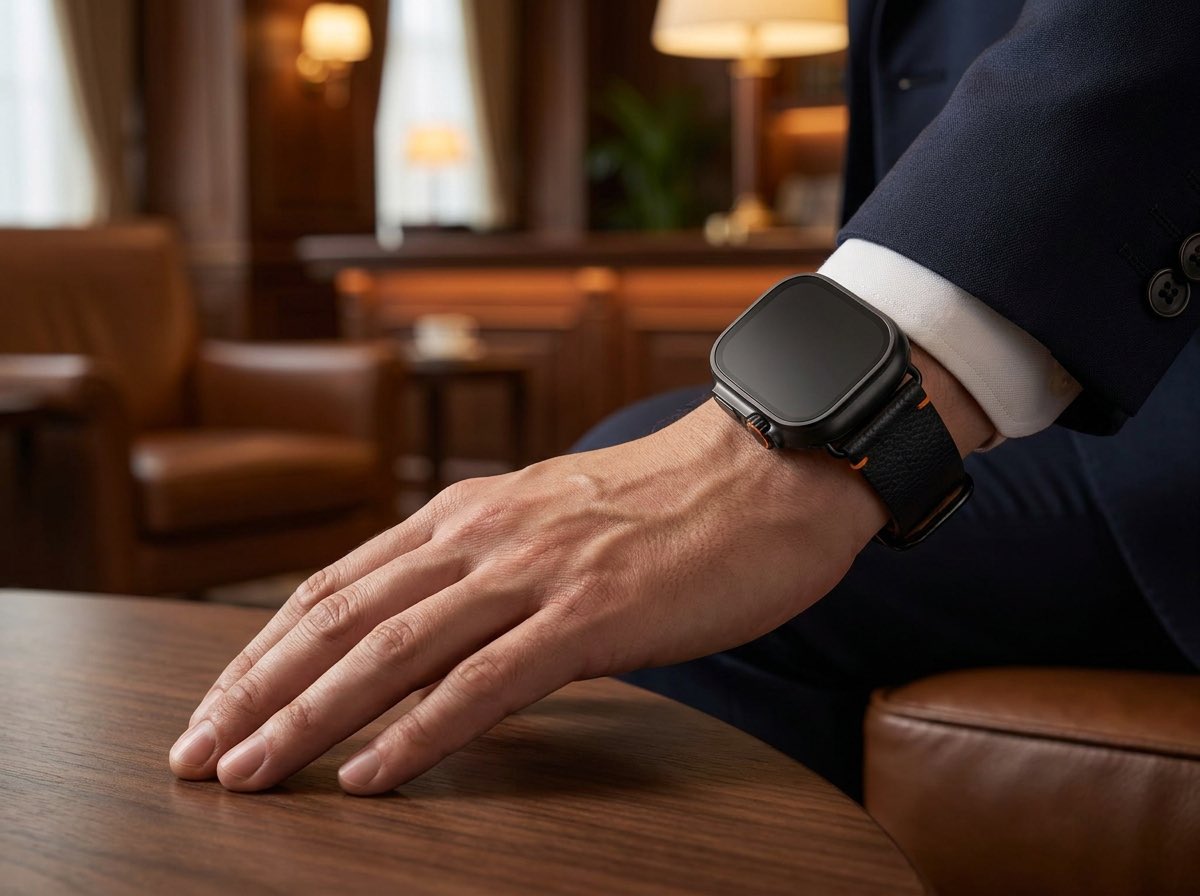
Create a photorealistic luxury lifestyle advertisement featuring a {argument name="smartwatch model" default="black Apple Watch Ultra-style smartwatch"} worn on the left wrist of a well-groomed adult man. The watch must be the hero object: a rounded-square black case with a dark inactive glass screen, thick rugged bezel, side crown and buttons, and a black leather or textured band with subtle warm brown edge accents; preserve the case shape, band shape, materials, and tactile textures exactly. Show the man's hand resting elegantly on a polished wooden table, fingers extended naturally, with realistic skin pores, veins, knuckles, nails, and soft highlights. He wears a {argument name="suit color" default="deep navy suit"} with a crisp white shirt cuff visible behind the watch. Set the scene in an upscale private lounge or hotel club with warm wood paneling, brown leather armchairs, a side table, soft curtains, a green plant, and glowing table lamps in the blurred background. Use shallow depth of field, warm amber indoor lighting, cinematic bokeh, premium editorial composition, and a close-up three-quarter angle from slightly above the table. Keep the watch sharply focused while the background is softly defocused. No text, no logo emphasis, no extra accessories, no distorted anatomy, no changed watch proportions, no added screen UI.