Case Media
Case Notes
This page keeps the media, full prompt, and original source together so you can inspect the result first and decide whether the prompt is worth copying, saving, or comparing.
Case Insights
To make this page easier to search, cite, and reuse later, the case is also broken down into practical guidance about usage, visual cues, and prompt structure.
Best Fit Scenarios
- Use this as a ui & social screens benchmark when you need a fast style baseline before rewriting your own prompt.
- It is especially helpful if your target overlaps with Cinematic, Illustration, UI and you want to judge the image result before tuning wording.
- Keep it as a control sample when you compare nearby prompt variants one variable at a time.
Visual Signals To Notice
- The clearest style signals here are Cinematic, Illustration, UI, so those should usually stay in your first rewrite.
- The important layer is usually interface density, card hierarchy, and how the screen tells the story before you read small text.
- This case keeps one primary output, so the first image should be treated as the main visual reference.
How The Prompt Is Structured
- The prompt reads as a long, highly specified prompt, which is useful when you want to judge how much specificity this direction needs.
- Its keyword cluster is centered on Cinematic, Illustration, UI, so you can usually keep that cluster while swapping subject, camera, layout, or copy details.
- A practical rewrite path is: keep the outcome, keep the strongest style cues, then replace only the subject and environment blocks.
Good Follow-up Questions
- What changes first if you keep Cinematic, Illustration, UI but switch the subject matter?
- Which part of the result comes from section-level structure (UI & Social Screens) versus tag-level style cues?
- Which related cases in the same section give you a cleaner or more extreme variation of the same direction?
Full Prompt
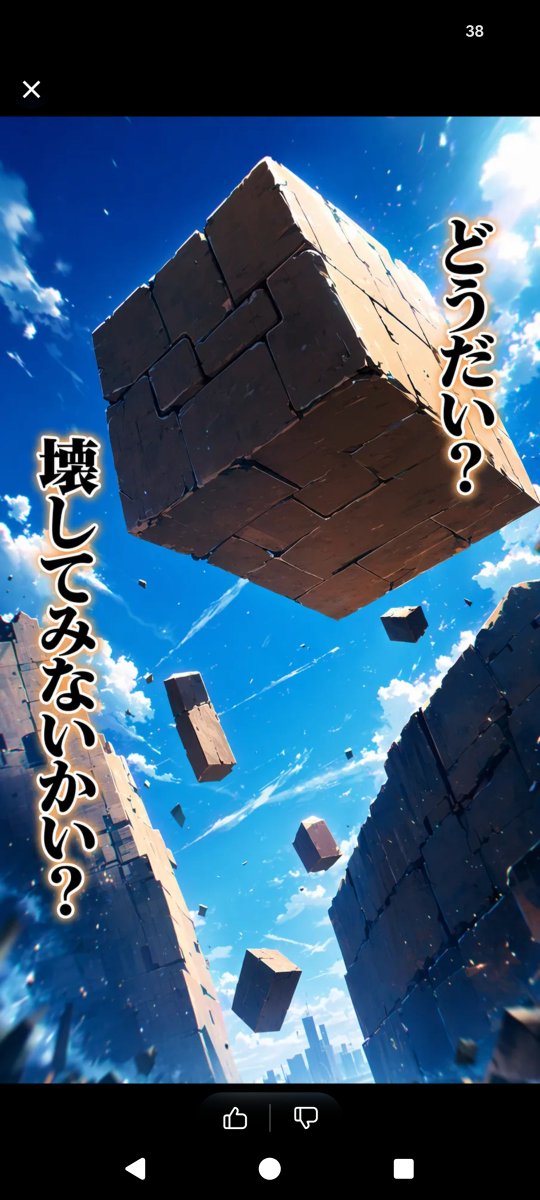
Create a vertical smartphone screenshot-style anime fantasy scene with black app UI bars at the top and bottom. In the main image, show a dramatic low-angle view looking up through a ruined canyon of towering cracked stone walls under a vivid deep blue sky with bright white clouds and sunlight flaring from the upper right. A massive cubical stone block floats in the center near the top, made of many cracked rectangular slabs, with sharp rim lighting, chipped edges, and small debris fragments breaking off. Count 6 floating stone objects total: 1 enormous central cube, 1 medium rectangular block below-left of center, 1 small cuboid at upper right, 1 small cuboid near lower center, 1 small cube near bottom center, and 1 tiny distant block among the debris. Add dynamic dust, sparks, and motion streaks to make the block feel suspended or falling. Place bold vertical Japanese manga text with thick black fill, white outline, and warm glow: on the right side, {argument name="right vertical text" default="どうだい?"}; on the left side, {argument name="left vertical text" default="壊してみないかい?"}. The art style should be cinematic high-detail anime, saturated colors, extreme perspective, dramatic lighting, crisp stone texture, and a sense of awe and challenge. Include a minimal social-media viewer overlay: black top bar with a white X icon at top left and the number {argument name="top counter" default="38"} at top right, plus a black bottom bar with small like and dislike icons in a rounded dark pill and Android navigation symbols.