Case Media
Case Notes
This page keeps the media, full prompt, and original source together so you can inspect the result first and decide whether the prompt is worth copying, saving, or comparing.
Case Insights
To make this page easier to search, cite, and reuse later, the case is also broken down into practical guidance about usage, visual cues, and prompt structure.
Best Fit Scenarios
- Use this as a ui & social screens benchmark when you need a fast style baseline before rewriting your own prompt.
- It is especially helpful if your target overlaps with Neon, Cinematic, Poster and you want to judge the image result before tuning wording.
- Keep it as a control sample when you compare nearby prompt variants one variable at a time.
Visual Signals To Notice
- The clearest style signals here are Neon, Cinematic, Poster, so those should usually stay in your first rewrite.
- The important layer is usually interface density, card hierarchy, and how the screen tells the story before you read small text.
- This case keeps one primary output, so the first image should be treated as the main visual reference.
How The Prompt Is Structured
- The prompt reads as a long, highly specified prompt, which is useful when you want to judge how much specificity this direction needs.
- Its keyword cluster is centered on Neon, Cinematic, Poster, so you can usually keep that cluster while swapping subject, camera, layout, or copy details.
- A practical rewrite path is: keep the outcome, keep the strongest style cues, then replace only the subject and environment blocks.
Good Follow-up Questions
- What changes first if you keep Neon, Cinematic, Poster but switch the subject matter?
- Which part of the result comes from section-level structure (UI & Social Screens) versus tag-level style cues?
- Which related cases in the same section give you a cleaner or more extreme variation of the same direction?
Full Prompt
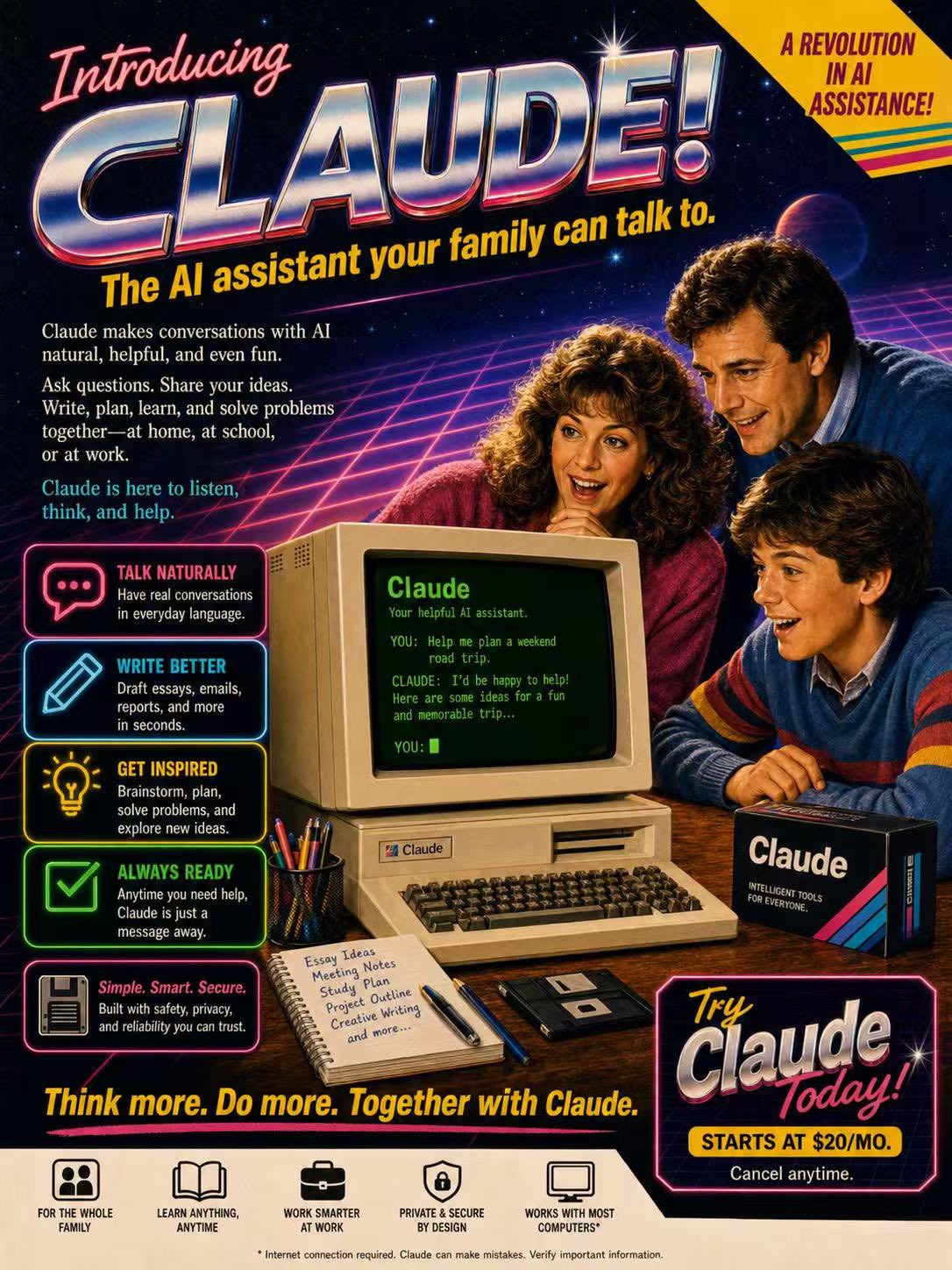
A fictional 1980s magazine advertisement poster introducing “Claude” as a revolutionary home AI assistant, retro commercial print ad style, bold headline at the top reading “Introducing Claude!”, large chrome metallic 3D typography with pink and blue reflections, yellow italic tagline underneath: “The AI assistant that talks back.” Center composition: a beige 1980s CRT home computer with chunky keyboard on a wooden desk, green monochrome terminal screen glowing, readable text on screen: “Claude”, subtitle: “The helpful AI assistant.” On the screen, a retro terminal-style conversation reads: “YOU: How can you help me today?” “CLAUDE: I can answer questions, help you write, summarize information, brainstorm ideas, and explain topics clearly.” “YOU:” A cheerful 1980s family of three gathers around the computer: father in a blue sweater, mother with curly hair in a pink sweater, young boy in a striped sweater, all looking amazed, delighted, and fascinated, warm nostalgic expressions, classic family technology advertising mood. Background: dark starry night sky, purple and blue neon perspective grid, retro sci-fi glow, subtle palm silhouettes, sparkling highlights, lens flares, dramatic yet friendly atmosphere. Poster layout: left side contains stacked retro feature boxes with glowing neon icons, including a question mark, pencil, light bulb, and clock. Each feature box includes short retro advertising copy: “ANSWERS QUESTIONS” — Get helpful, clear answers in everyday language. “HELPS YOU WRITE” — Draft ideas, notes, letters, and more with ease. “GENERATES IDEAS” — Brainstorm, create, and think bigger. “AVAILABLE WHENEVER YOU NEED IT” — Day or night, Claude is ready to help. Add a small retro text block describing Claude: “For the first time, an AI assistant you can have a conversation with. Ask questions. Get answers. Share ideas. Write drafts, notes, and reports. Explore topics, organize thoughts, and solve problems. Claude understands natural language and responds in a clear, helpful way.” Add a short highlighted copy block: “It’s helpful. It’s thoughtful. It’s always by your side.” Bottom area includes a large “Claude” brand wordmark with colorful diagonal retro stripes, and the slogan: “A smarter way to think, write, and explore.” Bottom right has a white promotional price sticker area with bold pink text: “Free!!” Smaller text underneath: “Available now for curious minds everywhere.” Top right has a bright yellow starburst badge saying: “A REVOLUTION IN AI ASSISTANCE!” Include a retro product box on the desk labeled “Claude” with small text: “SMARTER SOFTWARE FOR MODERN THINKERS.” Include a mug or accessory on the desk branded “Claude”. Visual style: 1985 consumer computer advertisement, airbrushed illustration, glossy print texture, halftone details, nostalgic retro futurism, high saturation, cinematic product lighting, authentic 1980s typography and layout, readable ad composition, detailed vintage commercial poster, highly polished, warm family-friendly mood, retro tech fantasy, vertical poster. Negative prompts: modern laptop, smartphone, flat design, minimalism, futuristic 2020s interface, cyberpunk overload, messy layout, unreadable typography, distorted text, misspelled words, deformed hands, extra fingers, bad anatomy, duplicate people, plastic skin, overexposed lighting, low resolution, blurry image, warped computer, broken keyboard, cluttered composition, inconsistent vintage style, random symbols, ugly poster design, poor hierarchy, incorrect perspective