Case Media
Case Notes
This page keeps the media, full prompt, and original source together so you can inspect the result first and decide whether the prompt is worth copying, saving, or comparing.
Case Insights
To make this page easier to search, cite, and reuse later, the case is also broken down into practical guidance about usage, visual cues, and prompt structure.
Best Fit Scenarios
- Use this as a poster & illustration benchmark when you need a fast style baseline before rewriting your own prompt.
- It is especially helpful if your target overlaps with Fashion, Poster, Illustration and you want to judge the image result before tuning wording.
- Keep it as a control sample when you compare nearby prompt variants one variable at a time.
Visual Signals To Notice
- The clearest style signals here are Fashion, Poster, Illustration, so those should usually stay in your first rewrite.
- Pay close attention to layout rhythm, headline hierarchy, illustration texture, and how information is staged in the frame.
- This case keeps one primary output, so the first image should be treated as the main visual reference.
How The Prompt Is Structured
- The prompt reads as a long, highly specified prompt, which is useful when you want to judge how much specificity this direction needs.
- Its keyword cluster is centered on Fashion, Poster, Illustration, so you can usually keep that cluster while swapping subject, camera, layout, or copy details.
- A practical rewrite path is: keep the outcome, keep the strongest style cues, then replace only the subject and environment blocks.
Good Follow-up Questions
- What changes first if you keep Fashion, Poster, Illustration but switch the subject matter?
- Which part of the result comes from section-level structure (Poster & Illustration) versus tag-level style cues?
- Which related cases in the same section give you a cleaner or more extreme variation of the same direction?
Full Prompt
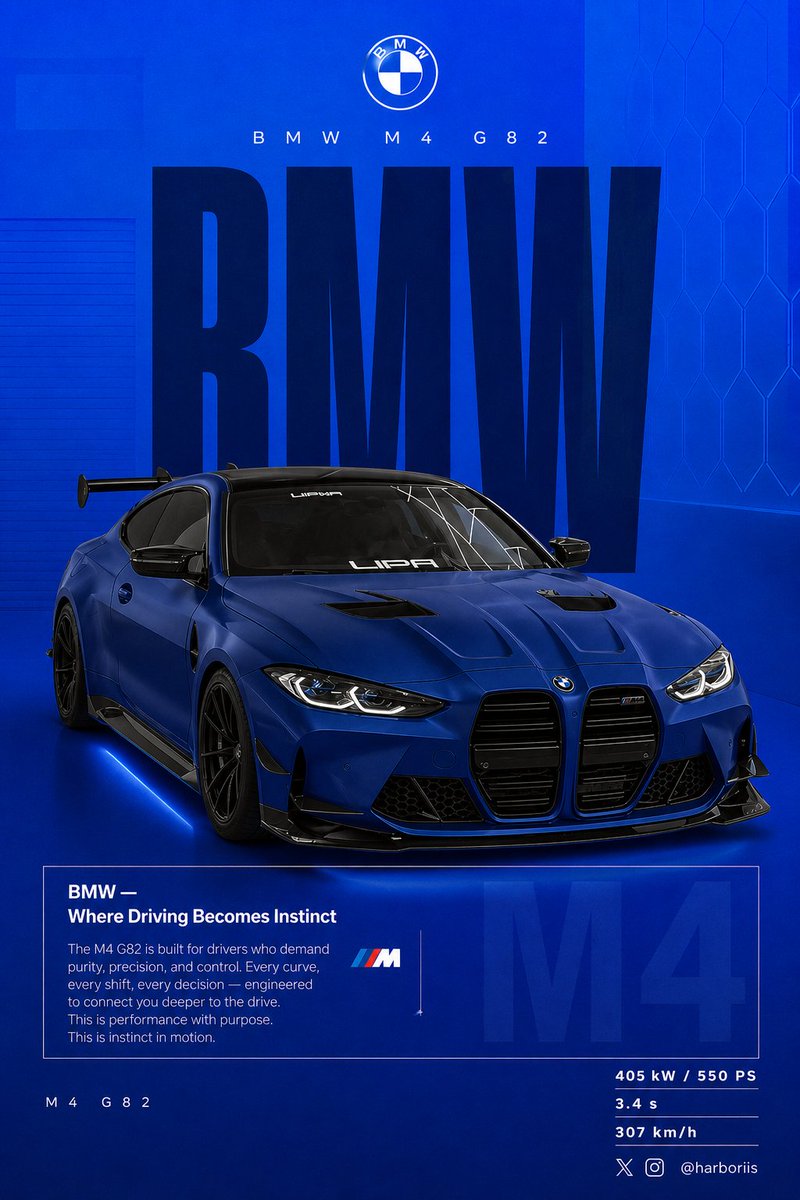
Create a 4:5 vertical social poster in ultra high resolution, 8K print quality sharpness. Use the {argument name="car model" default="BMW car"} from the reference image as the main subject and use the background structure/composition from the reference image, but transform it into a BMW themed design. Replace all black tones with a flat {argument name="background color" default="high-saturation BMW blue"} background. Keep the same layout, spacing, visual balance, and poster composition from the reference image. Background should use a smooth gradient from slightly lighter electric blue at the top to deep navy blue at the bottom. Add subtle grain texture (2 to 3%) and faint rectangular overlays (2 to 4% opacity). Keep it clean, graphic, premium, and non-realistic. Add a soft contact shadow under the car. Use the same BMW from the reference image, changing only the {argument name="paint finish" default="matte frozen blue"} or deep metallic navy. Keep the original body shape, wheels, stance, and design details from the reference image. Show the car in a rear 3/4 perspective matching the reference image angle exactly. Use a slightly elevated camera angle. Position the car slightly right of center. Include visible carbon roof, aggressive rear diffuser, sharp controlled reflections, and subtle brake details. Keep composition identical to the reference image: Top: branding Middle: giant type Center: car overlapping text Bottom: editorial block and specs Typography: Primary text: “BMW” Ultra condensed bold sans serif, tall vertical scaling like the reference poster. Color deep navy or near black. Static text with no distortion. Acts as structural backdrop. Secondary header: “BMW M4 G82” Thin font with wide tracking. Logo area: BMW roundel centered above. Editorial block: Headline: “BMW — Where Driving Becomes Instinct” Body copy focused on: driver connection control performance precision Use the same boxed editorial layout as the reference image. Background faded text: “M4” large scale with 3 to 5% opacity behind the box. Bottom left: “ M4 G82” Bottom right specs: 405 kW / 550 PS 3.4 s 307 km/h Lighting should be clean studio lighting with sharp but controlled highlights. Color grading should use deep blues, high contrast, clean blacks. Camera lens: 50mm, slightly elevated rear 3/4 angle. Mood: Performance. Precision. Driver focus. Add Bottom-right watermark: harboriis , with small x and Instagram logo