Case Media
Case Notes
This page keeps the media, full prompt, and original source together so you can inspect the result first and decide whether the prompt is worth copying, saving, or comparing.
Case Insights
To make this page easier to search, cite, and reuse later, the case is also broken down into practical guidance about usage, visual cues, and prompt structure.
Best Fit Scenarios
- Use this as a poster & illustration benchmark when you need a fast style baseline before rewriting your own prompt.
- It is especially helpful if your target overlaps with Poster, Illustration, Minimal and you want to judge the image result before tuning wording.
- Keep it as a control sample when you compare nearby prompt variants one variable at a time.
Visual Signals To Notice
- The clearest style signals here are Poster, Illustration, Minimal, so those should usually stay in your first rewrite.
- Pay close attention to layout rhythm, headline hierarchy, illustration texture, and how information is staged in the frame.
- This case keeps one primary output, so the first image should be treated as the main visual reference.
How The Prompt Is Structured
- The prompt reads as a long, highly specified prompt, which is useful when you want to judge how much specificity this direction needs.
- Its keyword cluster is centered on Poster, Illustration, Minimal, so you can usually keep that cluster while swapping subject, camera, layout, or copy details.
- A practical rewrite path is: keep the outcome, keep the strongest style cues, then replace only the subject and environment blocks.
Good Follow-up Questions
- What changes first if you keep Poster, Illustration, Minimal but switch the subject matter?
- Which part of the result comes from section-level structure (Poster & Illustration) versus tag-level style cues?
- Which related cases in the same section give you a cleaner or more extreme variation of the same direction?
Full Prompt
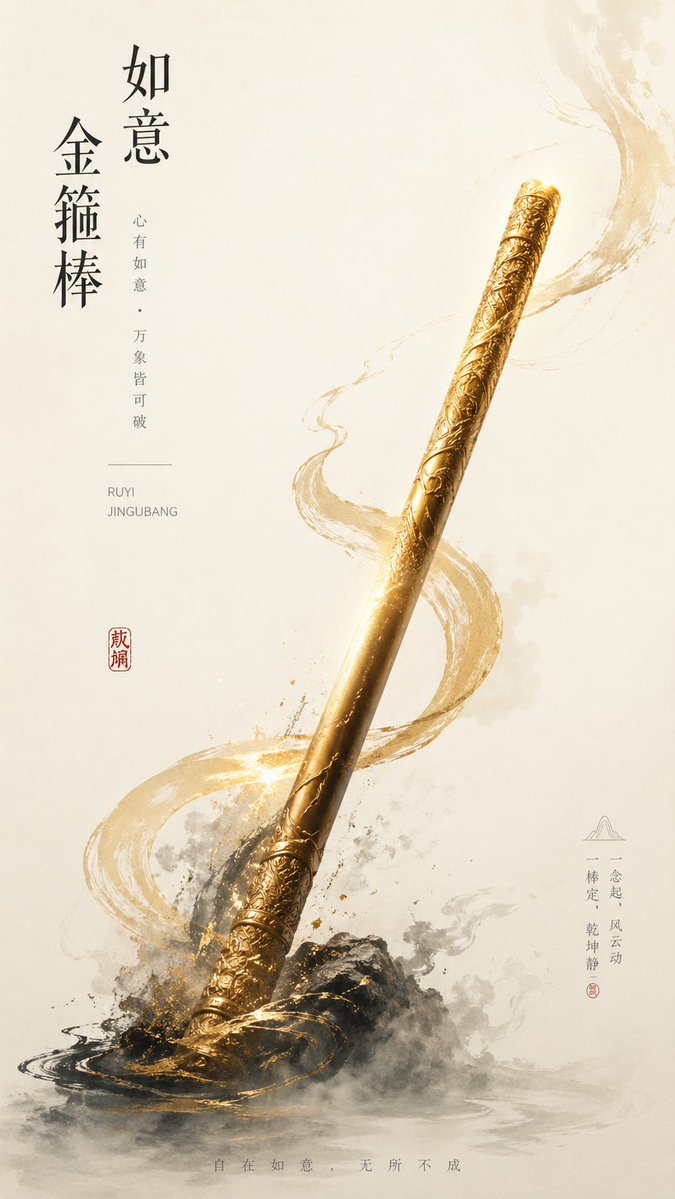
A refined New Chinese aesthetic poster on a warm ivory rice-paper background, minimalist and vertical, featuring a single luxurious golden 如意金箍棒 as the central subject. The staff is placed diagonally from the lower left foreground to the upper right, with the bottom end planted into a dark ink-splashed rocky surface and the top extending upward in a poised, heroic angle. The metal surface is richly engraved with intricate traditional relief patterns, cloud-and-dragon style ornament, polished gold highlights, and subtle glowing reflections. Around the staff, 2 sweeping metallic-gold brushstroke ribbons spiral upward in elegant S-curves, like calligraphic energy trails, partially transparent and painterly. At the base, black and gray ink wash, smoke, mist, and splash textures spread outward in a dramatic burst, blending realism with Chinese ink painting. Keep the composition spacious with strong negative space and a premium gallery-poster feel. Add 5 text groups arranged in traditional poster layout: on the upper left, a large vertical black calligraphy headline reading {argument name="headline text" default="如意金箍棒"}; beside it, a smaller vertical line of Chinese text reading "心有如意,万象皆可破"; below that, a small romanized subtitle in thin uppercase serif/sans style reading "RUYI JINGUBANG"; on the lower right, another vertical poetic line reading "一念起,风云动 / 一棒定,乾坤静"; at the bottom center, a faint small horizontal line reading "自在如意,无所不成". Include 2 red seal stamps, one on the left mid-lower area and one small seal near the lower-right text. Use elegant black typography, subtle gray ink traces, soft diffuse lighting, ultra-detailed product rendering, cultural luxury branding, serene yet powerful mood, and a balanced blend of ancient mythic artifact presentation and contemporary high-end Chinese poster design.