Case Media
Case Notes
This page keeps the media, full prompt, and original source together so you can inspect the result first and decide whether the prompt is worth copying, saving, or comparing.
Case Insights
To make this page easier to search, cite, and reuse later, the case is also broken down into practical guidance about usage, visual cues, and prompt structure.
Best Fit Scenarios
- Use this as a poster & illustration benchmark when you need a fast style baseline before rewriting your own prompt.
- It is especially helpful if your target overlaps with Poster, Illustration, Minimal and you want to judge the image result before tuning wording.
- Keep it as a control sample when you compare nearby prompt variants one variable at a time.
Visual Signals To Notice
- The clearest style signals here are Poster, Illustration, Minimal, so those should usually stay in your first rewrite.
- Pay close attention to layout rhythm, headline hierarchy, illustration texture, and how information is staged in the frame.
- This case keeps one primary output, so the first image should be treated as the main visual reference.
How The Prompt Is Structured
- The prompt reads as a short prompt that relies on a compact set of strong cues, which is useful when you want to judge how much specificity this direction needs.
- Its keyword cluster is centered on Poster, Illustration, Minimal, so you can usually keep that cluster while swapping subject, camera, layout, or copy details.
- A practical rewrite path is: keep the outcome, keep the strongest style cues, then replace only the subject and environment blocks.
Good Follow-up Questions
- What changes first if you keep Poster, Illustration, Minimal but switch the subject matter?
- Which part of the result comes from section-level structure (Poster & Illustration) versus tag-level style cues?
- Which related cases in the same section give you a cleaner or more extreme variation of the same direction?
Full Prompt
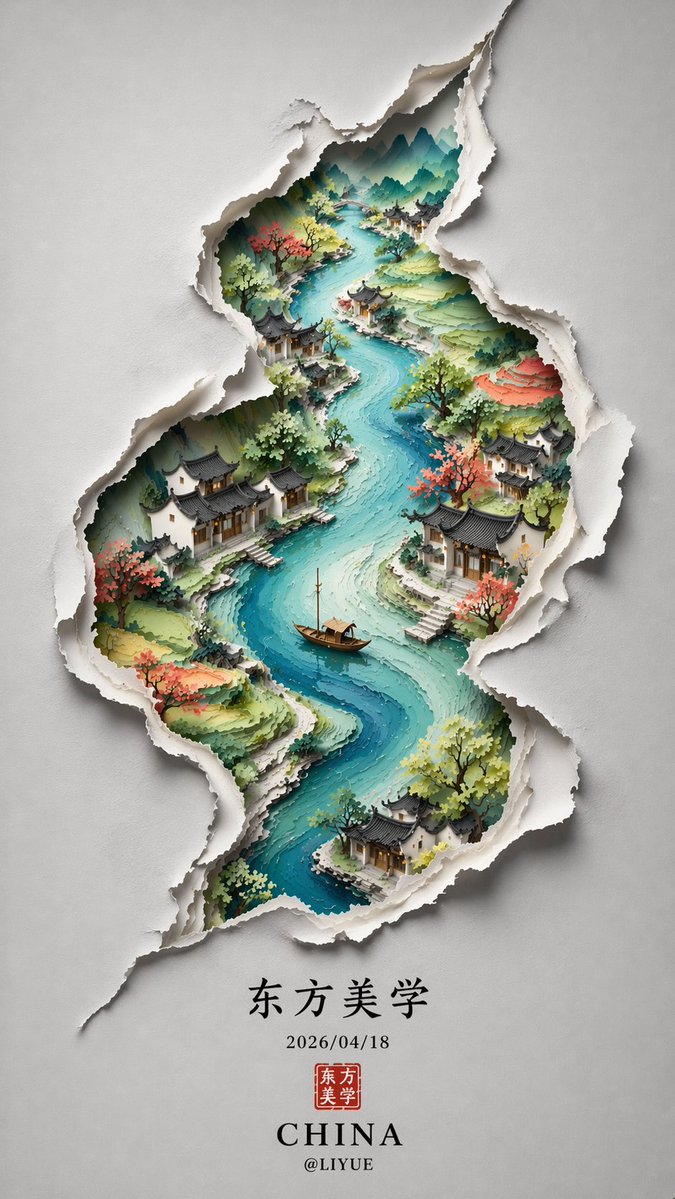
极简新中式美学风格,画面以淡雅的灰白色为底,呈现出一种纸艺剪影般的立体感。 一条S形蜿蜒的裂痕状边缘将画面分割,仿佛撕开了一层纸面,露出内部色彩斑斓的东方山水景象。 裂口内,一条蜿蜒的河流自上而下贯穿整个构图,河水以深浅不一的蓝色渲染,层次分明,仿佛流动的丝带。 河岸两侧点缀着青翠的山丘与梯田,色彩柔和,绿红交织,展现出田园的宁静之美。 沿河而建的古风建筑错落有致,飞檐翘角,白墙黛瓦,在光影的映衬下更显古朴典雅。 岸边树木葱茏,枝叶轻盈,一艘小船静泊于水中央,增添了几分悠然意境。 整体构图呈S形曲线,富有韵律感,仿佛自然与人文的和谐共生。 画作边缘采用撕纸效果,营造出立体浮雕般的视觉体验。 下方题字“东方美学”以黑色楷体书写,日期“2026/04/18”与红色印章相呼应,底部“CHINA”字样庄重醒目,署名“@LIYUE”低调收尾,整体氛围静谧深远,充满诗意与哲思。