Case Media
Case Notes
This page keeps the media, full prompt, and original source together so you can inspect the result first and decide whether the prompt is worth copying, saving, or comparing.
Case Insights
To make this page easier to search, cite, and reuse later, the case is also broken down into practical guidance about usage, visual cues, and prompt structure.
Best Fit Scenarios
- Use this as a poster & illustration benchmark when you need a fast style baseline before rewriting your own prompt.
- It is especially helpful if your target overlaps with Poster, Illustration, Minimal and you want to judge the image result before tuning wording.
- Keep it as a control sample when you compare nearby prompt variants one variable at a time.
Visual Signals To Notice
- The clearest style signals here are Poster, Illustration, Minimal, so those should usually stay in your first rewrite.
- Pay close attention to layout rhythm, headline hierarchy, illustration texture, and how information is staged in the frame.
- This case keeps one primary output, so the first image should be treated as the main visual reference.
How The Prompt Is Structured
- The prompt reads as a long, highly specified prompt, which is useful when you want to judge how much specificity this direction needs.
- Its keyword cluster is centered on Poster, Illustration, Minimal, so you can usually keep that cluster while swapping subject, camera, layout, or copy details.
- A practical rewrite path is: keep the outcome, keep the strongest style cues, then replace only the subject and environment blocks.
Good Follow-up Questions
- What changes first if you keep Poster, Illustration, Minimal but switch the subject matter?
- Which part of the result comes from section-level structure (Poster & Illustration) versus tag-level style cues?
- Which related cases in the same section give you a cleaner or more extreme variation of the same direction?
Full Prompt
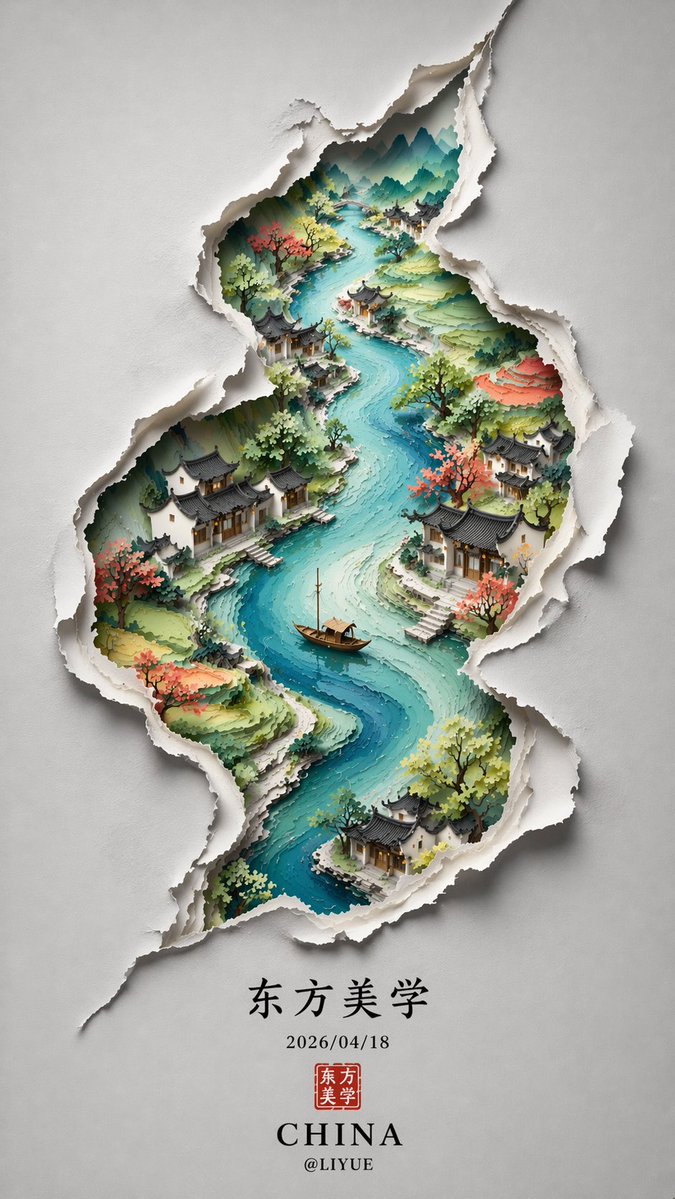
Minimalist neo-Chinese aesthetic style, the picture uses an elegant grayish-white as the background, presenting a three-dimensional sense like paper art silhouettes. A winding S-shaped crack-like edge divides the picture, as if tearing open a layer of paper, revealing the colorful oriental landscape scene inside. Inside the crack, a winding river runs through the entire composition from top to bottom, the river water is rendered in different shades of blue, with clear layers, like a flowing ribbon. Both sides of the riverbank are dotted with verdant hills and terraced fields, the colors are soft, green and red interwoven, showing the tranquil beauty of the pastoral. Ancient-style buildings built along the river are well-proportioned, with flying eaves and upturned corners, white walls and black tiles, appearing more quaint and elegant against the light and shadow. The trees on the bank are lush, the branches and leaves are light and graceful, a small boat is quietly moored in the middle of the water, adding a bit of leisurely artistic conception. The overall composition presents an S-shaped curve, full of rhythm, as if the harmonious coexistence of nature and humanity. The edges of the painting adopt a torn paper effect, creating a visual experience like a three-dimensional relief. The inscription "东方美学" at the bottom is written in black regular script, the date "2026/04/18" echoes with the red seal, the word "CHINA" at the bottom is solemn and eye-catching, and the signature "@LIYUE" ends in a low-key way. The overall atmosphere is quiet and profound, full of poetry and philosophical thinking.