Case Media
Case Notes
This page keeps the media, full prompt, and original source together so you can inspect the result first and decide whether the prompt is worth copying, saving, or comparing.
Case Insights
To make this page easier to search, cite, and reuse later, the case is also broken down into practical guidance about usage, visual cues, and prompt structure.
Best Fit Scenarios
- Use this as a portrait & photography benchmark when you need a fast style baseline before rewriting your own prompt.
- It is especially helpful if your target overlaps with Portrait, Illustration, Watercolor and you want to judge the image result before tuning wording.
- Keep it as a control sample when you compare nearby prompt variants one variable at a time.
Visual Signals To Notice
- The clearest style signals here are Portrait, Illustration, Watercolor, so those should usually stay in your first rewrite.
- Focus on framing, light direction, pose, and the distance between subject and camera.
- This case keeps one primary output, so the first image should be treated as the main visual reference.
How The Prompt Is Structured
- The prompt reads as a long, highly specified prompt, which is useful when you want to judge how much specificity this direction needs.
- Its keyword cluster is centered on Portrait, Illustration, Watercolor, so you can usually keep that cluster while swapping subject, camera, layout, or copy details.
- A practical rewrite path is: keep the outcome, keep the strongest style cues, then replace only the subject and environment blocks.
Good Follow-up Questions
- What changes first if you keep Portrait, Illustration, Watercolor but switch the subject matter?
- Which part of the result comes from section-level structure (Portrait & Photography) versus tag-level style cues?
- Which related cases in the same section give you a cleaner or more extreme variation of the same direction?
Full Prompt
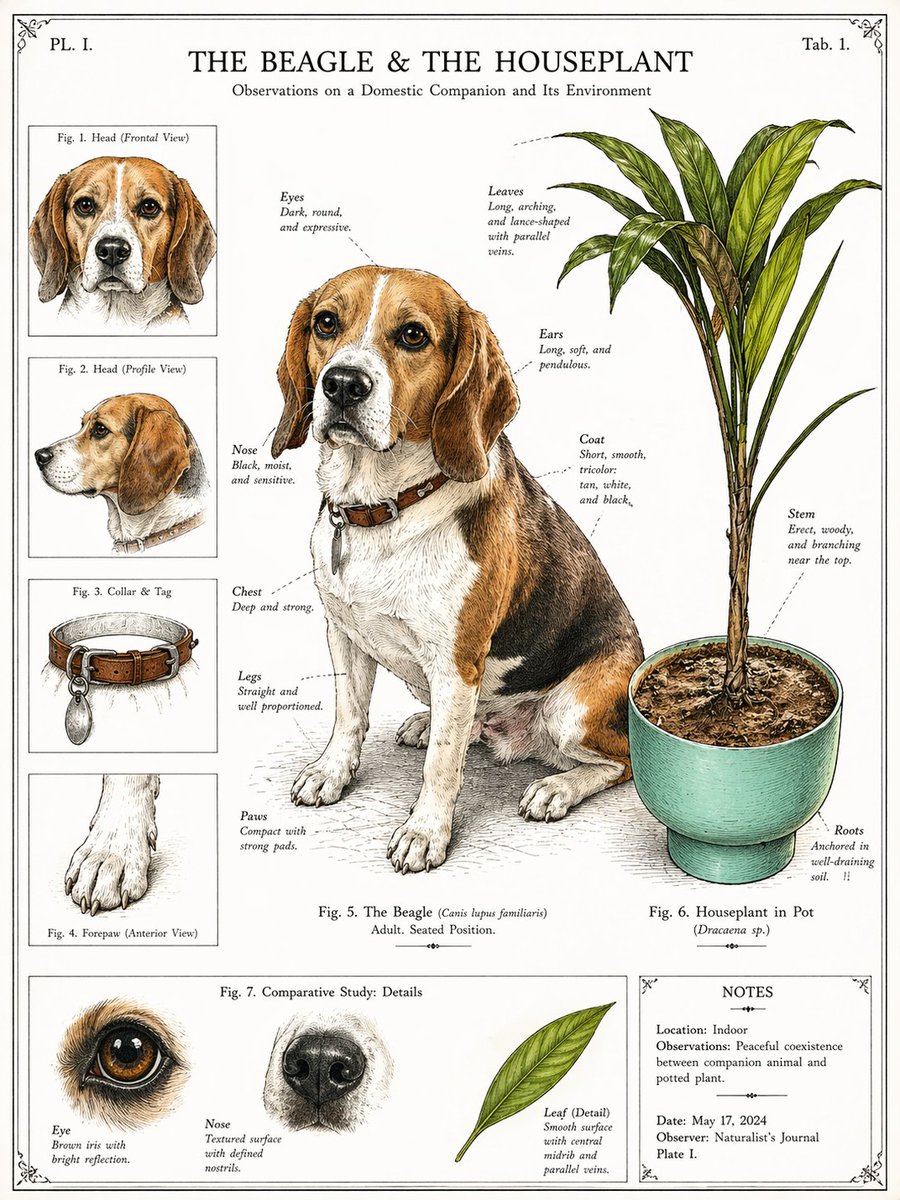
Using the provided reference image, transform the photo into a vintage naturalist encyclopedia plate in the style of a 19th-century scientific animal-and-botany illustration. Keep the same beagle and the same potted houseplant from the reference as the main subjects, but redraw them as finely inked and lightly hand-colored specimen illustrations on an aged off-white page. Preserve the dog's seated pose, collar and tag, and the plant's pot and overall structure. Add a formal infographic layout with 8 labeled figure areas total: 1 large central full-body beagle study, 1 large right-side plant study, 4 left-column inset studies labeled “Fig. 1. Head (Frontal View)”, “Fig. 2. Head (Profile View)”, “Fig. 3. Collar & Tag”, and “Fig. 4. Forepaw (Anterior View)”, 3 bottom comparative detail studies labeled “Eye”, “Nose”, and “Leaf (Detail)”, plus 1 bottom-right notes panel. Add delicate dotted annotation callouts around the main dog and plant identifying features such as eyes, ears, nose, chest, legs, paws, coat, leaves, stem, and roots. Include the page title “THE BEAGLE & THE HOUSEPLANT” at the top, the subtitle “Observations on a Domestic Companion and Its Environment”, corner plate markings “PL. I.” and “Tab. 1.”, a central caption “Fig. 5. The Beagle (Canis lupus familiaris) Adult. Seated Position.”, a plant caption “Fig. 6. Houseplant in Pot (Dracaena sp.)”, a bottom section title “Fig. 7. Comparative Study: Details”, and a notes box containing 5 lines: “Location: Indoor”, “Observations: Peaceful coexistence between companion animal and potted plant.”, “Date: May 17, 2024”, “Observer: Naturalist’s Journal”, and “Plate I.” Use clean engraved linework, restrained watercolor washes, subtle paper texture, decorative border corners, and a symmetrical museum-plate composition.