Case Media
Case Notes
This page keeps the media, full prompt, and original source together so you can inspect the result first and decide whether the prompt is worth copying, saving, or comparing.
Case Insights
To make this page easier to search, cite, and reuse later, the case is also broken down into practical guidance about usage, visual cues, and prompt structure.
Best Fit Scenarios
- Use this as a portrait & photography benchmark when you need a fast style baseline before rewriting your own prompt.
- It is especially helpful if your target overlaps with Portrait, Fashion, Illustration and you want to judge the image result before tuning wording.
- Keep it as a control sample when you compare nearby prompt variants one variable at a time.
Visual Signals To Notice
- The clearest style signals here are Portrait, Fashion, Illustration, so those should usually stay in your first rewrite.
- Focus on framing, light direction, pose, and the distance between subject and camera.
- This case keeps one primary output, so the first image should be treated as the main visual reference.
How The Prompt Is Structured
- The prompt reads as a long, highly specified prompt, which is useful when you want to judge how much specificity this direction needs.
- Its keyword cluster is centered on Portrait, Fashion, Illustration, so you can usually keep that cluster while swapping subject, camera, layout, or copy details.
- A practical rewrite path is: keep the outcome, keep the strongest style cues, then replace only the subject and environment blocks.
Good Follow-up Questions
- What changes first if you keep Portrait, Fashion, Illustration but switch the subject matter?
- Which part of the result comes from section-level structure (Portrait & Photography) versus tag-level style cues?
- Which related cases in the same section give you a cleaner or more extreme variation of the same direction?
Full Prompt
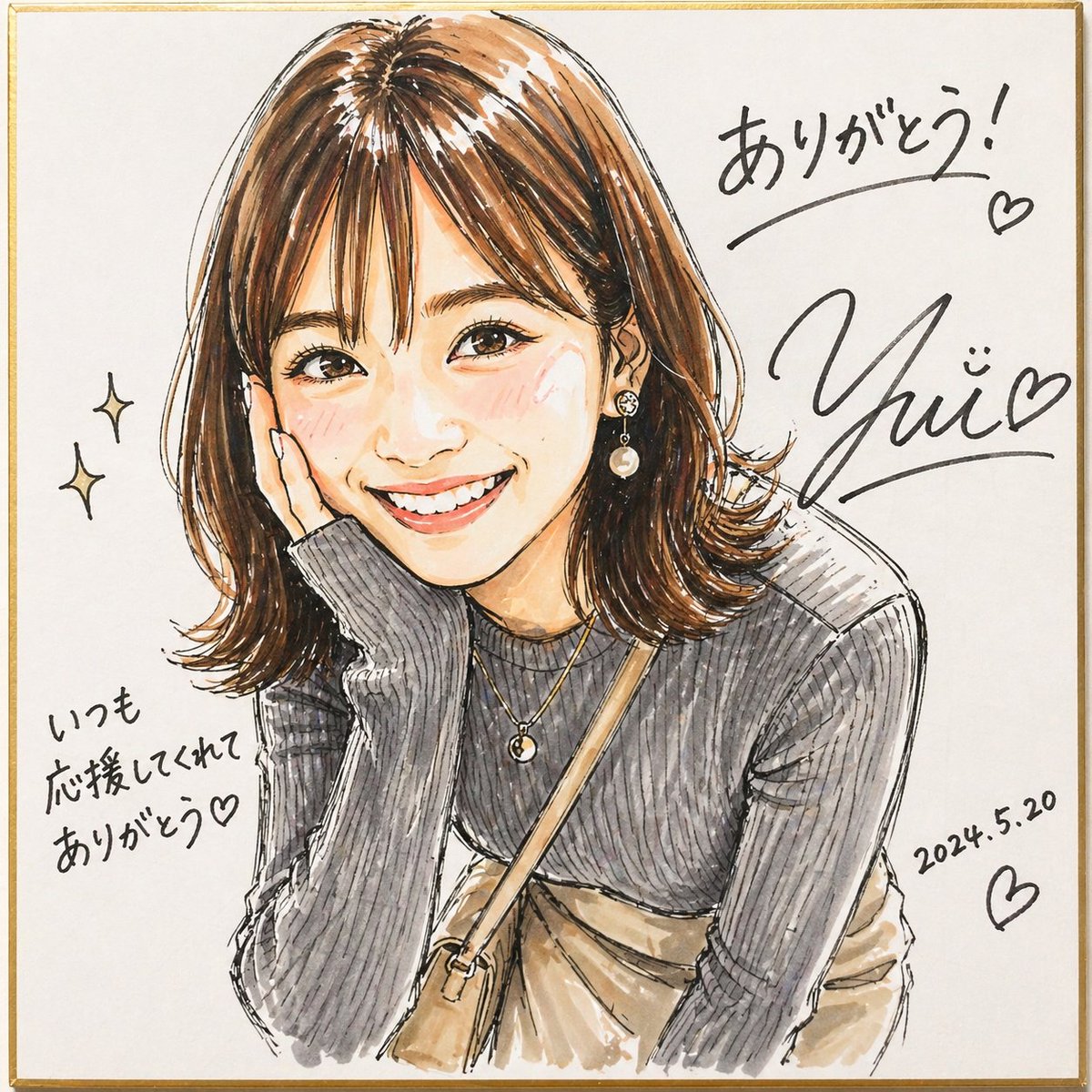
A lively hand-drawn fashion portrait in a changed illustration style, made to look like a signed fan-art sketch drawn with markers on a square white shikishi board with a thin gold border. Show a stylish young woman from about the waist up, leaning slightly forward with one elbow resting up near her face in a casual, friendly pose. Her face area is covered by a simple rectangular censor block in a muted beige tone. She has shoulder-length medium brown hair with warm highlights, soft volume, side-swept bangs, and flipped-out ends. Render the art with expressive black ink outlines, visible marker strokes, watercolor-like blending, sketchy hatching, and an energetic, vivid handmade feel. She wears a fitted dark gray ribbed long-sleeve knit top with subtle puffed shoulders, layered delicate gold necklaces, a dangling pearl earring, a beige crossbody bag strap running diagonally across her chest, and a light beige skirt or dress visible at the waist. Leave plenty of clean white background around the figure. Add 2 small sparkle doodles on the left side. Add handwritten Japanese thank-you messages and signature-style black ink writing around the portrait: at upper right write {argument name="top message" default="ありがとう!"} with an underline and a small heart, beneath it place a large stylized autograph reading {argument name="signature name" default="Yui"} with a smiling face mark and a heart, at lower left write {argument name="side message" default="いつも応援してくれてありがとう♡"}, and at lower right write the date {argument name="date" default="2024.5.20"} with another heart. The overall image should feel warm, personal, lively, and like a celebratory signed illustration on a square autograph board.