Case Media
Case Notes
This page keeps the media, full prompt, and original source together so you can inspect the result first and decide whether the prompt is worth copying, saving, or comparing.
Case Insights
To make this page easier to search, cite, and reuse later, the case is also broken down into practical guidance about usage, visual cues, and prompt structure.
Best Fit Scenarios
- Use this as a portrait & photography benchmark when you need a fast style baseline before rewriting your own prompt.
- It is especially helpful if your target overlaps with Portrait, Fashion, Poster and you want to judge the image result before tuning wording.
- Keep it as a control sample when you compare nearby prompt variants one variable at a time.
Visual Signals To Notice
- The clearest style signals here are Portrait, Fashion, Poster, so those should usually stay in your first rewrite.
- Focus on framing, light direction, pose, and the distance between subject and camera.
- This case keeps one primary output, so the first image should be treated as the main visual reference.
How The Prompt Is Structured
- The prompt reads as a long, highly specified prompt, which is useful when you want to judge how much specificity this direction needs.
- Its keyword cluster is centered on Portrait, Fashion, Poster, so you can usually keep that cluster while swapping subject, camera, layout, or copy details.
- A practical rewrite path is: keep the outcome, keep the strongest style cues, then replace only the subject and environment blocks.
Good Follow-up Questions
- What changes first if you keep Portrait, Fashion, Poster but switch the subject matter?
- Which part of the result comes from section-level structure (Portrait & Photography) versus tag-level style cues?
- Which related cases in the same section give you a cleaner or more extreme variation of the same direction?
Full Prompt
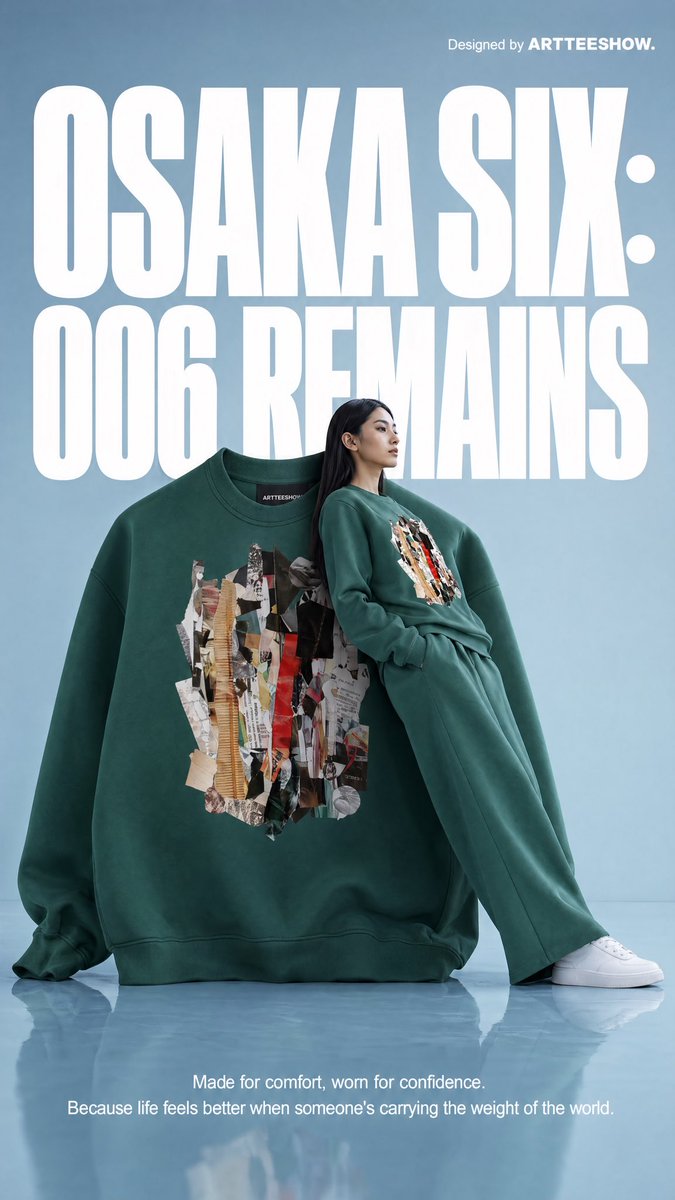
A clean editorial fashion advertisement poster on a pale powder-blue studio background with a glossy reflective floor. The composition is vertical and minimal, dominated by oversized bold white condensed sans-serif typography in the background reading “OSAKA SIX:” on the top line and “006 REMAINS” below, filling most of the upper half behind the subject. In the top right corner, small white branding text reads “Designed by ARTTEESHOW.” Centered in the lower middle is an oversized forest-green crewneck sweatshirt standing upright like a sculptural object, with soft heavy cotton fabric, dropped shoulders, extra-long sleeves pooled on the floor, and a small black neck label that reads ARTTEESHOW. On the chest of the sweatshirt is a large abstract collage print made from torn paper fragments in beige, tan, black, gray, white, and vivid red, arranged vertically like layered scraps. Leaning against the right side of the giant sweatshirt is a slim female fashion model with long straight black hair, wearing a matching {argument name="sweatshirt color" default="forest green"} sweatshirt and relaxed wide-leg sweatpants with clean white low-top sneakers. She is posed in profile with a calm detached editorial attitude, one hand in her pocket, her body reclining diagonally against the giant garment, legs extended forward; her face is obscured by a soft rectangular blur for an anonymous art-fashion look. The smaller worn sweatshirt has the same abstract torn-paper collage graphic centered on the chest. At the bottom center, add 2 lines of small white copy text: “Made for comfort, worn for confidence.” and “Because life feels better when someone’s carrying the weight of the world.” The image should feel like a premium conceptual streetwear campaign from the early 1990s reimagined as contemporary luxury advertising, with crisp studio lighting, soft shadows, subtle floor reflections, precise product focus, surreal scale contrast between the oversized sweatshirt and the model, and a polished magazine-poster aesthetic.