Case Media
Case Notes
This page keeps the media, full prompt, and original source together so you can inspect the result first and decide whether the prompt is worth copying, saving, or comparing.
Case Insights
To make this page easier to search, cite, and reuse later, the case is also broken down into practical guidance about usage, visual cues, and prompt structure.
Best Fit Scenarios
- Use this as a portrait & photography benchmark when you need a fast style baseline before rewriting your own prompt.
- It is especially helpful if your target overlaps with Portrait, Cinematic, Vertical and you want to judge the image result before tuning wording.
- Keep it as a control sample when you compare nearby prompt variants one variable at a time.
Visual Signals To Notice
- The clearest style signals here are Portrait, Cinematic, Vertical, so those should usually stay in your first rewrite.
- Focus on framing, light direction, pose, and the distance between subject and camera.
- This case keeps one primary output, so the first image should be treated as the main visual reference.
How The Prompt Is Structured
- The prompt reads as a long, highly specified prompt, which is useful when you want to judge how much specificity this direction needs.
- Its keyword cluster is centered on Portrait, Cinematic, Vertical, so you can usually keep that cluster while swapping subject, camera, layout, or copy details.
- A practical rewrite path is: keep the outcome, keep the strongest style cues, then replace only the subject and environment blocks.
Good Follow-up Questions
- What changes first if you keep Portrait, Cinematic, Vertical but switch the subject matter?
- Which part of the result comes from section-level structure (Portrait & Photography) versus tag-level style cues?
- Which related cases in the same section give you a cleaner or more extreme variation of the same direction?
Full Prompt
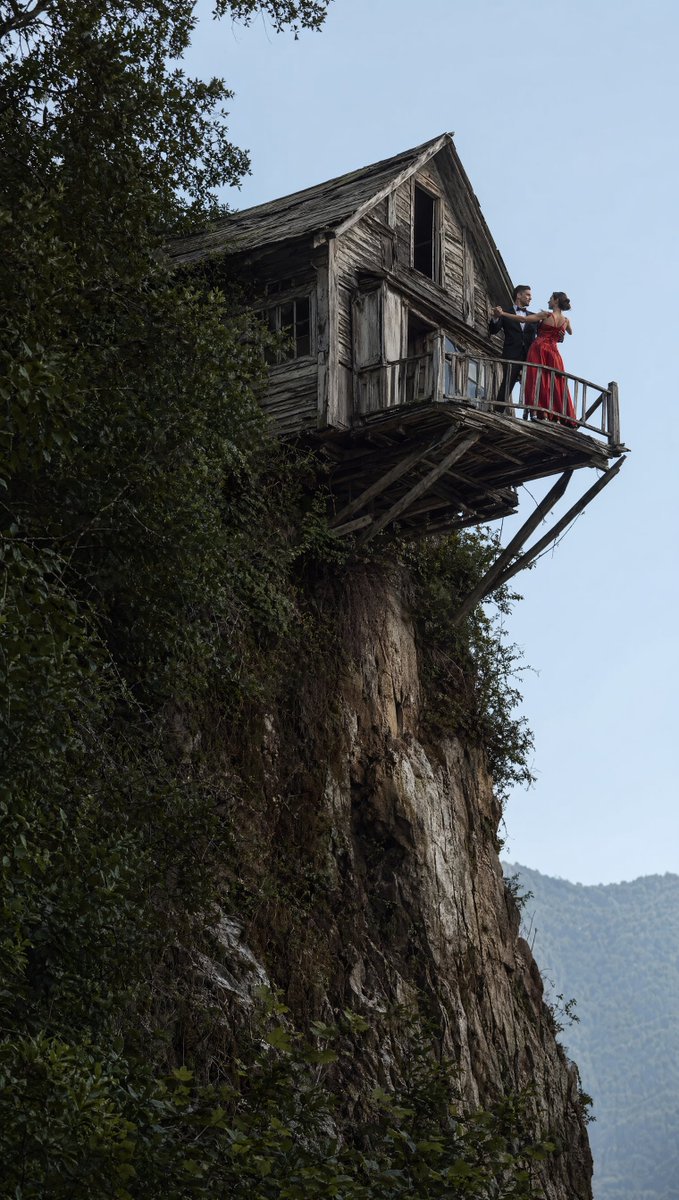
A dramatic vertical cinematic photograph of a weathered wooden house jutting out from the edge of a steep cliff, with a small balcony suspended over empty space. The house is old and dilapidated, made of gray, sun-bleached planks with warped boards, broken or dark window openings, and fragile angled wooden supports underneath the balcony. Dense green vines and foliage climb the cliff and partially frame the upper left side of the image, while the rock face drops sharply downward through most of the composition. On the balcony stand exactly 2 people: a formally dressed couple posed as if ballroom dancing. The man wears a dark suit or tuxedo and faces the woman with one arm raised in dance position; the woman wears a flowing {argument name="dress color" default="deep red"} evening gown, her hair styled up, and she mirrors his pose. The balcony railing is thin and rustic, emphasizing the dangerous height and precarious setting. The sky is pale blue-gray and overcast, with faint hazy mountains visible in the far lower right background. Use a realistic photographic style, moody natural light, high detail in the aged wood and cliff textures, a sense of vertigo and surreal elegance, and a composition that places the house in the upper left and the couple near the upper right edge of the structure.