Case Media
Case Notes
This page keeps the media, full prompt, and original source together so you can inspect the result first and decide whether the prompt is worth copying, saving, or comparing.
Case Insights
To make this page easier to search, cite, and reuse later, the case is also broken down into practical guidance about usage, visual cues, and prompt structure.
Best Fit Scenarios
- Use this as a portrait & photography benchmark when you need a fast style baseline before rewriting your own prompt.
- It is especially helpful if your target overlaps with 35mm, Portrait, Portrait & Photography and you want to judge the image result before tuning wording.
- Keep it as a control sample when you compare nearby prompt variants one variable at a time.
Visual Signals To Notice
- The clearest style signals here are 35mm, Portrait, Portrait & Photography, so those should usually stay in your first rewrite.
- Focus on framing, light direction, pose, and the distance between subject and camera.
- This case keeps one primary output, so the first image should be treated as the main visual reference.
How The Prompt Is Structured
- The prompt reads as a long, highly specified prompt, which is useful when you want to judge how much specificity this direction needs.
- Its keyword cluster is centered on 35mm, Portrait, Portrait & Photography, so you can usually keep that cluster while swapping subject, camera, layout, or copy details.
- A practical rewrite path is: keep the outcome, keep the strongest style cues, then replace only the subject and environment blocks.
Good Follow-up Questions
- What changes first if you keep 35mm, Portrait, Portrait & Photography but switch the subject matter?
- Which part of the result comes from section-level structure (Portrait & Photography) versus tag-level style cues?
- Which related cases in the same section give you a cleaner or more extreme variation of the same direction?
Full Prompt
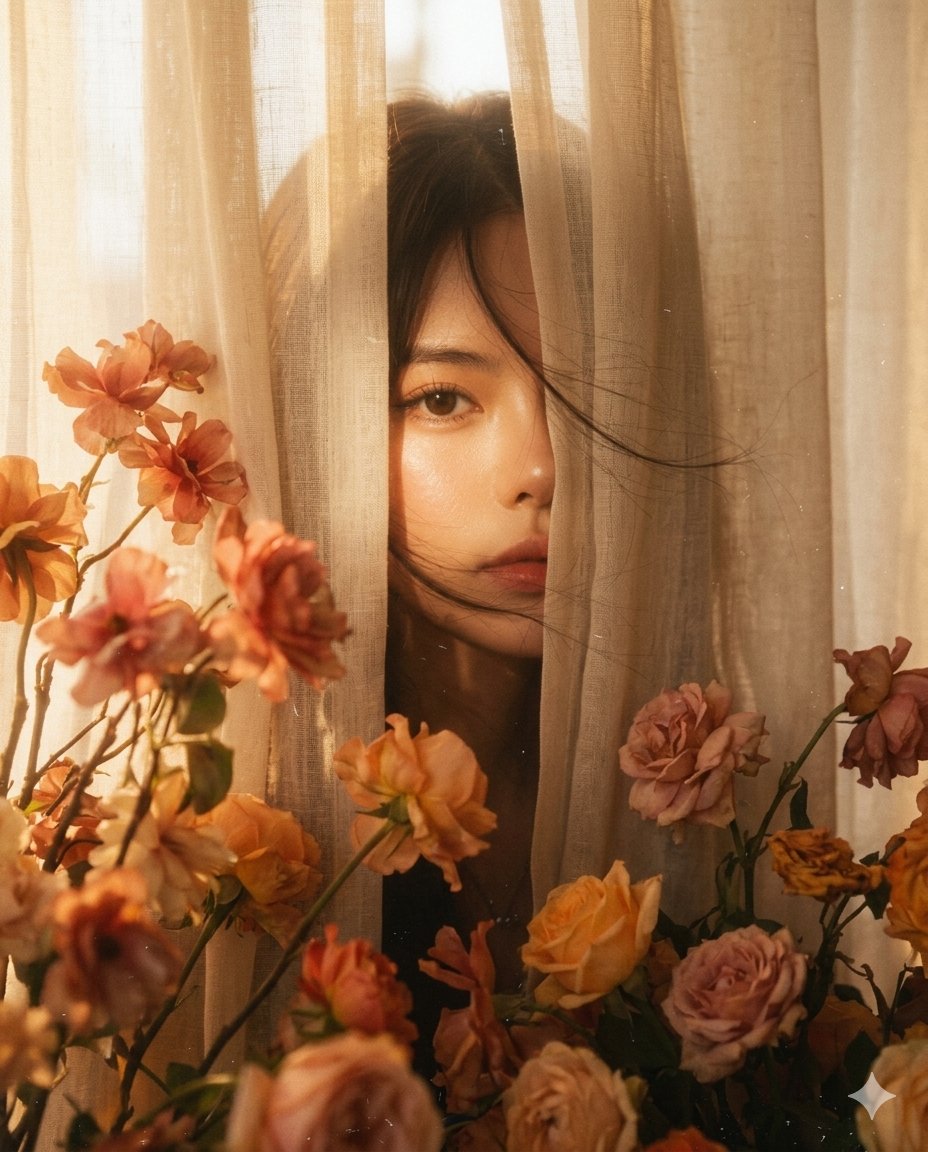
use the attached image as the main facial reference with high precision while preserving recognizable identity essence, exact facial proportions, natural asymmetry, skin tone, and facial structure. Use the reference only for the half-hidden face, curtain obstruction, floral foreground elements, intimate window light, and quiet emotional mood. Do not copy the reference image’s rendering style. Transform everything into dreamy smeared hazy memory photography. A forgotten afternoon memory hiding behind curtains, flowers, and fading sunlight. The subject appears only partially visible, as though someone accidentally glimpsed her through a doorway years ago and never forgot the moment. The image feels intimate, fragile, and emotionally unfinished. The camera observes from behind layers of translucent fabric and flowers. A large linen curtain occupies nearly half of the frame, physically obscuring part of the face. Only fragments of the subject emerge through the opening between curtain folds. The viewer feels as though they are discovering a memory rather than observing a portrait. The face remains only approximately 30–40% readable. Identity survives through the visible eye, lips, nose contour, cheek structure, jawline, and emotional presence rather than full facial visibility. Parts of the face dissolve into shadow, curtain texture, haze, and soft exposure overlap. The visible eye becomes the strongest emotional anchor. It emerges quietly from darkness and fabric, holding a distant, almost unreachable gaze. The lips remain softly visible beneath warm shadow and atmospheric softness. Flowers become a major storytelling element. Warm coral, peach, amber, and faded rose blossoms occupy much of the foreground. Some flowers remain recognizable while others dissolve into bloom, motion softness, translucent layering, and memory contamination. Branches and petals partially cross the face and body. Long dark hair drifts softly around the visible side of the face. Loose strands catch warm sunlight before disappearing into haze. Hair feels physically woven into the surrounding atmosphere. Skin appears luminous, creamy, and naturally textured beneath diffusion. Warm peach-gold highlights bloom across the cheekbone, eyelid, nose bridge, lips, and collarbone. Visible pores survive beneath the softness. Lighting behaves like a forgotten late-afternoon memory. Warm sunlight enters through an old window, filtered by curtains, flowers, and dust in the air. Bright highlights bloom heavily while shadows remain rich and dimensional. Light and shadow drift across the curtain fabric, creating soft organic patterns. Color punch: richer honey-gold sunlight, stronger peach-rose skin glow, deeper amber shadows, luminous coral flowers, warm terracotta highlights, vibrant but film-like saturation, nostalgic warmth without appearing digital or oversaturated. Shot on Kodak Portra 400 through vintage diffusion optics. Natural film color behavior. Warm skin rendering. Soft highlight rolloff. Gentle analog color separation. Optical behavior: strong Black Pro-Mist diffusion, heavy halation around window highlights, atmospheric haze, lens bloom, soft exposure overlap, faint ghosting, old-glass softness, drifting light contamination, translucent curtain layering, shallow focus transitions, film grain, dust particles, tiny scratches, aged photographic texture, organic light scattering. Composition: curtains, flowers, haze, sunlight, and atmosphere occupy approximately 70% of the emotional storytelling. The visible fragments of the face occupy approximately 30%. The viewer should feel as though they accidentally remembered someone standing behind a curtain on a summer afternoon decades ago. Mood: forgotten afternoon memory, dream-state intimacy, emotional longing, fading recollection, fragile beauty, floral melancholy, quiet mystery, timeless vulnerability. --ar 4:5