Case Media
Case Notes
This page keeps the media, full prompt, and original source together so you can inspect the result first and decide whether the prompt is worth copying, saving, or comparing.
Case Insights
To make this page easier to search, cite, and reuse later, the case is also broken down into practical guidance about usage, visual cues, and prompt structure.
Best Fit Scenarios
- Use this as a portrait & photography benchmark when you need a fast style baseline before rewriting your own prompt.
- It is especially helpful if your target overlaps with Portrait, Poster, Illustration and you want to judge the image result before tuning wording.
- Keep it as a control sample when you compare nearby prompt variants one variable at a time.
Visual Signals To Notice
- The clearest style signals here are Portrait, Poster, Illustration, so those should usually stay in your first rewrite.
- Focus on framing, light direction, pose, and the distance between subject and camera.
- This case keeps one primary output, so the first image should be treated as the main visual reference.
How The Prompt Is Structured
- The prompt reads as a long, highly specified prompt, which is useful when you want to judge how much specificity this direction needs.
- Its keyword cluster is centered on Portrait, Poster, Illustration, so you can usually keep that cluster while swapping subject, camera, layout, or copy details.
- A practical rewrite path is: keep the outcome, keep the strongest style cues, then replace only the subject and environment blocks.
Good Follow-up Questions
- What changes first if you keep Portrait, Poster, Illustration but switch the subject matter?
- Which part of the result comes from section-level structure (Portrait & Photography) versus tag-level style cues?
- Which related cases in the same section give you a cleaner or more extreme variation of the same direction?
Full Prompt
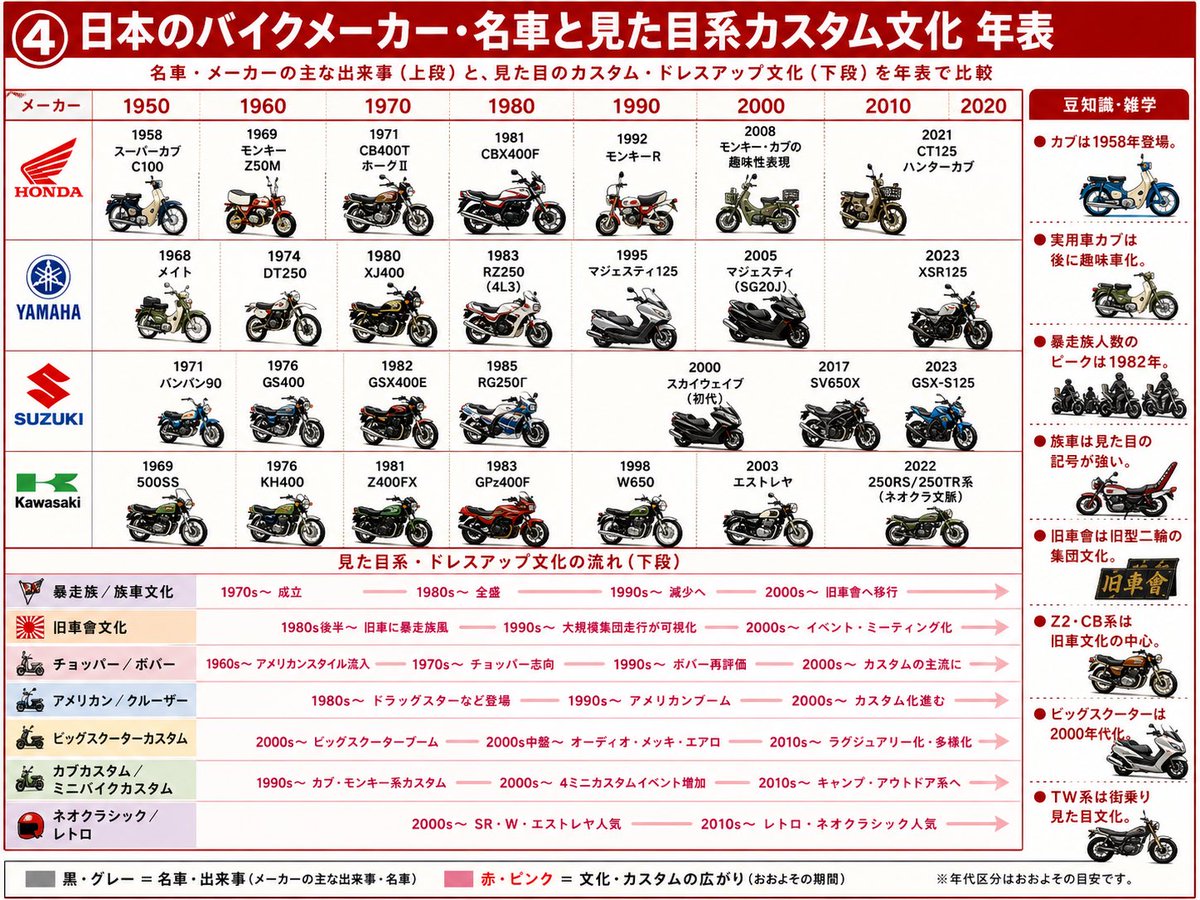
{"type":"Japanese infographic timeline poster","language":"Japanese","canvas":"landscape 4:3 educational chart with a clean white background, red grid lines, bold red title bar, small motorcycle illustrations, and dense Japanese annotations","headline":"{argument name=\"headline text\" default=\"④ 日本のバイクメーカー・名車と見た目系カスタム文化 年表\"}","subtitle":"名車・メーカーの主な出来事(上段)と、見た目のカスタム・ドレスアップ文化(下段)を年表で比較","layout":{"top_timeline":{"position":"upper two thirds","description":"matrix comparing 4 Japanese motorcycle manufacturers across 8 decade columns, with each cell showing a year, model name, and small detailed side-view motorcycle illustration","columns_count":8,"columns":["1950","1960","1970","1980","1990","2000","2010","2020"],"rows_count":4,"rows":[{"maker":"HONDA","logo_style":"red wing logo and HONDA text","entries_count":8,"entries":["1958 スーパーカブ C100","1969 モンキー Z50M","1971 CB400T ホークⅡ","1981 CBX400F","1992 モンキーR","2008 モンキー・カブの趣味性表現","2010 custom-style small bike illustration","2021 CT125 ハンターカブ"]},{"maker":"YAMAHA","logo_style":"blue tuning-fork circle logo and YAMAHA text","entries_count":7,"entries":["1968 メイト","1974 DT250","1980 XJ400","1983 RZ250 (4L3)","1995 マジェスティ125","2005 マジェスティ (SG20J)","2023 XSR125"]},{"maker":"SUZUKI","logo_style":"red S logo and SUZUKI text","entries_count":8,"entries":["1971 バンバン90","1976 GS400","1982 GSX400E","1985 RG250Γ","2000 スカイウェイブ(初代)","2017 SV650X","2023 GSX-S125","one empty/spacing decade cell to preserve grid alignment"]},{"maker":"Kawasaki","logo_style":"green Kawasaki mark and text","entries_count":8,"entries":["1969 500SS","1976 KH400","1981 Z400FX","1983 GPz400F","1998 W650","2003 エストレヤ","2022 250RS/250TR系(ネオクラ系譜)","one empty/spacing decade cell to preserve grid alignment"]}]},"bottom_culture_timeline":{"position":"lower third","section_title":"見た目系・ドレスアップ文化の流れ(下段)","description":"7 horizontal culture rows with pale colored category labels on the left and pink arrows showing approximate periods of popularity","rows_count":7,"rows":[{"label":"暴走族/族車文化","icon":"small aggressive motorcycle emblem","timeline":"1970s〜成立 → 1980s〜全盛 → 1990s〜減少へ → 2000s〜旧車會へ移行"},{"label":"旧車會文化","icon":"rising-sun style icon","timeline":"1980s後半〜旧車に暴走族風 → 1990s〜大規模集団走行が可視化 → 2000s〜イベント・ミーティング化"},{"label":"チョッパー/ボバー","icon":"chopper motorcycle silhouette","timeline":"1960s〜アメリカンスタイル流入 → 1970s〜チョッパー志向 → 1990s〜ボバー再評価 → 2000s〜カスタムの主流に"},{"label":"アメリカン/クルーザー","icon":"cruiser motorcycle silhouette","timeline":"1980s〜ドラッグスターなど登場 → 1990s〜アメリカンブーム → 2000s〜カスタム化進む"},{"label":"ビッグスクーターカスタム","icon":"large scooter silhouette","timeline":"2000s〜ビッグスクーターブーム → 2000s中盤〜オーディオ・メッキ・エアロ → 2010s〜ラグジュアリー化・多様化"},{"label":"カブカスタム/ミニバイクカスタム","icon":"green small bike silhouette","timeline":"1990s〜カブ・モンキー系カスタム → 2000s〜4ミニカスタムイベント増加 → 2010s〜キャンプ・アウトドア系へ"},{"label":"ネオクラシック/レトロ","icon":"red helmet icon","timeline":"2000s〜SR・W・エストレヤ人気 → 2010s〜レトロ・ネオクラシック人気"}]},"right_sidebar":{"position":"right edge","title":"豆知識・雑学","style":"vertical column with red bullet dots, dotted separators, and 8 small motorcycle or emblem illustrations","facts_count":8,"facts":["カブは1958年登場。","実用車カブは後に趣味車化。","暴走族人数のピークは1982年。","族車は見た目の記号が強い。","旧車會は旧型二輪の集団文化。","Z2・CB系は旧車文化の中心。","ビッグスクーターは2000年代に。","TW系は街乗り見た目文化。"]},"footer":{"legend_count":2,"legend":["黒・グレー=名車・出来事(メーカーの主な出来事・名車)","赤・ピンク=文化・カスタムの広がり(おおよその期間)"],"note":"※年代区分はおおよその目安です。"}},"visual_style":{"typography":"bold Japanese sans-serif, red headings, compact black labels, clear chart hierarchy","colors":"dominant red and white, pale pink arrows, light beige/pink/green/lavender category strips, maker logos in brand colors","illustration_style":"small crisp semi-realistic side-view motorcycle drawings with shadows, varied colors and eras, infographic clarity rather than photorealism","rendering":"high-resolution print-ready poster, sharp legible text, neat grid alignment, educational magazine style"}}