Case Media
Case Notes
This page keeps the media, full prompt, and original source together so you can inspect the result first and decide whether the prompt is worth copying, saving, or comparing.
Case Insights
To make this page easier to search, cite, and reuse later, the case is also broken down into practical guidance about usage, visual cues, and prompt structure.
Best Fit Scenarios
- Use this as a portrait & photography benchmark when you need a fast style baseline before rewriting your own prompt.
- It is especially helpful if your target overlaps with Portrait, Fashion, Illustration and you want to judge the image result before tuning wording.
- Keep it as a control sample when you compare nearby prompt variants one variable at a time.
Visual Signals To Notice
- The clearest style signals here are Portrait, Fashion, Illustration, so those should usually stay in your first rewrite.
- Focus on framing, light direction, pose, and the distance between subject and camera.
- This case keeps one primary output, so the first image should be treated as the main visual reference.
How The Prompt Is Structured
- The prompt reads as a long, highly specified prompt, which is useful when you want to judge how much specificity this direction needs.
- Its keyword cluster is centered on Portrait, Fashion, Illustration, so you can usually keep that cluster while swapping subject, camera, layout, or copy details.
- A practical rewrite path is: keep the outcome, keep the strongest style cues, then replace only the subject and environment blocks.
Good Follow-up Questions
- What changes first if you keep Portrait, Fashion, Illustration but switch the subject matter?
- Which part of the result comes from section-level structure (Portrait & Photography) versus tag-level style cues?
- Which related cases in the same section give you a cleaner or more extreme variation of the same direction?
Full Prompt
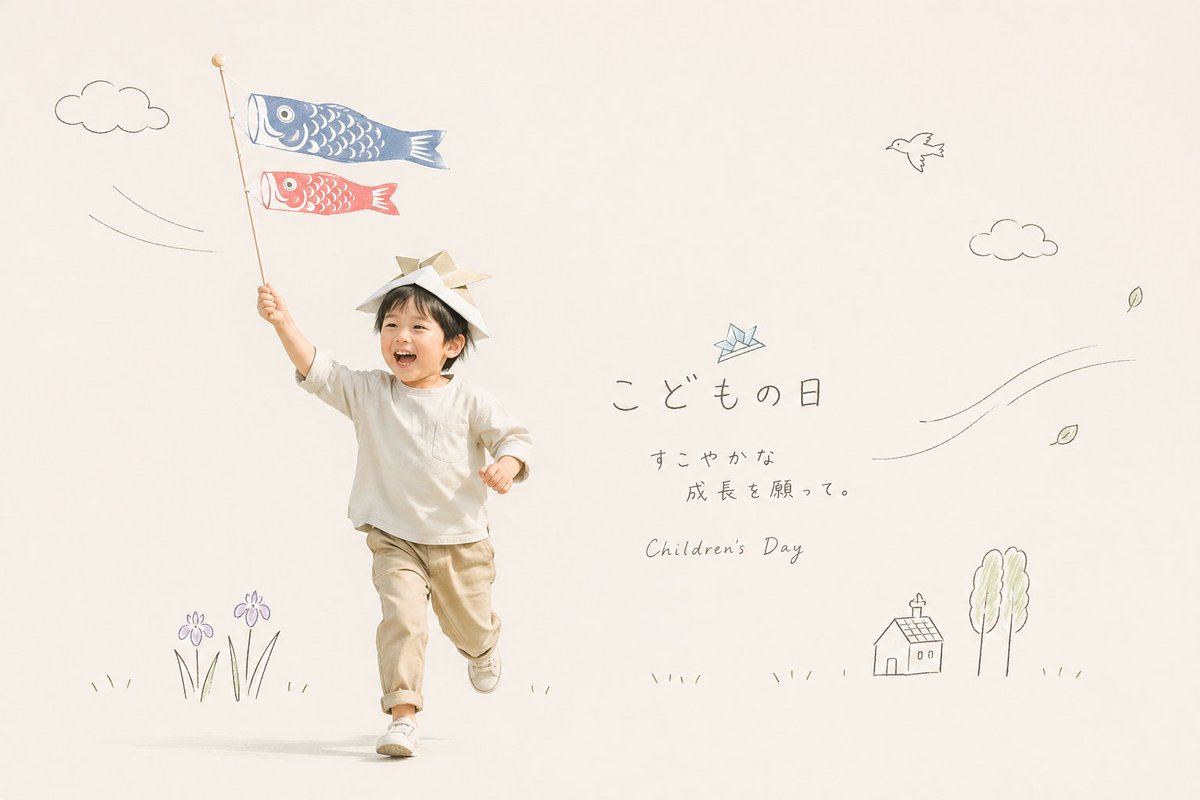
A soft, airy studio photograph on a warm off-white background with a minimalist Japanese greeting-card aesthetic. Show a small child, about toddler to preschool age, running joyfully toward the camera from left-center, with one arm raised high holding a tall pole with 2 carp streamers attached: 1 large blue koinobori on top and 1 smaller red koinobori below. The child wears a simple handmade samurai helmet folded from paper, a loose long-sleeve ivory shirt, light beige pants with rolled cuffs, and white sneakers. Keep the face unobtrusive and generic, with the focus on motion, innocence, and seasonal atmosphere. Surround the child with delicate hand-drawn doodle illustrations in thin gray pencil-like lines and faint pastel accents: 2 puffy clouds, 1 flying bird, 1 small origami crane near the text, 4 drifting leaves, 2 curved wind-line clusters, 1 small house, 2 tall trees, 2 purple iris flowers with grass at the bottom left, and sparse grass marks along the ground. On the right side, add elegant Japanese handwritten text reading {argument name="headline text" default="こどもの日"}, beneath it smaller Japanese text {argument name="subtext" default="すこやかな\n成長を願って。"}, and below that the English subtitle {argument name="english subtitle" default="Children's Day"} in a light handwritten script. Use a clean editorial layout with abundant negative space, natural soft lighting, muted cream and beige tones, subtle pastel blue and red accents, gentle shadows, and a calm premium lifestyle-photography look suitable for a seasonal holiday card or social media post.