Case Media
Case Notes
This page keeps the media, full prompt, and original source together so you can inspect the result first and decide whether the prompt is worth copying, saving, or comparing.
Case Insights
To make this page easier to search, cite, and reuse later, the case is also broken down into practical guidance about usage, visual cues, and prompt structure.
Best Fit Scenarios
- Use this as a portrait & photography benchmark when you need a fast style baseline before rewriting your own prompt.
- It is especially helpful if your target overlaps with Portrait, Fashion, Minimal and you want to judge the image result before tuning wording.
- Keep it as a control sample when you compare nearby prompt variants one variable at a time.
Visual Signals To Notice
- The clearest style signals here are Portrait, Fashion, Minimal, so those should usually stay in your first rewrite.
- Focus on framing, light direction, pose, and the distance between subject and camera.
- This case keeps one primary output, so the first image should be treated as the main visual reference.
How The Prompt Is Structured
- The prompt reads as a long, highly specified prompt, which is useful when you want to judge how much specificity this direction needs.
- Its keyword cluster is centered on Portrait, Fashion, Minimal, so you can usually keep that cluster while swapping subject, camera, layout, or copy details.
- A practical rewrite path is: keep the outcome, keep the strongest style cues, then replace only the subject and environment blocks.
Good Follow-up Questions
- What changes first if you keep Portrait, Fashion, Minimal but switch the subject matter?
- Which part of the result comes from section-level structure (Portrait & Photography) versus tag-level style cues?
- Which related cases in the same section give you a cleaner or more extreme variation of the same direction?
Full Prompt
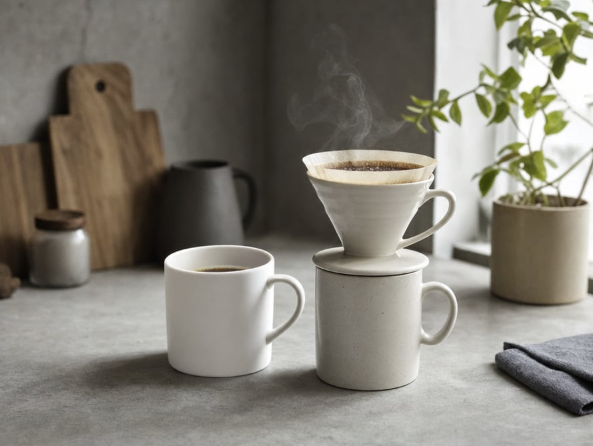
Create a realistic lifestyle product photograph of a calm morning coffee scene on a gray concrete kitchen countertop. In the foreground, place exactly 3 white ceramic coffee items: 1 plain white mug on the left filled with black coffee, 1 taller off-white speckled ceramic mug on the right, and 1 white ceramic pour-over dripper sitting on top of the taller mug. The dripper contains a tan paper filter with dark coffee grounds and brewed coffee visible, with thin wisps of steam rising upward. Use {argument name="coffee setup" default="a white ceramic pour-over dripper on an off-white mug beside a white coffee mug"} as the central subject. The scene should feel minimalist, cozy, and natural, with soft diffused daylight coming from a window on the right. In the background, include exactly 5 supporting objects: 2 wooden cutting boards leaning against a gray wall on the left, 1 matte black kettle behind the left mug, 1 small white ceramic jar with a brown lid near the cutting boards, and 1 beige potted green plant by the bright window on the right. Add 1 folded dark gray cloth napkin at the bottom-right edge of the counter. Use a muted neutral color palette of {argument name="color palette" default="warm whites, stone gray, beige, natural wood, matte black, and leafy green"}. Set the environment in a {argument name="room style" default="minimal modern kitchen with concrete surfaces"}. Shoot at eye-level with a slight front angle, shallow depth of field, realistic shadows, soft background blur, no people, no text, no logos, no extra cups or objects. Make it look like a premium editorial coffee advertisement photographed with natural light, crisp focus on the cups and dripper, subtle steam, and a serene quiet atmosphere.