Case Media
Case Notes
This page keeps the media, full prompt, and original source together so you can inspect the result first and decide whether the prompt is worth copying, saving, or comparing.
Case Insights
To make this page easier to search, cite, and reuse later, the case is also broken down into practical guidance about usage, visual cues, and prompt structure.
Best Fit Scenarios
- Use this as a portrait & photography benchmark when you need a fast style baseline before rewriting your own prompt.
- It is especially helpful if your target overlaps with Portrait, Cinematic, Fashion and you want to judge the image result before tuning wording.
- Keep it as a control sample when you compare nearby prompt variants one variable at a time.
Visual Signals To Notice
- The clearest style signals here are Portrait, Cinematic, Fashion, so those should usually stay in your first rewrite.
- Focus on framing, light direction, pose, and the distance between subject and camera.
- This case keeps 2 media outputs, which makes it easier to check whether the style remains stable across multiple results.
How The Prompt Is Structured
- The prompt reads as a long, highly specified prompt, which is useful when you want to judge how much specificity this direction needs.
- Its keyword cluster is centered on Portrait, Cinematic, Fashion, so you can usually keep that cluster while swapping subject, camera, layout, or copy details.
- A practical rewrite path is: keep the outcome, keep the strongest style cues, then replace only the subject and environment blocks.
Good Follow-up Questions
- What changes first if you keep Portrait, Cinematic, Fashion but switch the subject matter?
- Which part of the result comes from section-level structure (Portrait & Photography) versus tag-level style cues?
- Which related cases in the same section give you a cleaner or more extreme variation of the same direction?
Full Prompt
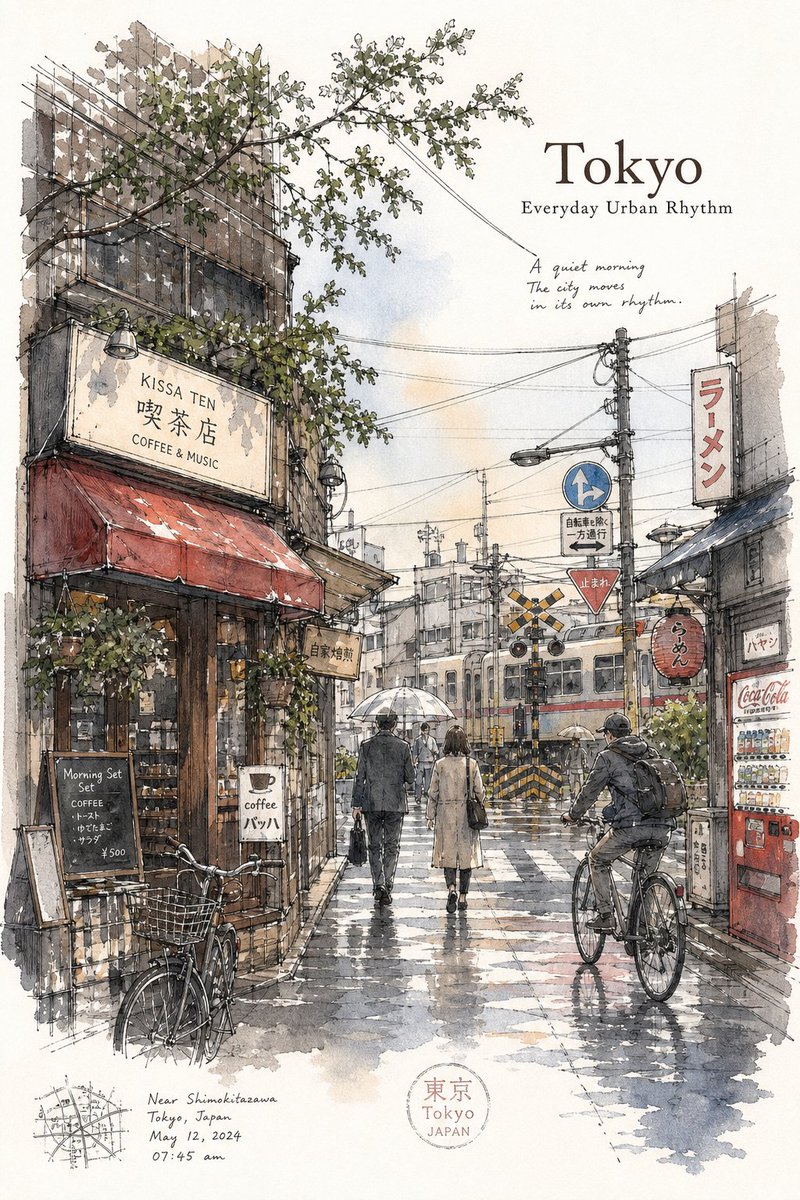
Tokyo minimalist urban travel sketch poster, drawn like a real location sketch captured by an experienced urban sketch artist during quiet morning travel moments. Before drawing, carefully analyze and express the authentic visual identity and emotional rhythm of Tokyo: its layered architectural density, narrow side streets opening into wide urban avenues, the coexistence of modern glass towers and aging low-rise storefronts, quiet residential alleys, railway culture, convenience stores glowing softly at street corners, vending machines, crosswalk movement, compact cafés, bicycles parked beside tiled walls, subway entrances, utility poles and overhead cables, subtle seasonal atmosphere, and the calm choreography of everyday pedestrian life. Style: refined on-location urban sketching, expressive pen-and-ink drawing combined with transparent watercolor washes, delicate but confident black ink linework, varied line weight, slightly imperfect hand-drawn perspective, quick observational sketch strokes, broken contour lines, subtle architectural drafting details, visible sketch construction marks, organic hand pressure variation, authentic travel sketchbook feeling. Watercolor treatment: transparent watercolor layering, soft watercolor blooming, gentle pigment granulation, wet-on-wet diffusion, accidental watercolor bleeding, subtle paper absorption texture, light watercolor stains, soft atmospheric washes, preserved white paper highlights, minimal but emotionally rich color palette inspired by Tokyo mornings — muted concrete grays, soft cream tones, faded signage reds, moss greens, warm café browns, pale sky blues. Paper: clean white premium sketchbook paper, subtle cotton paper grain, slightly textured watercolor paper surface, visible dry brush friction, natural sketchbook breathing space. Composition: calm editorial travel poster layout, asymmetrical visual balance, large negative space, airy and elegant composition, human-scale street perspective, foreground-middle-background depth, natural eye-flow through the street scene, quiet cinematic framing. Scene: show an authentic everyday moment in Tokyo, a calm side street near a railway crossing or neighborhood café district, early commuters walking quietly, a cyclist passing by, small ramen shops and kissaten cafés opening for the morning, subtle station signage, crosswalk markings softened by age, street trees casting light shadows, weathered concrete textures, warm reflections on windows after light rain, not a tourist postcard, no famous landmarks dominating the composition. Include subtle local urban elements naturally integrated into the environment: Japanese street signs, vending machines, small cafés, noren fabric curtains, bicycles, pedestrians with umbrellas or tote bags, crosswalks, quiet side-street shops, railway infrastructure, street trees, compact cars, weathered architectural textures, gentle daily movement. Mood: warm, poetic, observational, ca