Case Media
Case Notes
This page keeps the media, full prompt, and original source together so you can inspect the result first and decide whether the prompt is worth copying, saving, or comparing.
Case Insights
To make this page easier to search, cite, and reuse later, the case is also broken down into practical guidance about usage, visual cues, and prompt structure.
Best Fit Scenarios
- Use this as a portrait & photography benchmark when you need a fast style baseline before rewriting your own prompt.
- It is especially helpful if your target overlaps with Portrait, Fashion, Poster and you want to judge the image result before tuning wording.
- Keep it as a control sample when you compare nearby prompt variants one variable at a time.
Visual Signals To Notice
- The clearest style signals here are Portrait, Fashion, Poster, so those should usually stay in your first rewrite.
- Focus on framing, light direction, pose, and the distance between subject and camera.
- This case keeps 2 media outputs, which makes it easier to check whether the style remains stable across multiple results.
How The Prompt Is Structured
- The prompt reads as a long, highly specified prompt, which is useful when you want to judge how much specificity this direction needs.
- Its keyword cluster is centered on Portrait, Fashion, Poster, so you can usually keep that cluster while swapping subject, camera, layout, or copy details.
- A practical rewrite path is: keep the outcome, keep the strongest style cues, then replace only the subject and environment blocks.
Good Follow-up Questions
- What changes first if you keep Portrait, Fashion, Poster but switch the subject matter?
- Which part of the result comes from section-level structure (Portrait & Photography) versus tag-level style cues?
- Which related cases in the same section give you a cleaner or more extreme variation of the same direction?
Full Prompt
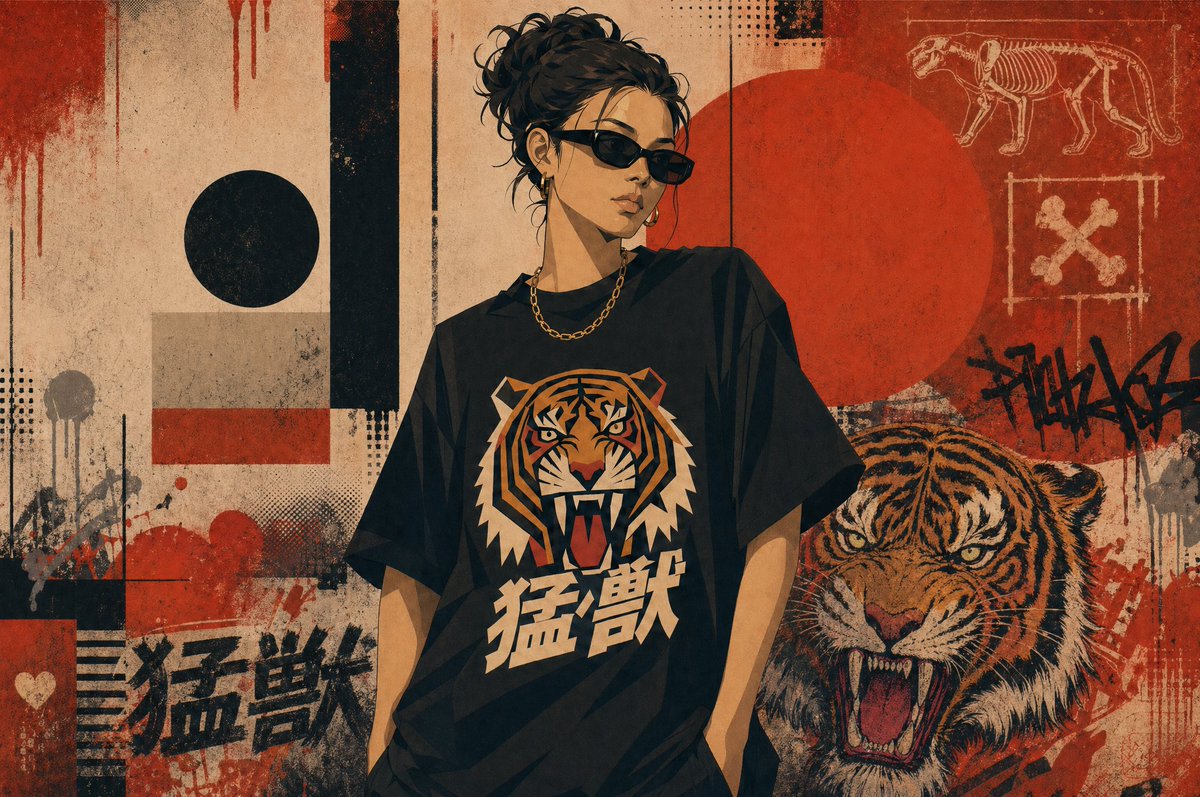
Create a gritty streetwear poster illustration with a single central figure standing in front of an urban collage wall. The person is a stylish young adult with {argument name="hair color" default="dark brown to black"} curly hair tied in a messy bun, wearing black rectangular sunglasses, a short gold chain necklace, and an oversized black graphic T-shirt. The face is intentionally obscured by a vertical blurred rectangular censor block in warm beige-brown tones. The shirt features a large roaring tiger head graphic in orange, cream, black, and red, with bold Japanese kanji text reading {argument name="shirt text" default="猛獣"} beneath it. Show the figure from about mid-thigh up, relaxed posture, one hand tucked in a pocket, fashion-editorial attitude. The background is a distressed mixed-media mural in beige, black, and brick red with heavy grunge texture, paper wear, paint drips, splatters, halftone dots, and graffiti layering. Include 2 large circles: 1 black circle on the left and 1 large red circle behind the figure on the right. Include 3 tall black vertical bars in the composition, plus 1 pale rectangular block and 1 thin horizontal red stripe on the left side. Add 2 visible instances of the kanji text 猛獣 in the wall art, one large black painted version in the lower left and one on the shirt. On the right side of the wall, include 1 detailed roaring tiger illustration in profile/front three-quarter view, mouth open, orange and black striped fur. In the upper right corner, add 2 chalk-like diagram motifs: 1 skeletal big cat drawing and 1 square-framed crossed-bones symbol. Add 1 black graffiti tag near the right edge and 1 small white heart near the lower left. Use a muted vintage palette of tan, rust red, black, cream, and dark orange. The overall style should feel like Japanese-inspired street fashion poster art, raw, rebellious, textured, high-contrast, and screen-printed on worn paper.