Case Media
Case Notes
This page keeps the media, full prompt, and original source together so you can inspect the result first and decide whether the prompt is worth copying, saving, or comparing.
Case Insights
To make this page easier to search, cite, and reuse later, the case is also broken down into practical guidance about usage, visual cues, and prompt structure.
Best Fit Scenarios
- Use this as a portrait & photography benchmark when you need a fast style baseline before rewriting your own prompt.
- It is especially helpful if your target overlaps with 35mm, Portrait, Cinematic and you want to judge the image result before tuning wording.
- Keep it as a control sample when you compare nearby prompt variants one variable at a time.
Visual Signals To Notice
- The clearest style signals here are 35mm, Portrait, Cinematic, so those should usually stay in your first rewrite.
- Focus on framing, light direction, pose, and the distance between subject and camera.
- This case keeps one primary output, so the first image should be treated as the main visual reference.
How The Prompt Is Structured
- The prompt reads as a long, highly specified prompt, which is useful when you want to judge how much specificity this direction needs.
- Its keyword cluster is centered on 35mm, Portrait, Cinematic, so you can usually keep that cluster while swapping subject, camera, layout, or copy details.
- A practical rewrite path is: keep the outcome, keep the strongest style cues, then replace only the subject and environment blocks.
Good Follow-up Questions
- What changes first if you keep 35mm, Portrait, Cinematic but switch the subject matter?
- Which part of the result comes from section-level structure (Portrait & Photography) versus tag-level style cues?
- Which related cases in the same section give you a cleaner or more extreme variation of the same direction?
Full Prompt
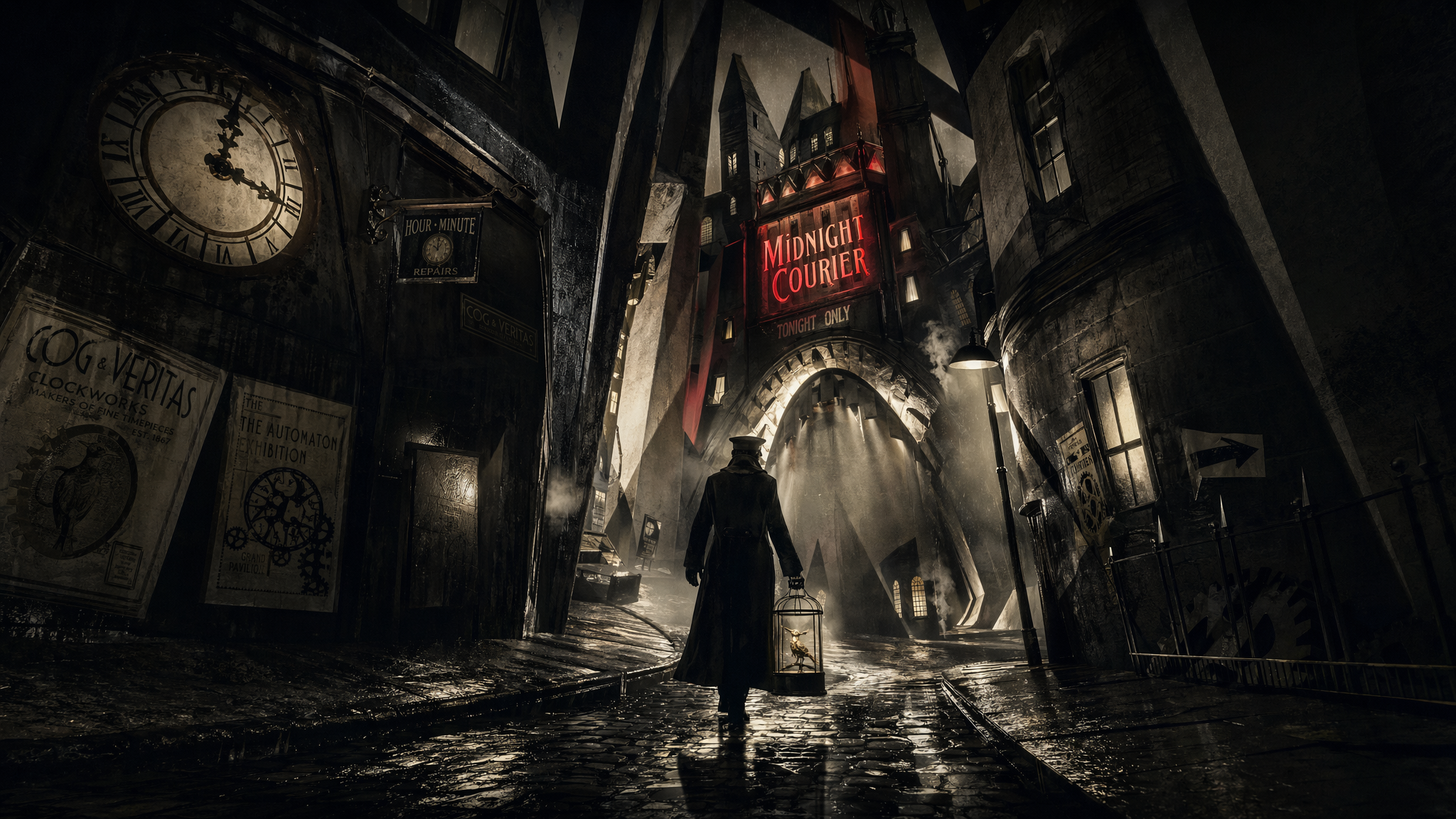
A dramatic cinematic wide frame inspired by German Expressionist noir and early silent-film set design, showing a rain-slick clockwork alley at midnight. Tall crooked buildings lean inward like theatrical flats, casting jagged triangular shadows across wet cobblestones. In the center, a solitary courier in a long charcoal coat carries a small glowing brass automaton bird in a glass cage. The palette is deep ink black, tarnished brass, bone white, and one controlled accent of crimson from a distant theatre sign reading "MIDNIGHT COURIER". Lighting is high-contrast chiaroscuro with hard backlight, steam from vents, reflected puddles, and sharp silhouettes. Camera: 32mm anamorphic wide shot, low angle, strong leading lines, deep focus, subtle film grain. The scene should feel like a premium production still: surreal, graphic, moody, and meticulously composed, not horror-gory, no real person likeness.