Case Media
Case Notes
This page keeps the media, full prompt, and original source together so you can inspect the result first and decide whether the prompt is worth copying, saving, or comparing.
Case Insights
To make this page easier to search, cite, and reuse later, the case is also broken down into practical guidance about usage, visual cues, and prompt structure.
Best Fit Scenarios
- Use this as a portrait & photography benchmark when you need a fast style baseline before rewriting your own prompt.
- It is especially helpful if your target overlaps with Portrait, Cinematic, Fashion and you want to judge the image result before tuning wording.
- Keep it as a control sample when you compare nearby prompt variants one variable at a time.
Visual Signals To Notice
- The clearest style signals here are Portrait, Cinematic, Fashion, so those should usually stay in your first rewrite.
- Focus on framing, light direction, pose, and the distance between subject and camera.
- This case keeps 2 media outputs, which makes it easier to check whether the style remains stable across multiple results.
How The Prompt Is Structured
- The prompt reads as a long, highly specified prompt, which is useful when you want to judge how much specificity this direction needs.
- Its keyword cluster is centered on Portrait, Cinematic, Fashion, so you can usually keep that cluster while swapping subject, camera, layout, or copy details.
- A practical rewrite path is: keep the outcome, keep the strongest style cues, then replace only the subject and environment blocks.
Good Follow-up Questions
- What changes first if you keep Portrait, Cinematic, Fashion but switch the subject matter?
- Which part of the result comes from section-level structure (Portrait & Photography) versus tag-level style cues?
- Which related cases in the same section give you a cleaner or more extreme variation of the same direction?
Full Prompt
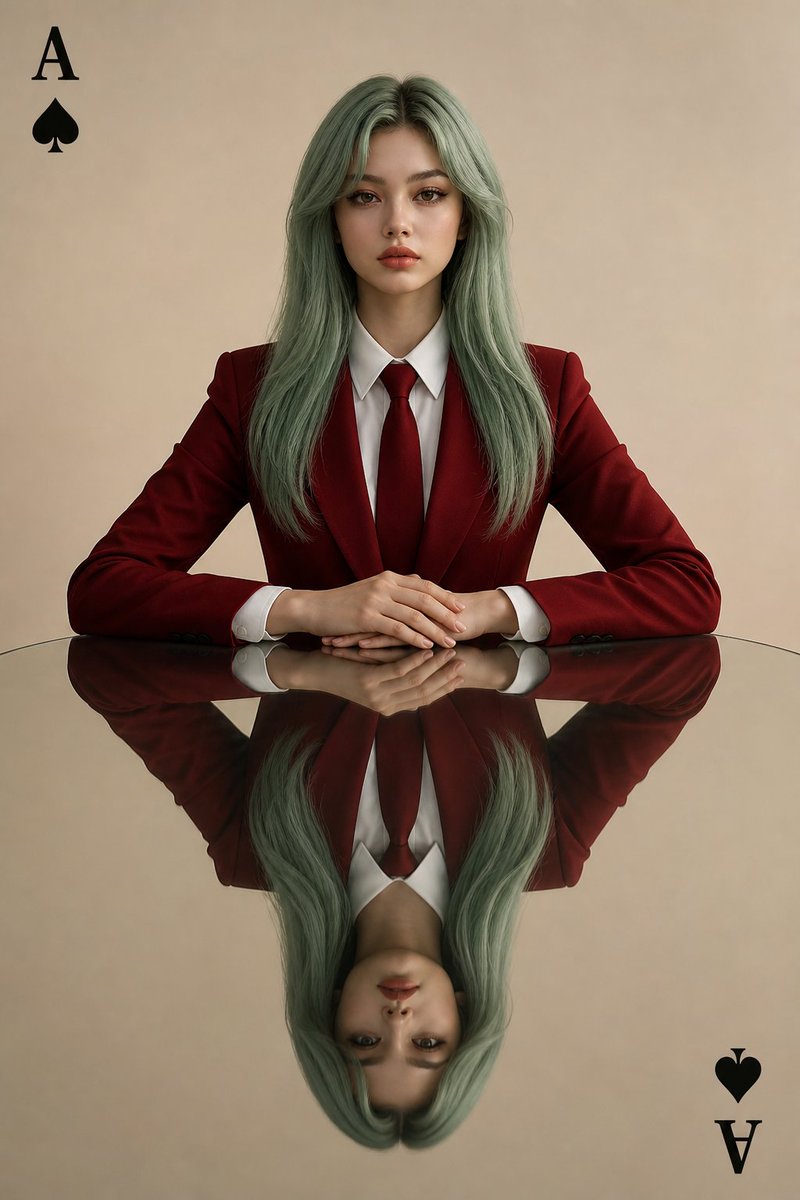
Use my uploaded image as the exact face reference. Preserve facial features, skin tone, and identity with high accuracy. Create a highly stylized, minimalist portrait inspired by a playing card concept. The subject is sitting at a glass table, hands gently folded, looking directly at the camera with a calm, confident, slightly cold expression. Outfit: {argument name="outfit description" default="tailored deep red suit jacket, white shirt, red tie, clean and sharp fashion styling"}. Hair: long, straight, smooth, centered part (adjust to match my face naturally if needed). Scene: {argument name="background" default="soft beige background, clean and minimal with no distractions"}. Composition: perfectly symmetrical, centered framing. A clear mirror reflection of the subject is visible on the glass table, creating a vertical flip effect like a playing card. Add subtle “Ace of Spades” symbols in opposite corners (top left and bottom right), elegant and minimal. Lighting: soft, diffused studio lighting, high-end fashion editorial style, smooth shadows, ultra clean. Style: cinematic, luxury fashion photography, ultra-realistic, sharp focus, 8k detail. Avoid distortion, keep anatomy natural, especially hands and face. Add a subtle surreal touch: the reflection has a slightly different expression (more intense or mysterious), while the real face stays calm. Keep it realistic, not horror.