Case Media
Case Notes
This page keeps the media, full prompt, and original source together so you can inspect the result first and decide whether the prompt is worth copying, saving, or comparing.
Case Insights
To make this page easier to search, cite, and reuse later, the case is also broken down into practical guidance about usage, visual cues, and prompt structure.
Best Fit Scenarios
- Use this as a portrait & photography benchmark when you need a fast style baseline before rewriting your own prompt.
- It is especially helpful if your target overlaps with Portrait, Vertical, Portrait & Photography and you want to judge the image result before tuning wording.
- Keep it as a control sample when you compare nearby prompt variants one variable at a time.
Visual Signals To Notice
- The clearest style signals here are Portrait, Vertical, Portrait & Photography, so those should usually stay in your first rewrite.
- Focus on framing, light direction, pose, and the distance between subject and camera.
- This case keeps 2 media outputs, which makes it easier to check whether the style remains stable across multiple results.
How The Prompt Is Structured
- The prompt reads as a long, highly specified prompt, which is useful when you want to judge how much specificity this direction needs.
- Its keyword cluster is centered on Portrait, Vertical, Portrait & Photography, so you can usually keep that cluster while swapping subject, camera, layout, or copy details.
- A practical rewrite path is: keep the outcome, keep the strongest style cues, then replace only the subject and environment blocks.
Good Follow-up Questions
- What changes first if you keep Portrait, Vertical, Portrait & Photography but switch the subject matter?
- Which part of the result comes from section-level structure (Portrait & Photography) versus tag-level style cues?
- Which related cases in the same section give you a cleaner or more extreme variation of the same direction?
Full Prompt
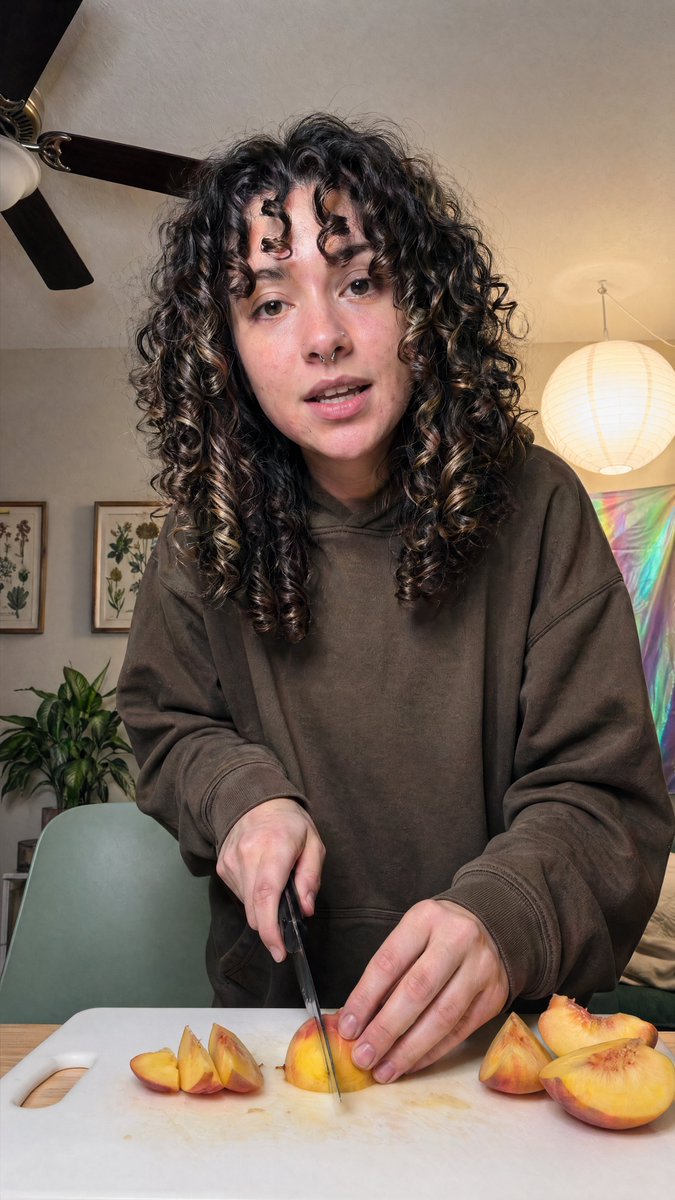
A realistic vertical smartphone photo of a {argument name="person" default="young woman"} standing at a kitchen or dining table, slicing ripe peaches on a white plastic cutting board. The subject is centered and framed from about mid-thigh or waist up, leaning slightly toward the camera in a casual candid pose. She has very thick, long, dark brown to black naturally curly hair with defined ringlets and a few lighter brown highlights, falling around her shoulders and partially covering the sides of her face. She wears an oversized {argument name="hoodie color" default="dark brown"} hoodie with loose sleeves, giving the image a relaxed at-home lifestyle feel. One hand holds a kitchen knife vertically as it cuts into a peach wedge in the center of the board, while the other hand steadies the fruit. Show exactly 7 peach pieces visible on the cutting board: 3 smaller wedges grouped on the left, 1 central wedge being cut, and 3 larger pieces on the right including a half peach. The table surface is light wood. The room is warmly lit and cozy, with a beige wall and ceiling, a dark ceiling fan with 3 visible blades in the upper left, 2 framed botanical prints on the left wall, 1 leafy green houseplant in the lower left background, 1 pale sage-green chair behind the table, 1 glowing round white paper lantern hanging on the right, and 1 iridescent pastel wall hanging or reflective fabric panel in the right background. Use soft indoor lighting, natural skin tones, subtle shadows, realistic fruit texture and knife detail, documentary-style composition, shallow to medium depth of field, and an authentic everyday home aesthetic.