Case Media
Case Notes
This page keeps the media, full prompt, and original source together so you can inspect the result first and decide whether the prompt is worth copying, saving, or comparing.
Case Insights
To make this page easier to search, cite, and reuse later, the case is also broken down into practical guidance about usage, visual cues, and prompt structure.
Best Fit Scenarios
- Use this as a portrait & photography benchmark when you need a fast style baseline before rewriting your own prompt.
- It is especially helpful if your target overlaps with Portrait, Cinematic, Fashion and you want to judge the image result before tuning wording.
- Keep it as a control sample when you compare nearby prompt variants one variable at a time.
Visual Signals To Notice
- The clearest style signals here are Portrait, Cinematic, Fashion, so those should usually stay in your first rewrite.
- Focus on framing, light direction, pose, and the distance between subject and camera.
- This case keeps 2 media outputs, which makes it easier to check whether the style remains stable across multiple results.
How The Prompt Is Structured
- The prompt reads as a long, highly specified prompt, which is useful when you want to judge how much specificity this direction needs.
- Its keyword cluster is centered on Portrait, Cinematic, Fashion, so you can usually keep that cluster while swapping subject, camera, layout, or copy details.
- A practical rewrite path is: keep the outcome, keep the strongest style cues, then replace only the subject and environment blocks.
Good Follow-up Questions
- What changes first if you keep Portrait, Cinematic, Fashion but switch the subject matter?
- Which part of the result comes from section-level structure (Portrait & Photography) versus tag-level style cues?
- Which related cases in the same section give you a cleaner or more extreme variation of the same direction?
Full Prompt
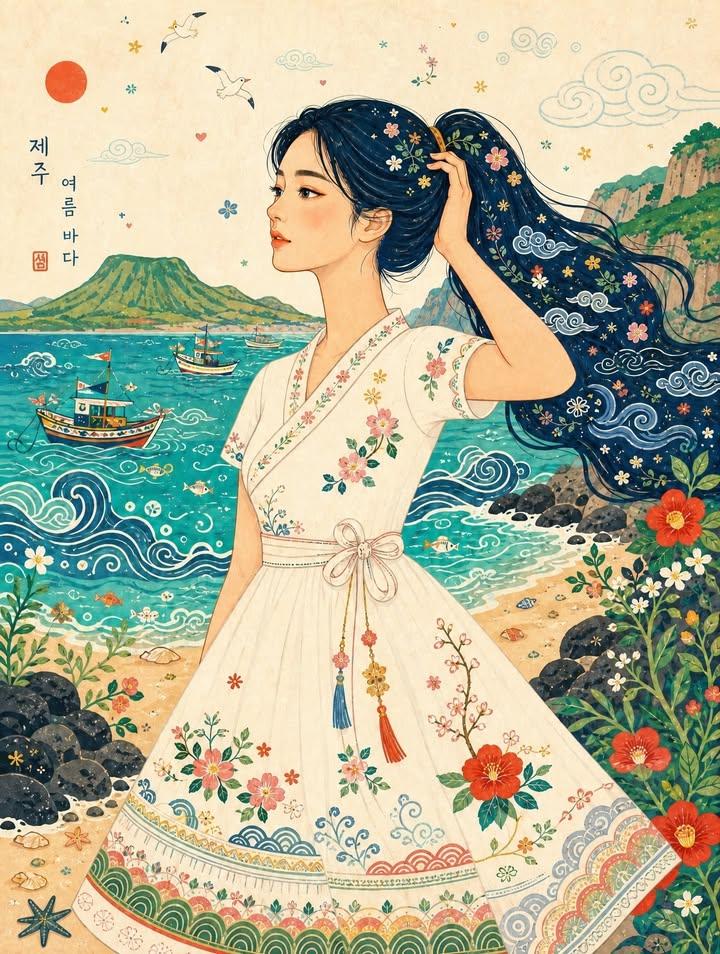
Use the bottom photograph as the main content and composition reference, and use the top image only as the illustration-style reference. Transform the woman and the entire seaside scene into a bright, playful, Korean-inspired naïve folk-art editorial illustration. Preserve the original woman’s side-profile pose, body proportions, hand holding her long ponytail, three-quarter body framing, and the overall camera composition, but reinterpret the setting with the atmosphere of a serene Korean summer coast. Set the scene on a dreamy Korean seaside inspired by Jeju Island or the South Coast of Korea. Replace the tropical-exotic mood with a warm and lyrical Korean summer mood: clear emerald-blue water, a gentle sandy shoreline, soft sea breeze, calm waves, and dark volcanic rocks or softly rounded coastal cliffs reminiscent of Jeju. The background should feel peaceful, nostalgic, and distinctly Korean rather than tropical resort-like. Illustrate the woman with a warm peach skin tone, an elegant simplified side-profile face, minimal facial details, gently elongated proportions, and clean five-finger hands. Keep her long dark ponytail, but reinterpret it as a flowing deep indigo or navy graphic hair shape decorated with delicate Korean-inspired decorative motifs such as stars, cloud swirls, leaves, tiny flowers, and subtle patterns inspired by minhwa and traditional folk ornament. Keep the original white halter crop top and flowing summer skirt silhouette, but reinterpret the outfit as a charming Korean summer folk-style resort dress inspired by modernized hanbok details. Add decorative embroidery and pattern accents inspired by Korean aesthetics: small mugunghwa, camellia, wildflowers, plum blossoms, simplified dancheong-like borders, wave motifs, and hand-drawn stitched details. The outfit should remain light, feminine, and summery, while feeling rooted in Korean visual sensibility. Simplify the entire environment into flat, colorful graphic shapes with a handmade look. Render the sea as a vivid jade-turquoise or blue-green color field with hand-drawn white and indigo wave lines inspired by traditional decorative patterns. Replace the tropical boats with small Korean fishing boats, simple leisure boats, or stylized boats inspired by the Korean coast, rendered in colorful folk-art form with playful geometric decoration. Turn the cliffs and shoreline into rounded green hills, basalt rocks, coastal plants, and simplified seaside vegetation that feel natural to Korea. Add small decorative details that evoke Korean summer by the sea: tiny fish, shells, bubbles, wild coastal flowers, seabirds, hearts, stars, stylized seaweed, and a few whimsical minhwa-like elements, but keep the composition airy and not overcrowded. Avoid overly exotic tropical creatures; instead, focus on a gentle Korean coastal atmosphere. Use a cheerful but refined color palette inspired by Korean folk painting and summer landscapes: jade turquoise, celadon blue-green, coral red, warm peach, indigo, deep navy, soft ivory, golden yellow, muted leaf green, and touches of dancheong-like accent colors. The palette should feel vivid yet balanced, with a slightly nostalgic Korean warmth. The final image should feature flat spot colors, simple hand-drawn organic contours, slightly uneven naïve linework, minimal perspective, no realistic shading, no gradients, subtle hanji-like paper grain, and a soft matte printed finish. It should feel like a premium Korean summer folk-art poster—whimsical, decorative, lyrical, and full of gentle emotional warmth. Maintain generous breathing space around the woman’s head and upper body. Vertical 3:4 composition. The overall result should feel like a handcrafted Korean folk-art editorial poster that blends cute modern illustration with the emotional atmosphere of a peaceful Korean seaside summer. Avoid photorealism, realistic skin texture, 3D rendering, cinematic lighting, complex shadows..