Case Media
Case Notes
This page keeps the media, full prompt, and original source together so you can inspect the result first and decide whether the prompt is worth copying, saving, or comparing.
Case Insights
To make this page easier to search, cite, and reuse later, the case is also broken down into practical guidance about usage, visual cues, and prompt structure.
Best Fit Scenarios
- Use this as a portrait & photography benchmark when you need a fast style baseline before rewriting your own prompt.
- It is especially helpful if your target overlaps with Portrait, Screenshot, City Visual and you want to judge the image result before tuning wording.
- Keep it as a control sample when you compare nearby prompt variants one variable at a time.
Visual Signals To Notice
- The clearest style signals here are Portrait, Screenshot, City Visual, so those should usually stay in your first rewrite.
- Focus on framing, light direction, pose, and the distance between subject and camera.
- This case keeps 2 media outputs, which makes it easier to check whether the style remains stable across multiple results.
How The Prompt Is Structured
- The prompt reads as a long, highly specified prompt, which is useful when you want to judge how much specificity this direction needs.
- Its keyword cluster is centered on Portrait, Screenshot, City Visual, so you can usually keep that cluster while swapping subject, camera, layout, or copy details.
- A practical rewrite path is: keep the outcome, keep the strongest style cues, then replace only the subject and environment blocks.
Good Follow-up Questions
- What changes first if you keep Portrait, Screenshot, City Visual but switch the subject matter?
- Which part of the result comes from section-level structure (Portrait & Photography) versus tag-level style cues?
- Which related cases in the same section give you a cleaner or more extreme variation of the same direction?
Full Prompt
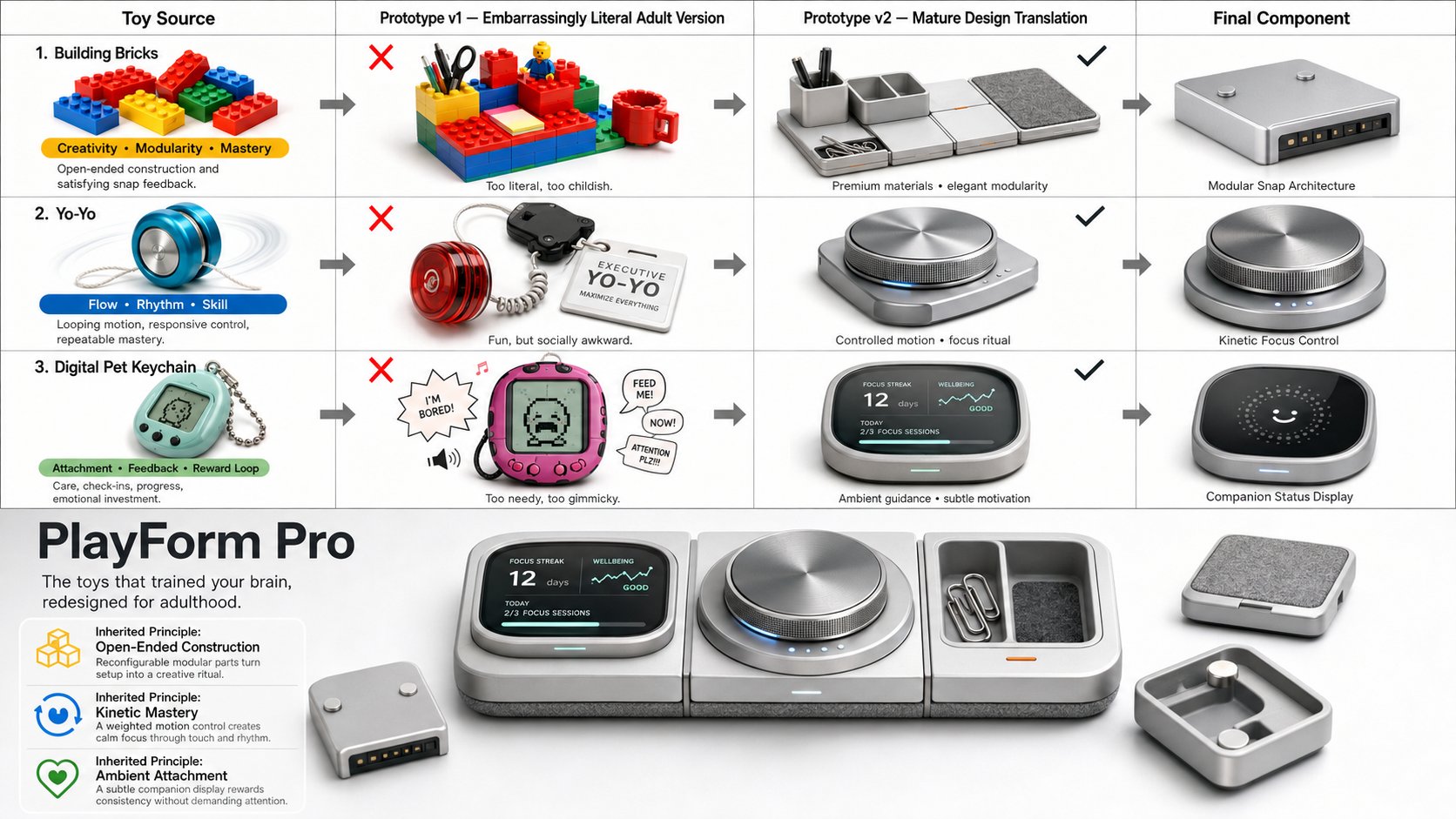
[Instructions] Act as a world class toy designer, industrial designer, behavioral psychologist, and premium product strategist. Task: Design a transformative adult product called PlayForm Pro, evolved from three childhood toy archetypes: [Toy 1: e.g., LEGO] [Toy 2: e.g., yo-yo] [Toy 3: e.g., Tamagotchi] Step 1: Analyze the deep behavioral appeal of each toy: interaction loop, tactility, emotional reward, creativity, mastery, or attachment. Step 2: Translate each toy into an absurd literal adult product prototype. Step 3: Refine each into a mature, useful product feature. Step 4: Combine the refined features into one final premium adult product. Output instruction: Generate a single wide-format high-resolution image in the style of Apple product photography, premium Kickstarter campaign, and playful design infographic. Top Section: A 3x4 Evolution Grid. Rows: Each row represents one toy archetype. Column 1: Toy Source. Show the toy with highlighted behavioral principle. Column 2: Prototype v1, The Embarrassingly Literal Adult Version. Show a funny, impractical version that copies the toy too directly. Column 3: Prototype v2, The Mature Design Translation. Show a sleek, useful, socially acceptable product feature. Column 4: Final Component. Show the perfected component, such as modular snap architecture, kinetic focus control, companion status display, reward loop indicator, or tactile creativity panel. Visualizing Iteration: Red X marks over childish colors, gimmicks, and impractical parts. Checkmarks over premium materials, elegant interaction, and adult usefulness. Bottom Section: The Product Launch Banner. Show the final PlayForm Pro as a desirable adult product. It can become a desk tool, wearable, productivity device, home object, travel product, or creative instrument depending on the toys selected. The final product must visibly combine all three final components from the grid. Text elements: Title: PlayForm Pro Subtitle: “The toys that trained your brain, redesigned for adulthood.” Add three callout blocks explaining the inherited toy principles. Style: Clean white background, soft studio lighting, premium plastic, aluminum, glass, fabric, playful but refined color accents, photorealistic rendering, clear infographic labels, modern typography. [/Instructions]