Case Media
Case Notes
This page keeps the media, full prompt, and original source together so you can inspect the result first and decide whether the prompt is worth copying, saving, or comparing.
Case Insights
To make this page easier to search, cite, and reuse later, the case is also broken down into practical guidance about usage, visual cues, and prompt structure.
Best Fit Scenarios
- Use this as a model & community benchmark when you need a fast style baseline before rewriting your own prompt.
- It is especially helpful if your target overlaps with Cinematic, Illustration, Character and you want to judge the image result before tuning wording.
- Keep it as a control sample when you compare nearby prompt variants one variable at a time.
Visual Signals To Notice
- The clearest style signals here are Cinematic, Illustration, Character, so those should usually stay in your first rewrite.
- This kind of case is strongest when you watch deltas: what changed, what broke, and which prompt choice caused that shift.
- This case keeps one primary output, so the first image should be treated as the main visual reference.
How The Prompt Is Structured
- The prompt reads as a long, highly specified prompt, which is useful when you want to judge how much specificity this direction needs.
- Its keyword cluster is centered on Cinematic, Illustration, Character, so you can usually keep that cluster while swapping subject, camera, layout, or copy details.
- A practical rewrite path is: keep the outcome, keep the strongest style cues, then replace only the subject and environment blocks.
Good Follow-up Questions
- What changes first if you keep Cinematic, Illustration, Character but switch the subject matter?
- Which part of the result comes from section-level structure (Model & Community) versus tag-level style cues?
- Which related cases in the same section give you a cleaner or more extreme variation of the same direction?
Full Prompt
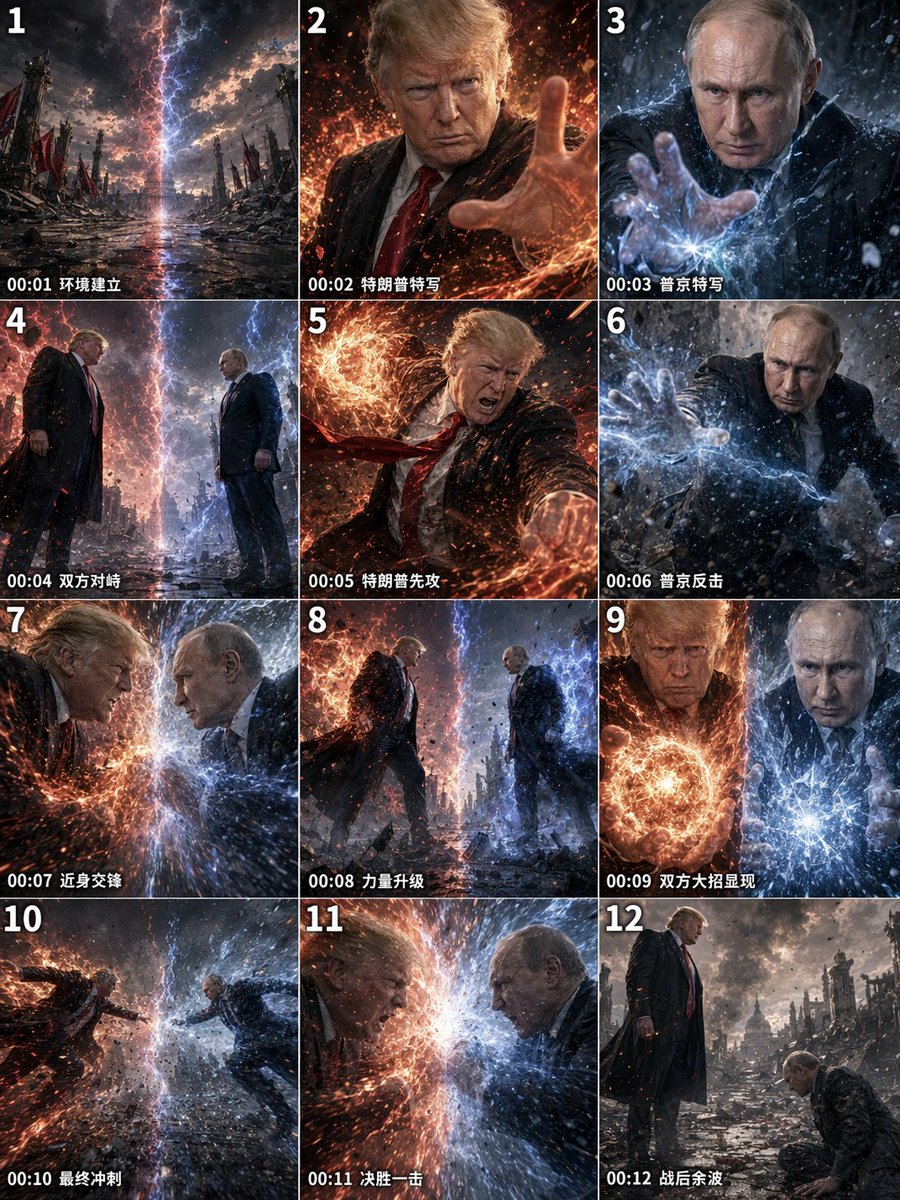
Please generate a high-energy storyboard image in [xx style], featuring [Character A] vs [Character B]. The overall image must be in a 3:4 vertical composition, adopting a 3-column x 4-row layout with a total of 12 storyboard panels, presenting a complete set of continuously progressing animated battle storyboard, rather than an ordinary collage or a collection of single illustrations. The overall style should have a high-energy anime feel, cinematic camera tension, intense action design, and an epic battle atmosphere, like a collection of key frames from an already edited passionate anime trailer. The entire set of images must strictly advance according to the following rhythm: Panel 1 environment establishment, Panel 2 Character A close-up, Panel 3 Character B close-up, Panel 4 confrontation between both sides, Panel 5 Character A attacks first, Panel 6 Character B counterattacks, Panel 7 close-quarters clash, Panel 8 power escalation, Panel 9 both sides' ultimate moves manifest, Panel 10 final sprint, Panel 11 decisive blow, Panel 12 aftermath of the battle. Each panel must have a clear large white number 1~12 in the top left corner, and each panel must have a white timecode and a concise Chinese description in the bottom left corner. Character A and Character B must maintain a unified appearance, unified clothing, unified abilities, and unified temperament throughout the entire set of 12 panels; if they are well-known characters, their highly recognizable classic images and ability characteristics must be retained; if they are original characters, a distinct design must be automatically generated based on the name and maintained consistently throughout. The overall must emphasize character contrast, ability contrast, color contrast, and aura contrast, strengthen the sense of speed, sense of burst, sense of impact, energy fission, smoke, debris, and ultimate move special effects, ultimately forming a high-energy anime storyboard image where one can see at a glance the "complete battle process".