Case Media
Case Notes
This page keeps the media, full prompt, and original source together so you can inspect the result first and decide whether the prompt is worth copying, saving, or comparing.
Case Insights
To make this page easier to search, cite, and reuse later, the case is also broken down into practical guidance about usage, visual cues, and prompt structure.
Best Fit Scenarios
- Use this as a model & community benchmark when you need a fast style baseline before rewriting your own prompt.
- It is especially helpful if your target overlaps with 35mm, Portrait, Cinematic and you want to judge the image result before tuning wording.
- Keep it as a control sample when you compare nearby prompt variants one variable at a time.
Visual Signals To Notice
- The clearest style signals here are 35mm, Portrait, Cinematic, so those should usually stay in your first rewrite.
- This kind of case is strongest when you watch deltas: what changed, what broke, and which prompt choice caused that shift.
- This case keeps one primary output, so the first image should be treated as the main visual reference.
How The Prompt Is Structured
- The prompt reads as a long, highly specified prompt, which is useful when you want to judge how much specificity this direction needs.
- Its keyword cluster is centered on 35mm, Portrait, Cinematic, so you can usually keep that cluster while swapping subject, camera, layout, or copy details.
- A practical rewrite path is: keep the outcome, keep the strongest style cues, then replace only the subject and environment blocks.
Good Follow-up Questions
- What changes first if you keep 35mm, Portrait, Cinematic but switch the subject matter?
- Which part of the result comes from section-level structure (Model & Community) versus tag-level style cues?
- Which related cases in the same section give you a cleaner or more extreme variation of the same direction?
Full Prompt
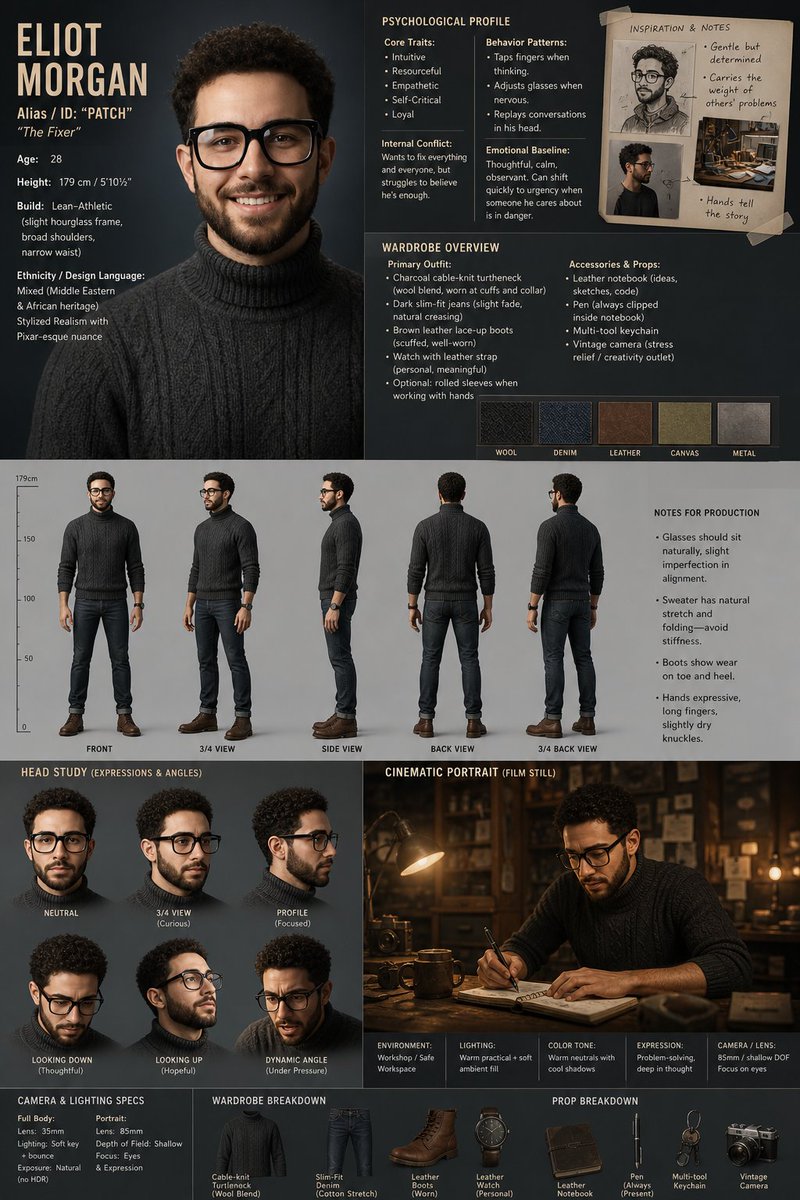
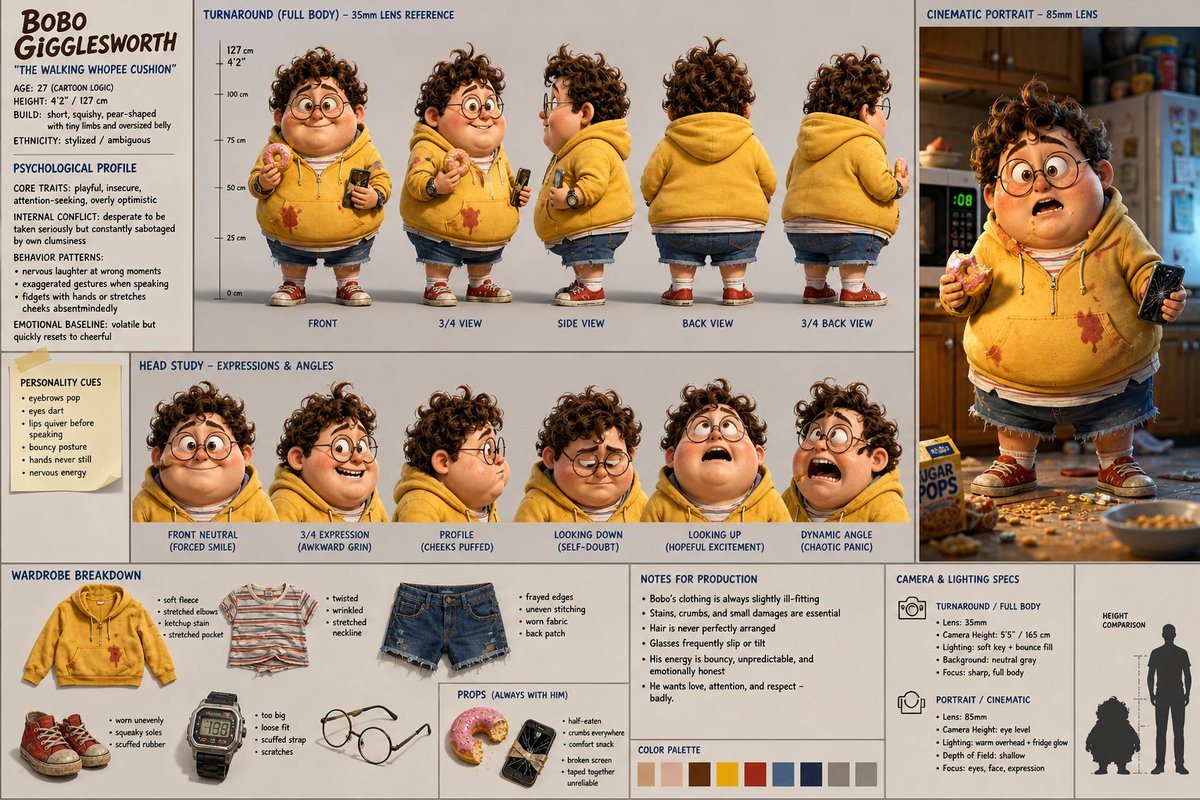
Create a cinematic, film-production-grade character design sheet intended for a director, casting team, and costume department. This must feel like a high-budget animated film pitch board, not a generic model sheet. CORE DIRECTIVE (NON-NEGOTIABLE)No generic layouts No evenly spaced grids No symmetry for the sake of neatness Composition must feel art-directed, intentional, slightly asymmetrical Every section should feel placed, not auto-generated CHARACTER IDENTITY Name: [Full character name] Alias / ID: [Nickname, codename, symbolic title] Age: [Real or stylized age logic] Height: [Exact height in cm/ft] Build: [Detailed body type with nuance — proportions, weight distribution, posture tendencies] Ethnicity / Design Language:[Real-world influence or stylized hybrid approach — Pixar-esque, anime-inspired, culturally grounded, etc.] FACE DESIGN Structure:[Face shape, bone structure, exaggeration level, asymmetry] Skin / Surface:[Texture, tone, subsurface softness, imperfections, stylization level] Eyes:[Size, spacing, color, expressiveness, quirks] Hair:[Style, texture, behavior (physics), imperfections, movement logic] Distinct Features:[Any defining traits — scars, dimples, stretch, elasticity, etc.] PSYCHOLOGICAL PROFILE (DRIVES PERFORMANCE) Core Traits:[3–5 dominant personality traits] Internal Conflict:[What they want vs what sabotages them] Behavior Patterns: [Habit 1] [Habit 2] [Habit 3] Emotional Baseline:[Default emotional state + how quickly it shifts] PERFORMANCE DIRECTION (CRITICAL) Character must feel like a real actor caught mid-moment, not posing. Expression Notes: Micro-expressions required (lip tension, eye movement, eyebrow shifts) Avoid staged symmetry Capture transitional emotion (before/after reaction) Body Language: [Posture tendencies] [Movement rhythm: stiff, bouncy, dragging, sharp, etc.] [Idle behavior: fidgeting, stillness, tension] WARDROBE (PRODUCTION-REALISTIC WITH STYLIZATION) Primary Outfit: [Garment 1: fabric type, wear, imperfections] [Garment 2: fit, distortion, stitching details] [Layering logic] Footwear:[Material, wear patterns, realism vs stylization] Accessories:[Functional + character-revealing items] Props:[Objects frequently carried that reinforce personality] MATERIAL & TEXTURE ACCURACY Fabrics must show stretch, stitching, wrinkles, wear Surfaces must avoid plastic look unless intentionally stylized Skin should have soft light interaction, slight bounce Include imperfections: dirt, smudges, aging, usage marks TURNAROUND REQUIREMENTS (STRICT CONSISTENCY) Generate full-body turnaround with identical proportions and design fidelity: Front View 3/4 View Side View Back View 3/4 Back View No drift in proportions, face, or costume. HEAD STUDY (ACTOR REFERENCE QUALITY) Include expressive head variations: Front (neutral or controlled expression) 3/4 (primary personality expression) Profile (structure clarity) Looking Down (emotion: [insert]) Looking Up (emotion: [insert]) Dynamic Angle (emotion: [insert intense state]) Expressions must feel captured mid-thought, not posed. CINEMATIC PORTRAIT (FILM STILL) Environment:[Specific location tied to character behavior] Lighting:[Motivated sources — practical lights, ambient glow, contrast level] Color Tone:[Palette direction — warm, cool, mixed, stylized] Expression:[Specific narrative moment] Camera:[Real-world lens feel — 50mm, 85mm, etc.] Shallow depth of field, cinematic realism CAMERA + LIGHTING SPECIFICATIONS Full Body: Lens: [e.g., 35mm] Lighting: soft key + bounce Natural exposure, no HDR Portrait: Lens: [e.g., 85mm] Depth of field: shallow Focus priority: eyes and expression COMPOSITION & LAYOUT Clean but art-directed sheet layout Neutral background (gray or soft tone) for turnaround Structured but visually dynamic section placement Include: Height scale reference Annotation callouts (fabric stretch, personality cues, prop usage) Wardrobe breakdown section Notes for production Layout must feel like a premium studio presentation board STYLE [Define clearly] Examples: Pixar-style stylized realism Hyper-expressive animation realism Semi-realistic cinematic character design Must include: Appealing exaggeration Soft geometry Cinematic lighting High emotional readability CONSISTENCY RULE (STRICT) Face, proportions, costume, and details must remain identical across all views and sections No reinterpretation between angles. OUTPUT QUALITY Extremely high detail Sharp focus Production-ready fidelity Suitable for film development, merchandising, and pitch decks