Case Media
Case Notes
This page keeps the media, full prompt, and original source together so you can inspect the result first and decide whether the prompt is worth copying, saving, or comparing.
Case Insights
To make this page easier to search, cite, and reuse later, the case is also broken down into practical guidance about usage, visual cues, and prompt structure.
Best Fit Scenarios
- Use this as a model & community benchmark when you need a fast style baseline before rewriting your own prompt.
- It is especially helpful if your target overlaps with Poster, Screenshot, Character and you want to judge the image result before tuning wording.
- Keep it as a control sample when you compare nearby prompt variants one variable at a time.
Visual Signals To Notice
- The clearest style signals here are Poster, Screenshot, Character, so those should usually stay in your first rewrite.
- This kind of case is strongest when you watch deltas: what changed, what broke, and which prompt choice caused that shift.
- This case keeps one primary output, so the first image should be treated as the main visual reference.
How The Prompt Is Structured
- The prompt reads as a long, highly specified prompt, which is useful when you want to judge how much specificity this direction needs.
- Its keyword cluster is centered on Poster, Screenshot, Character, so you can usually keep that cluster while swapping subject, camera, layout, or copy details.
- A practical rewrite path is: keep the outcome, keep the strongest style cues, then replace only the subject and environment blocks.
Good Follow-up Questions
- What changes first if you keep Poster, Screenshot, Character but switch the subject matter?
- Which part of the result comes from section-level structure (Model & Community) versus tag-level style cues?
- Which related cases in the same section give you a cleaner or more extreme variation of the same direction?
Full Prompt
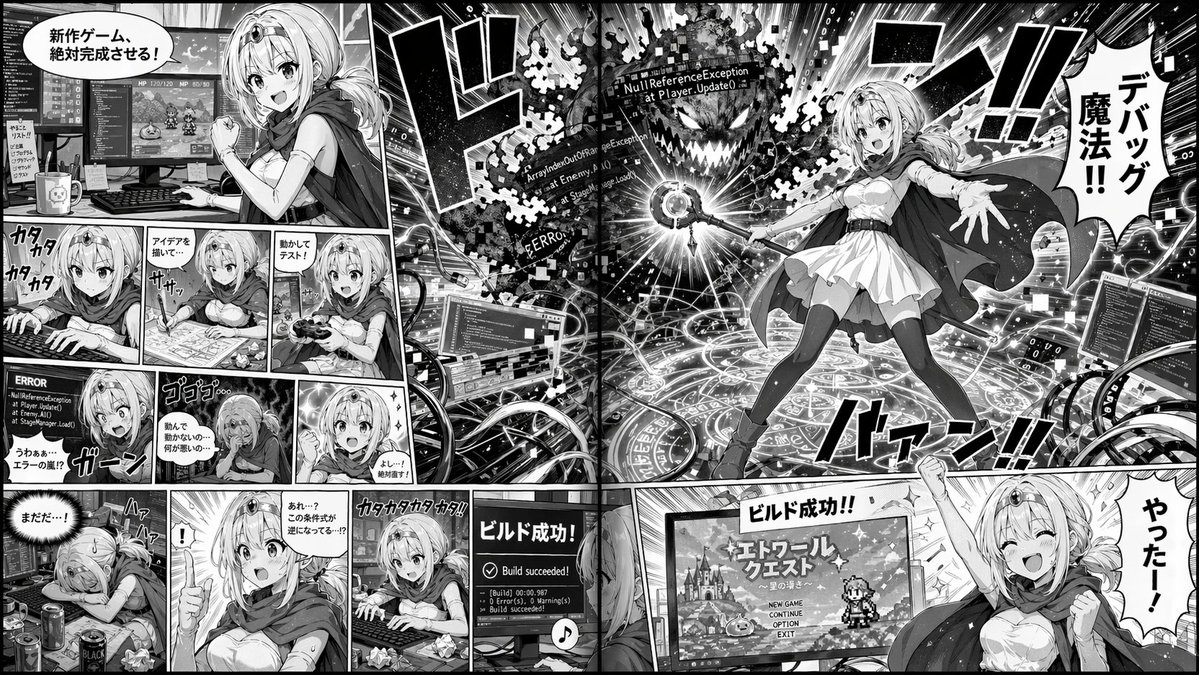
{ "type": "2-page manga spread", "style": "monochrome anime manga, screentones", "theme": "{argument name=\"main action\" default=\"fantasy mage developing a video game\"}", "character": "{argument name=\"character appearance\" default=\"anime girl with blonde hair, tiara, cape, white dress, thigh-highs\"}", "layout": { "left_page": { "panel_count": 11, "rows": [ {"panels": 1, "action": "Determined at dual-monitor desk, speech bubble: '新作ゲーム、絶対完成させる!'"}, {"panels": 3, "action": "Typing, drawing on tablet, testing with controller"}, {"panels": 3, "action": "Shocked at ERROR screen, depressed, determined again"}, {"panels": 4, "action": "Exhausted, sudden realization, furious typing, monitor showing 'Build succeeded!'"} ] }, "right_page": { "panel_count": 2, "panels": [ {"type": "large splash", "action": "Casting magic from a glowing circle at a code-error monster labeled '{argument name=\"error text\" default=\"NullReferenceException\"}'. Speech bubble: '{argument name=\"spell text\" default=\"デバッグ魔法!!\"}'"}, {"type": "bottom banner", "action": "Cheering in front of RPG title screen. Speech bubble: '{argument name=\"success text\" default=\"やったー!\"}'"} ] } } }