Case Media
Case Notes
This page keeps the media, full prompt, and original source together so you can inspect the result first and decide whether the prompt is worth copying, saving, or comparing.
Case Insights
To make this page easier to search, cite, and reuse later, the case is also broken down into practical guidance about usage, visual cues, and prompt structure.
Best Fit Scenarios
- Use this as a model & community benchmark when you need a fast style baseline before rewriting your own prompt.
- It is especially helpful if your target overlaps with Illustration, Character, Typography and you want to judge the image result before tuning wording.
- Keep it as a control sample when you compare nearby prompt variants one variable at a time.
Visual Signals To Notice
- The clearest style signals here are Illustration, Character, Typography, so those should usually stay in your first rewrite.
- This kind of case is strongest when you watch deltas: what changed, what broke, and which prompt choice caused that shift.
- This case keeps one primary output, so the first image should be treated as the main visual reference.
How The Prompt Is Structured
- The prompt reads as a long, highly specified prompt, which is useful when you want to judge how much specificity this direction needs.
- Its keyword cluster is centered on Illustration, Character, Typography, so you can usually keep that cluster while swapping subject, camera, layout, or copy details.
- A practical rewrite path is: keep the outcome, keep the strongest style cues, then replace only the subject and environment blocks.
Good Follow-up Questions
- What changes first if you keep Illustration, Character, Typography but switch the subject matter?
- Which part of the result comes from section-level structure (Model & Community) versus tag-level style cues?
- Which related cases in the same section give you a cleaner or more extreme variation of the same direction?
Full Prompt
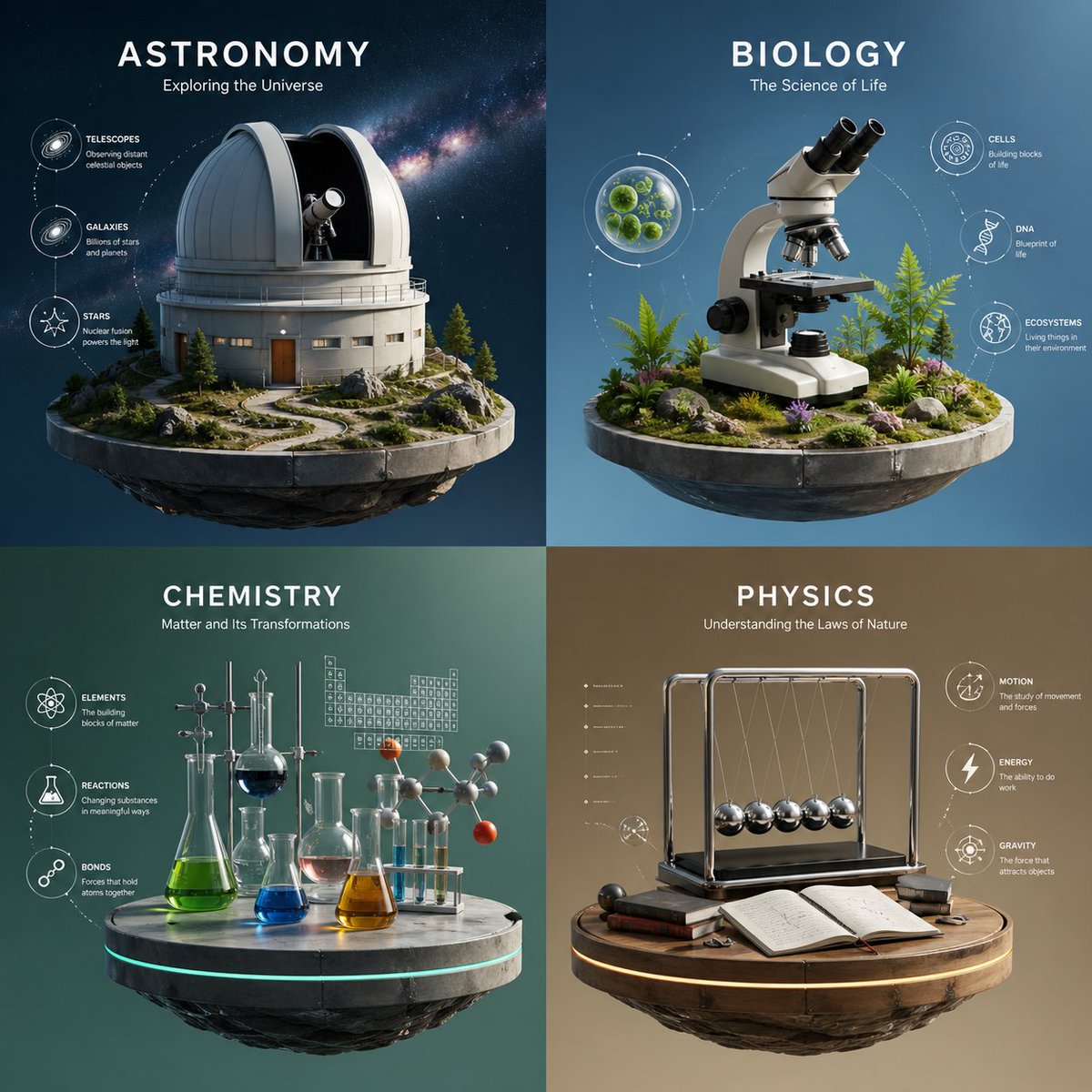
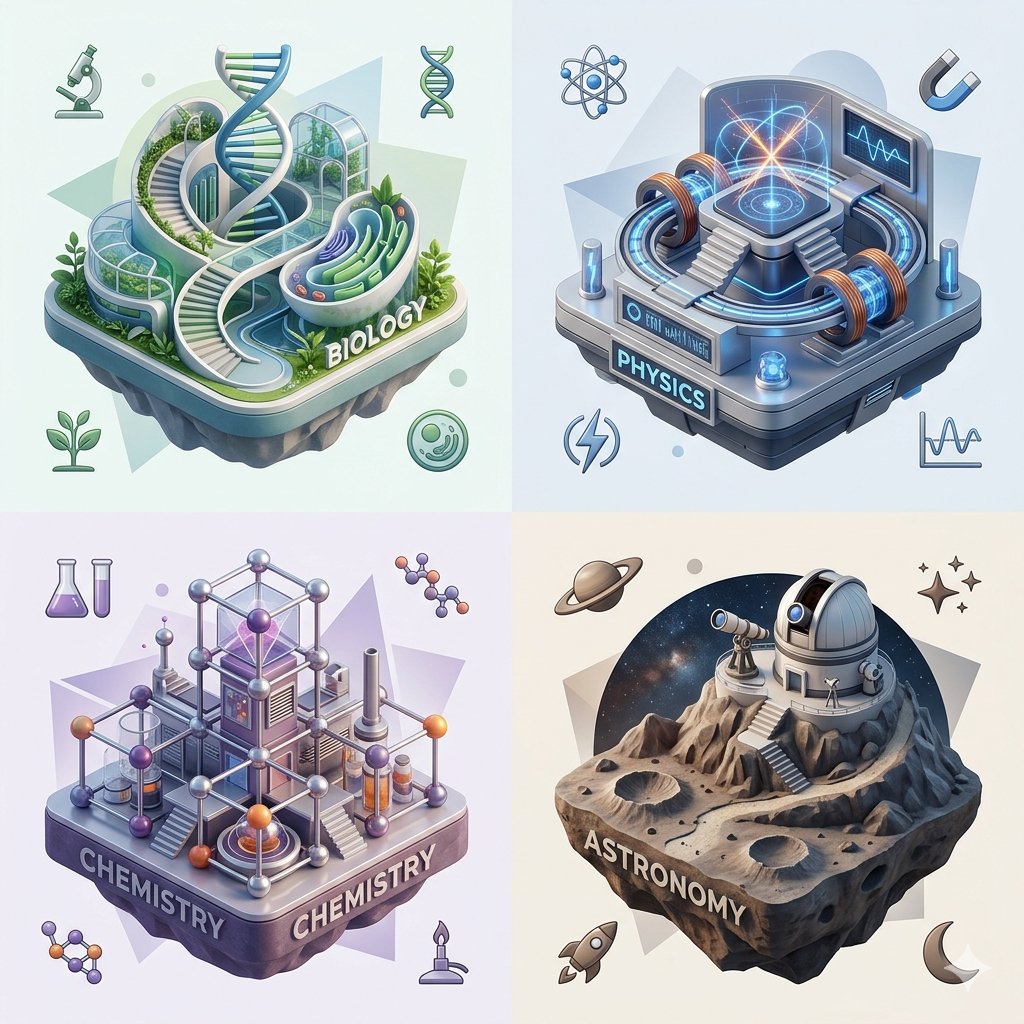
A clean 2x2 conceptual entity model infographic on a soft light background, showing four separate floating isometric diorama tiles that personify branches of {argument name="theme" default="science"} in a polished 3D illustration style with pastel gradients, glossy materials, soft ambient lighting, subtle shadows, rounded futuristic forms, and high detail. Top left: BIOLOGY, a lush bio-lab island with a large central DNA double helix tower, curved glass greenhouse architecture, spiral stairways, layered organic pathways, greenery, plant beds, and fluid biomorphic structures; the word "BIOLOGY" is integrated on the front edge of the platform. Surrounding this tile are 4 small biology-related icons: a microscope, a DNA symbol, a sprouting plant, and a circular cell or petri-dish symbol. Top right: PHYSICS, a high-tech energy laboratory tile in cool blue tones with a central glowing platform, circular accelerator rings, copper-like electromagnetic coils, stairs leading up to the core, a monitor screen with waveform graphics, and a futuristic industrial base labeled "PHYSICS"; add 4 surrounding physics-themed icons: an atom, a horseshoe magnet, a lightning bolt, and a line graph waveform. Bottom left: CHEMISTRY, a modular molecular research structure in purple and silver, built from spheres-and-rods lattice frameworks, lab columns, beakers, flasks, and a glowing crystalline core; the platform prominently reads "CHEMISTRY" on two visible sides. Surrounding this tile are 4 chemistry-related icons: two molecular diagrams, a pair of lab test tubes or flasks, and a small burner. Bottom right: ASTRONOMY, a rocky lunar observatory island with cratered terrain, a dome observatory, a telescope, stairs carved into the rock, and a circular cosmic starfield backdrop behind it; the front edge reads "ASTRONOMY". Surrounding this tile are 4 astronomy-themed icons: a ringed planet, spark-like stars, a small rocket, and a crescent moon. Keep all 4 tiles evenly spaced in a quadrant layout, each with its own muted geometric backdrop shape, cohesive pastel palette tuned per discipline, and a premium gpt-image-2 style that makes each concept feel like a collectible miniature world. No people, no extra text beyond the four discipline labels.