Case Media
Case Notes
This page keeps the media, full prompt, and original source together so you can inspect the result first and decide whether the prompt is worth copying, saving, or comparing.
Case Insights
To make this page easier to search, cite, and reuse later, the case is also broken down into practical guidance about usage, visual cues, and prompt structure.
Best Fit Scenarios
- Use this as a model & community benchmark when you need a fast style baseline before rewriting your own prompt.
- It is especially helpful if your target overlaps with Neon, Cinematic, Poster and you want to judge the image result before tuning wording.
- Keep it as a control sample when you compare nearby prompt variants one variable at a time.
Visual Signals To Notice
- The clearest style signals here are Neon, Cinematic, Poster, so those should usually stay in your first rewrite.
- This kind of case is strongest when you watch deltas: what changed, what broke, and which prompt choice caused that shift.
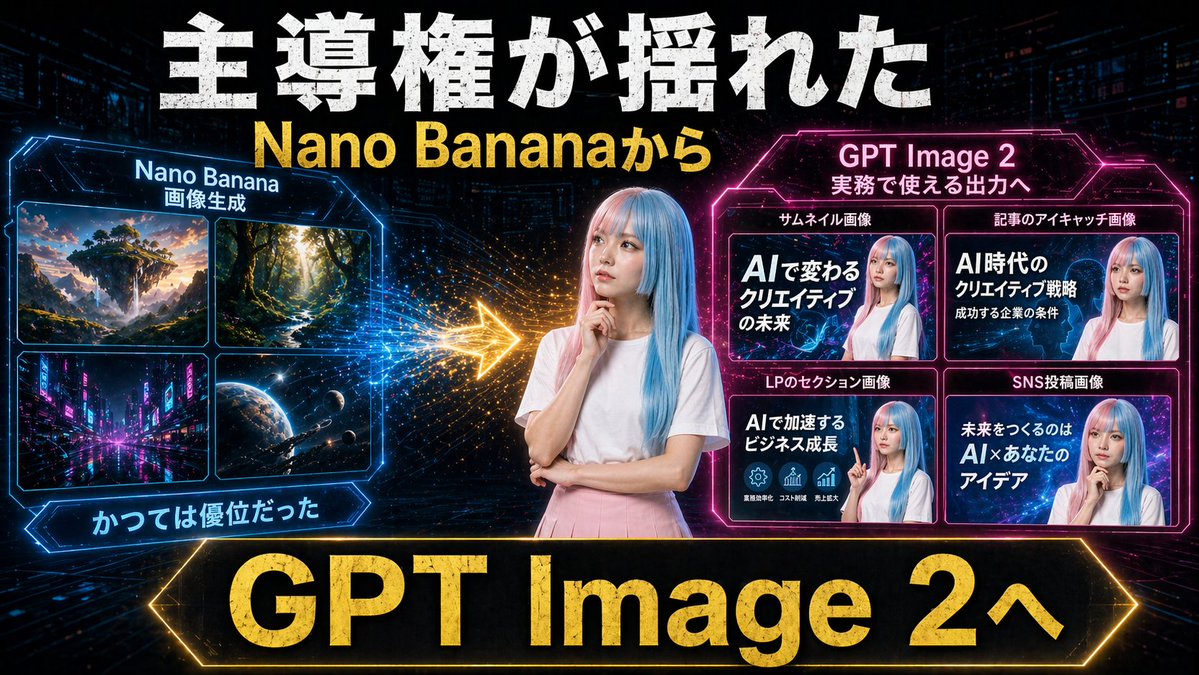
- This case keeps one primary output, so the first image should be treated as the main visual reference.
How The Prompt Is Structured
- The prompt reads as a long, highly specified prompt, which is useful when you want to judge how much specificity this direction needs.
- Its keyword cluster is centered on Neon, Cinematic, Poster, so you can usually keep that cluster while swapping subject, camera, layout, or copy details.
- A practical rewrite path is: keep the outcome, keep the strongest style cues, then replace only the subject and environment blocks.
Good Follow-up Questions
- What changes first if you keep Neon, Cinematic, Poster but switch the subject matter?
- Which part of the result comes from section-level structure (Model & Community) versus tag-level style cues?
- Which related cases in the same section give you a cleaner or more extreme variation of the same direction?
Full Prompt
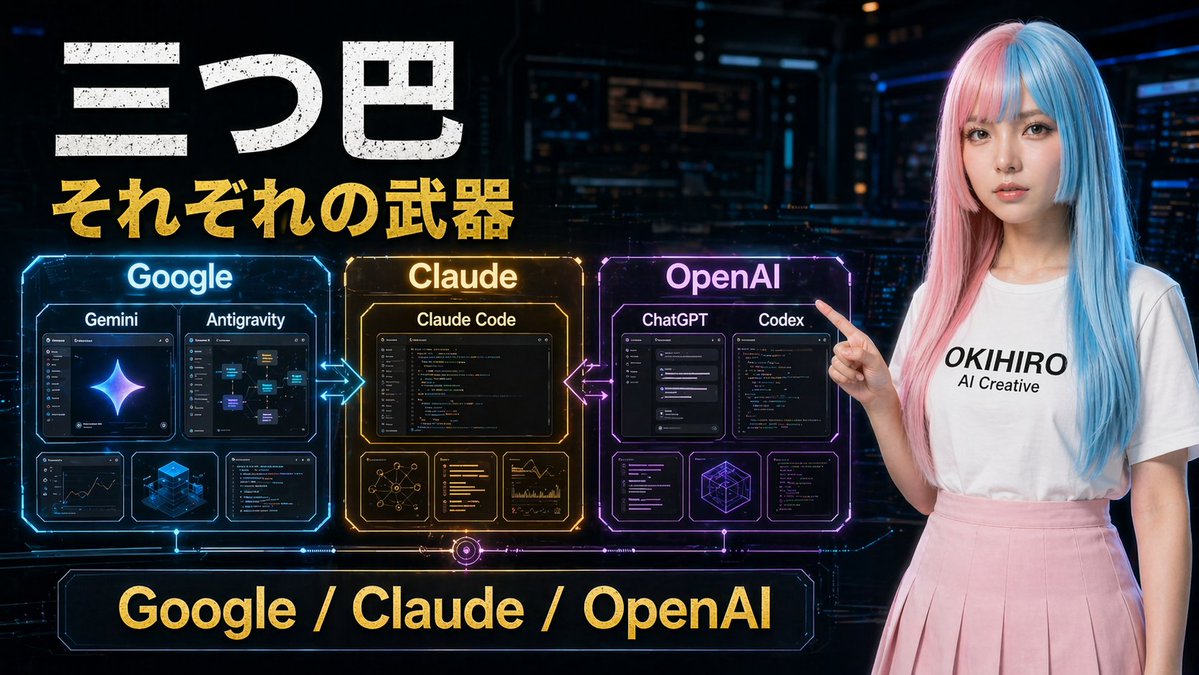
A futuristic Japanese tech comparison poster in a dark cyberpunk control-room setting, wide 16:9 composition. Large distressed white Japanese headline text at the upper left reading "三つ巴", with a bold gold subtitle directly below reading "それぞれの武器". Across the center-left are 3 glowing holographic comparison panels arranged horizontally and connected by neon arrows: a blue panel labeled "Google", an amber-gold panel labeled "Claude", and a purple-magenta panel labeled "OpenAI". The Google panel contains 4 inner cards: 2 larger top cards labeled "Gemini" and "Antigravity", plus 2 smaller bottom cards showing analytics/dashboard-like visuals and a blue isometric cube graphic. The Claude panel contains 4 inner cards: 1 large top card labeled "Claude Code", plus 3 smaller bottom cards showing a network diagram, text/code list, and chart analytics. The OpenAI panel contains 5 inner cards: 2 larger top cards labeled "ChatGPT" and "Codex", plus 3 smaller bottom cards showing interface/code windows and a geometric wireframe cube. Add glowing bidirectional arrows between Google and Claude, and between Claude and OpenAI. At the bottom center, place a large neon-framed banner with gold text reading "Google / Claude / OpenAI". On the right side, include a young woman standing and pointing left toward the panels, with long straight split-dyed hair in pastel pink and cyan blue, a plain white t-shirt with black text reading "{argument name="shirt text" default="OKIHIRO AI Creative"}", and a soft pink pleated skirt. Her face is obscured by a smooth rectangular blur block. Use cinematic sci-fi lighting, glossy hologram UI details, high contrast, vivid blue-gold-purple accents, and a polished YouTube thumbnail aesthetic.