Case Media
Case Notes
This page keeps the media, full prompt, and original source together so you can inspect the result first and decide whether the prompt is worth copying, saving, or comparing.
Case Insights
To make this page easier to search, cite, and reuse later, the case is also broken down into practical guidance about usage, visual cues, and prompt structure.
Best Fit Scenarios
- Use this as a model & community benchmark when you need a fast style baseline before rewriting your own prompt.
- It is especially helpful if your target overlaps with Poster, Illustration, Character and you want to judge the image result before tuning wording.
- Keep it as a control sample when you compare nearby prompt variants one variable at a time.
Visual Signals To Notice
- The clearest style signals here are Poster, Illustration, Character, so those should usually stay in your first rewrite.
- This kind of case is strongest when you watch deltas: what changed, what broke, and which prompt choice caused that shift.
- This case keeps one primary output, so the first image should be treated as the main visual reference.
How The Prompt Is Structured
- The prompt reads as a long, highly specified prompt, which is useful when you want to judge how much specificity this direction needs.
- Its keyword cluster is centered on Poster, Illustration, Character, so you can usually keep that cluster while swapping subject, camera, layout, or copy details.
- A practical rewrite path is: keep the outcome, keep the strongest style cues, then replace only the subject and environment blocks.
Good Follow-up Questions
- What changes first if you keep Poster, Illustration, Character but switch the subject matter?
- Which part of the result comes from section-level structure (Model & Community) versus tag-level style cues?
- Which related cases in the same section give you a cleaner or more extreme variation of the same direction?
Full Prompt
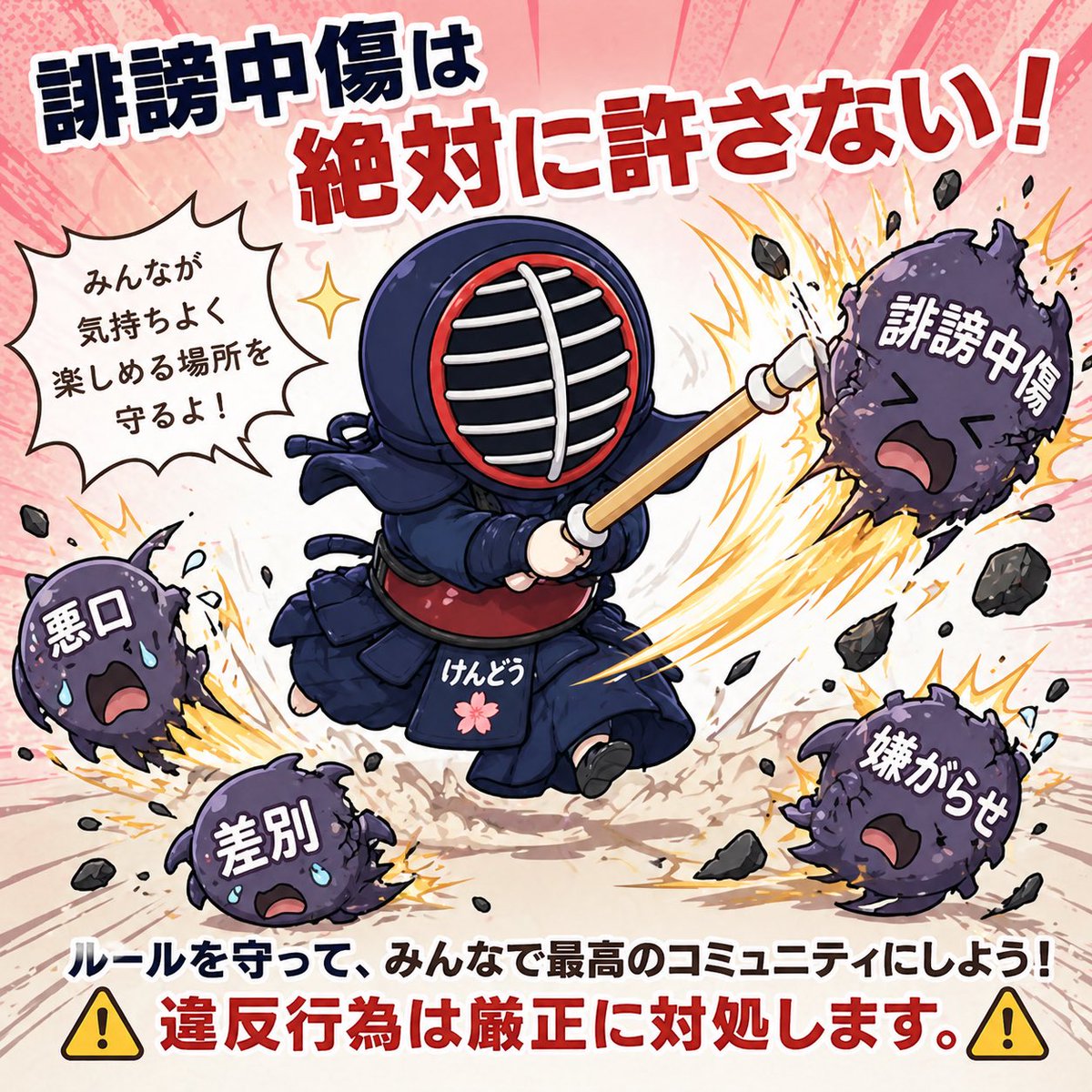
A bold Japanese anti-harassment awareness poster in a cute but forceful chibi anime style, square social-media graphic composition. In the center, a super-deformed kendo character in full navy blue bogu armor is mid-swing with a shinai, charging forward dynamically. The helmet has a dark indigo men with white grill bars and a red inner rim, the torso armor is deep blue with a red do, and the waist apron has the white hiragana text "けんどう" plus a small pink cherry blossom emblem. The character is striking hostile purple spiky monster balls that represent bad behavior. Show exactly 4 monsters with expressive faces and large Japanese labels on their bodies: top right monster labeled "誹謗中傷", lower right monster labeled "嫌がらせ", lower left monster labeled "差別", and left monster labeled "悪口". Each monster is being knocked away or smashed with explosive yellow-orange impact bursts, scattered black debris, motion lines, dust, and sweat tears on some of the monsters. Add a comic speech bubble on the left side containing the Japanese text "みんなが気持ちよく楽しめる場所を守るよ!". At the top, place a huge energetic headline in Japanese with thick outlined lettering: dark navy text for "誹謗中傷は" and bright red text for "絶対に許さない!". At the bottom, add 2 lines of Japanese text: first line in bold dark blue "ルールを守って、みんなで最高のコミュニティにしよう!" and second line in bold red "違反行為は厳正に対処します。". Place one yellow warning triangle icon on the bottom left and one on the bottom right, exactly 2 total. Use a pale pink radial burst background with manga-style speed lines and light texture. Make the overall look clean, high-contrast, friendly, and motivational, like a polished community guidelines illustration for a {argument name="platform type" default="kendo"} community on social media, with thick white sticker-like outlines around major text and characters.