Case Media
Case Notes
This page keeps the media, full prompt, and original source together so you can inspect the result first and decide whether the prompt is worth copying, saving, or comparing.
Case Insights
To make this page easier to search, cite, and reuse later, the case is also broken down into practical guidance about usage, visual cues, and prompt structure.
Best Fit Scenarios
- Use this as a model & community benchmark when you need a fast style baseline before rewriting your own prompt.
- It is especially helpful if your target overlaps with Portrait, Typography, Infographic and you want to judge the image result before tuning wording.
- Keep it as a control sample when you compare nearby prompt variants one variable at a time.
Visual Signals To Notice
- The clearest style signals here are Portrait, Typography, Infographic, so those should usually stay in your first rewrite.
- This kind of case is strongest when you watch deltas: what changed, what broke, and which prompt choice caused that shift.
- This case keeps one primary output, so the first image should be treated as the main visual reference.
How The Prompt Is Structured
- The prompt reads as a long, highly specified prompt, which is useful when you want to judge how much specificity this direction needs.
- Its keyword cluster is centered on Portrait, Typography, Infographic, so you can usually keep that cluster while swapping subject, camera, layout, or copy details.
- A practical rewrite path is: keep the outcome, keep the strongest style cues, then replace only the subject and environment blocks.
Good Follow-up Questions
- What changes first if you keep Portrait, Typography, Infographic but switch the subject matter?
- Which part of the result comes from section-level structure (Model & Community) versus tag-level style cues?
- Which related cases in the same section give you a cleaner or more extreme variation of the same direction?
Full Prompt
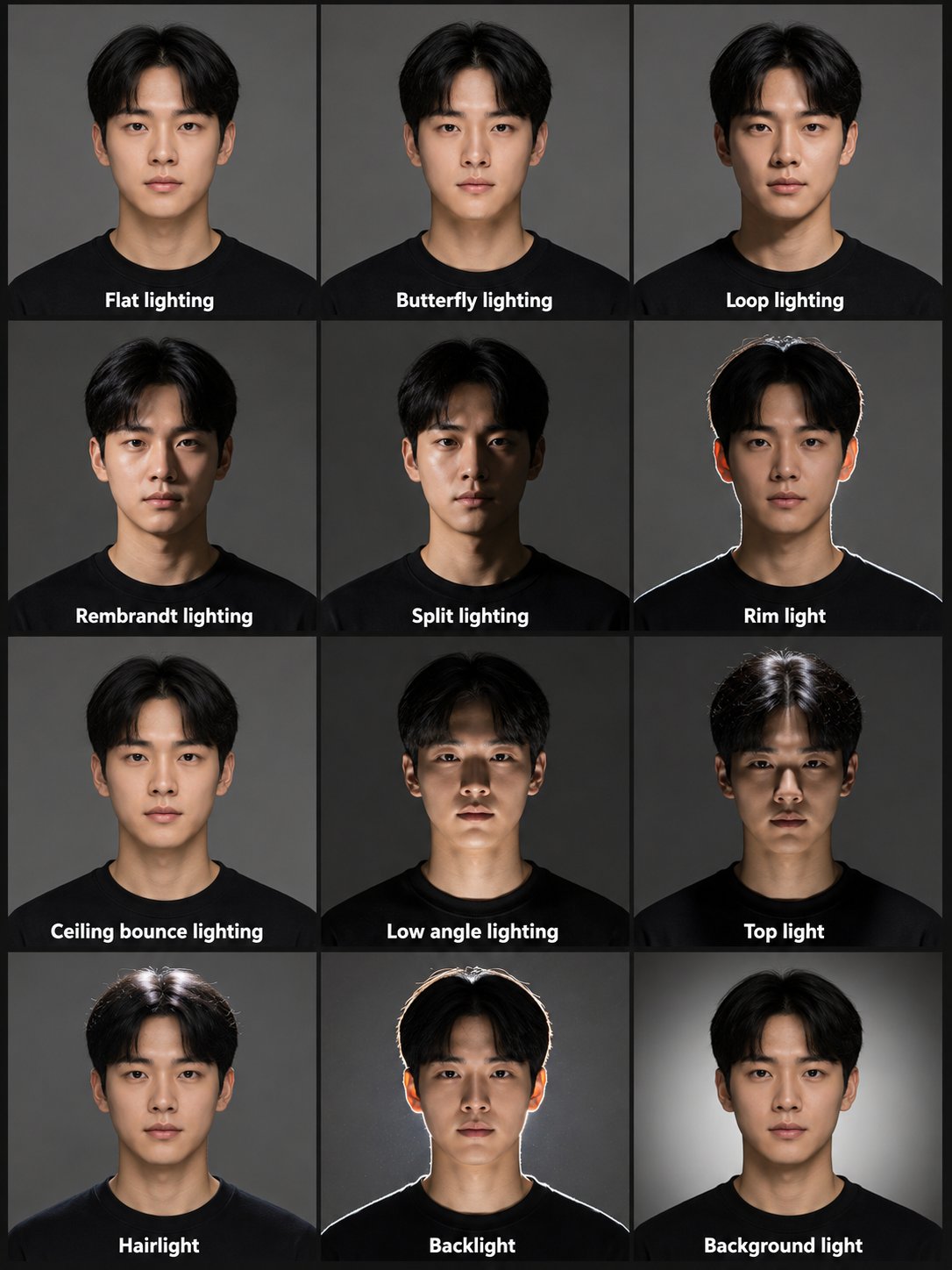
Create a professional studio portrait lighting reference chart featuring the same young Asian model shown in 12 separate portrait panels arranged in a clean 3 column by 4 row grid. The model has short black center-parted hair, smooth natural skin, a neutral black crewneck top, and a calm front facing expression. Each panel shows the same face and pose but with a different lighting setup. Use a simple gray studio background and realistic photography style. Add clear white text labels at the bottom of each panel. Lighting setups to include: Flat lighting Butterfly lighting Loop lighting Rembrandt lighting Split lighting Rim light Ceiling bounce lighting Low angle lighting Top light Hairlight Backlight Background light The image should look like a professional cinematography or photography lighting guide, with consistent framing, realistic shadows, natural skin texture, accurate facial highlights and clear comparison between each lighting style. Use soft studio portrait quality, sharp focus, high detail, and educational reference layout.