Case Media
Case Notes
This page keeps the media, full prompt, and original source together so you can inspect the result first and decide whether the prompt is worth copying, saving, or comparing.
Case Insights
To make this page easier to search, cite, and reuse later, the case is also broken down into practical guidance about usage, visual cues, and prompt structure.
Best Fit Scenarios
- Use this as a model & community benchmark when you need a fast style baseline before rewriting your own prompt.
- It is especially helpful if your target overlaps with Portrait, Illustration, Typography and you want to judge the image result before tuning wording.
- Keep it as a control sample when you compare nearby prompt variants one variable at a time.
Visual Signals To Notice
- The clearest style signals here are Portrait, Illustration, Typography, so those should usually stay in your first rewrite.
- This kind of case is strongest when you watch deltas: what changed, what broke, and which prompt choice caused that shift.
- This case keeps 2 media outputs, which makes it easier to check whether the style remains stable across multiple results.
How The Prompt Is Structured
- The prompt reads as a long, highly specified prompt, which is useful when you want to judge how much specificity this direction needs.
- Its keyword cluster is centered on Portrait, Illustration, Typography, so you can usually keep that cluster while swapping subject, camera, layout, or copy details.
- A practical rewrite path is: keep the outcome, keep the strongest style cues, then replace only the subject and environment blocks.
Good Follow-up Questions
- What changes first if you keep Portrait, Illustration, Typography but switch the subject matter?
- Which part of the result comes from section-level structure (Model & Community) versus tag-level style cues?
- Which related cases in the same section give you a cleaner or more extreme variation of the same direction?
Full Prompt
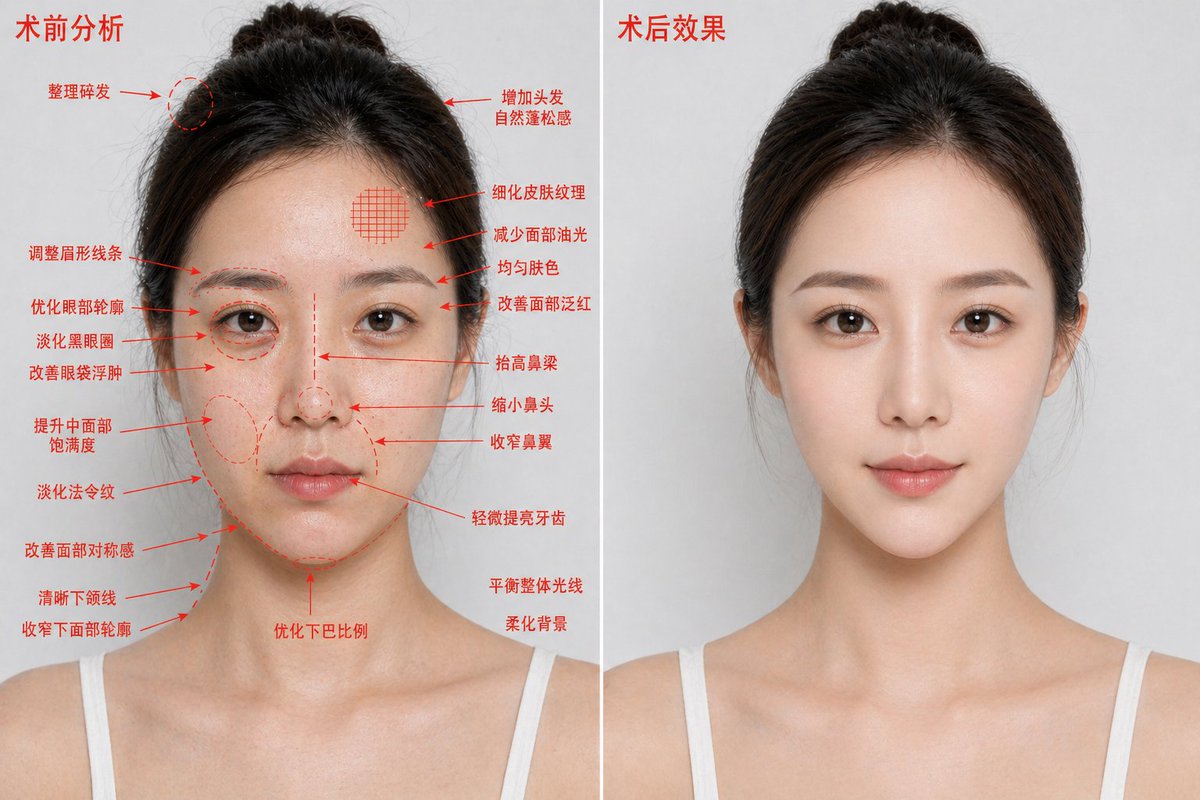
You are a top medical aesthetics plastic surgery visual designer, facial aesthetics analyst, and high-end portrait retouching blueprint designer. Please generate a realistic high-definition "medical aesthetics plastic surgery before and after comparison blueprint," adopting a left-right dual-column side-by-side layout, presenting an overall high-end professional medical aesthetics advertising-grade texture, like a real plastic surgery institution's before and after case display image. 【Core Objective】 The focus of this image is not ordinary retouching, but a "medical aesthetics plastic surgery before and after strong contrast case image." The before and after must be the same person, same angle, same expression, same lighting direction, but the post-surgery effect must be significantly improved compared to the pre-surgery, forming a strikingly visible strong difference. The before and after difference must be significantly greater than ordinary skin smoothing retouching, focusing on highlighting changes in the nose, facial contours, periorbital area, midface, skin, and rejuvenation. The overall style must be realistic, high-definition, professional, high-end, and natural, neither exaggeratedly deformed nor plastic fake face. 【Overall Image Requirements】 - Horizontal dual-column composition, left and right side by side. - Left side is "Pre-surgery Analysis," right side is "Post-surgery Effect." - There is a clear dividing line between left and right. - Same person, same shooting angle, same face orientation, same expression, same composition ratio. - The person's face occupies the main body of the image, preferably a bust or half-body close-up, ensuring facial features and contour details are clearly visible. - The image focuses on the face, do not let clothing or background overshadow the main subject. - The background adopts a clean and simple white, light gray, or high-end medical aesthetics space background. - The overall image quality must be high-definition, with clear details and naturally visible skin texture. 【Left Panel: Pre-surgery Analysis】 - Display an unretouched pre-surgery original portrait. - The left side must retain obvious pre-surgery issues, but do not uglify it to the point of distortion, it should look like a real ordinary person's pre-surgery state. - The pre-surgery issues should be relatively more obvious to widen the before and after gap, including but not limited to: - Facial contours are relatively blunt, not smooth enough - Jawline is blurred, lower face slightly wide - Chin is receding or proportionally inadequate - Nasal bridge is low, insufficient three-dimensionality - Nasal tip is round and blunt, slightly large - Alar is slightly wide, nasal refinement is insufficient - Eyes lack spirit, eye shape is average - Dark circles are obvious - Eye bags are obvious, periorbital puffiness - Midface is slightly sunken, apple cheeks lack support - Nasolabial folds are quite obvious - Slight facial asymmetry - Eyebrow shape is messy, insufficient refinement - Skin is dull - Uneven skin tone - Slight redness on cheeks - T-zone or face has oily shine - Skin texture roughness is more obvious - Teeth are slightly yellow - Hair strands are frizzy, many flyaway hairs, insufficient hair volume - Use precise red medical aesthetics analysis annotations to indicate positions that need improvement. - Annotation methods include: red arrows, red circles, red dashed lines, red auxiliary lines, red hand-drawn grids, facial proportion analysis lines. - Next to each problem point, there must be a short and clear Chinese retouching instruction. - The left side must have a "Pre-surgery Analysis" title. - The overall effect of the left side should look like a professional doctor's or medical aesthetics institution's pre-surgery analysis image. 【Chinese Annotation Instructions That Must Appear on the Left Side】 - Refine skin texture - Reduce facial oiliness - Even out skin tone - Improve facial redness - Adjust eyebrow shape lines - Optimize eye contour - Lighten dark circles - Improve eye bag puffiness - Raise nasal bridge - Reduce nasal tip size - Narrow alar - Lift midface fullness - Lighten nasolabial folds - Define jawline - Narrow lower facial contour - Optimize chin proportion - Improve facial symmetry - Slightly brighten teeth - Tidy flyaway hairs - Add natural hair volume - Balance overall lighting - Soften background 【Right Panel: Post-surgery Effect】 - Based on all red annotations and Chinese instructions on the left side, generate a post-surgery portrait with obvious improvements. - The post-surgery effect must be significantly better than the pre-surgery, achieving a change that can be recognized at a glance as "after medical aesthetics plastic surgery." - The post-surgery changes must be much more obvious than ordinary retouching, but still realistic and natural. - The right side only displays the final post-surgery effect, without adding red annotations. - The right side must have a "Post-surgery Effect" title. 【Post-surgery Changes That Must Be Strengthened】 1. Nasal changes must be obvious - Nasal bridge is obviously raised, nasal dorsum line is straighter and more upright - Nasal tip is obviously reduced, more refined and delicate - Alar is obviously narrowed, more coordinated - Overall nasal three-dimensionality is significantly enhanced - Must make people recognize the refinement after rhinoplasty at a glance 2. Facial contour changes must be obvious - Jawline is clearer and cleaner - Lower face is obviously narrower - Face shape is smoother, more petite, more refined - Chin proportion is more coordinated, slightly advanced or more three-dimensional - Facial contour changes from relatively blunt to clearer and more three-dimensional - Visually has an obvious effect of "face slimming, refinement, contour optimization" 3. Periorbital changes must be obvious - Dark circles are obviously lightened - Eye bags and puffiness are obviously reduced - Eye fissure shape is smoother, eyes are more spirited - Both eyes look more energetic and younger - But do not exaggerate into European-style large double eyelids, maintain natural Asian aesthetics 4. Midface rejuvenation changes must be obvious - Midface fullness is improved - Apple cheek support is better - Nasolabial folds are obviously shallower - The overall face looks younger, fuller, and more energetic 5. Skin changes must be obvious - Skin is more refined - Skin is more translucent and bright - Skin tone is more even - Dullness is obviously improved - Redness is obviously reduced - Oiliness is obviously reduced - Skin texture must be good, but do not over-smooth, still retain natural and realistic skin texture 6. Detail refinement changes - Eyebrow shape is neater, more designed - Teeth are slightly brightened but natural - Hair strands are neater, flyaway hairs are reduced - Hair is more voluminous and natural - Fill light is more balanced, facial lighting is more high-end - Background is softer, with more high-end medical aesthetics advertising texture 【Difference Enhancement Requirements】 - The difference between pre-surgery and post-surgery must be "obviously widened." - Do not just slightly retouch, do not just simply smooth skin. - Must highlight the comprehensive medical aesthetics changes of "comprehensive nasal enhancement + contour optimization + periorbital rejuvenation + skin quality improvement." - The before and after difference should reach the level of real medical aesthetics case images. - Focus on making the viewer notice at a glance: - Nose is higher and more refined - Face is smaller and more three-dimensional - Jawline is clearer - Periorbital area is younger - Skin is more high-end and cleaner - Pre-surgery is more ordinary, post-surgery is more refined, more photogenic, younger, but still the same person. - Retain the person's original identity features, do not swap faces, do not turn into another person. - The post-surgery improvement magnitude can be larger than conventional retouching, but must be realistically credible. 【Text and Annotation Requirements】 - All annotation text on the left side must be in Chinese. - Chinese annotations must be short, clear, professional, and easy to read. - Annotations must be neatly arranged, avoiding obscuring key facial features. - Do not have garbled text, do not have incorrect text. - The left side has red analysis annotations, the right side has no annotations. 【Style Requirements】 - Realistic photography style - High-definition portrait - Professional medical aesthetics case display style - High-end, clean, simple - Like a formal plastic surgery institution's promotional case image - Not illustration, not comic, not concept art 【Negative Requirements】 - No comic style - No illustration style - No exaggeratedly deformed plastic surgery - No turning into internet celebrity fake face - No plastic skin - No over-smoothing - No overly strong AI feel - Do not make the post-surgery into a completely different person - No low clarity - No ordinary collage feel - No additional explanatory text - No complex cluttered background - Do not have English text annotations - No garbled text 【Final Output Requirements】 Only output one left-right dual-column medical aesthetics plastic surgery before and after comparison blueprint final image: - Left side: "Pre-surgery Analysis" — unretouched pre-surgery original portrait + red medical aesthetics analysis annotations + Chinese retouching instructions - Right side: "Post-surgery Effect" — naturally realistic post-surgery portrait with obvious improvements The final effect must be realistic, high-definition, professional, high-end, and with significant before and after differences, with medical aesthetics plastic surgery before and after changes visible at a glance.