Case Media
Case Notes
This page keeps the media, full prompt, and original source together so you can inspect the result first and decide whether the prompt is worth copying, saving, or comparing.
Case Insights
To make this page easier to search, cite, and reuse later, the case is also broken down into practical guidance about usage, visual cues, and prompt structure.
Best Fit Scenarios
- Use this as a character design benchmark when you need a fast style baseline before rewriting your own prompt.
- It is especially helpful if your target overlaps with Cinematic, Poster, Illustration and you want to judge the image result before tuning wording.
- Keep it as a control sample when you compare nearby prompt variants one variable at a time.
Visual Signals To Notice
- The clearest style signals here are Cinematic, Poster, Illustration, so those should usually stay in your first rewrite.
- Look at silhouette, costume language, mood styling, and whether the character reads clearly at a glance.
- This case keeps one primary output, so the first image should be treated as the main visual reference.
How The Prompt Is Structured
- The prompt reads as a long, highly specified prompt, which is useful when you want to judge how much specificity this direction needs.
- Its keyword cluster is centered on Cinematic, Poster, Illustration, so you can usually keep that cluster while swapping subject, camera, layout, or copy details.
- A practical rewrite path is: keep the outcome, keep the strongest style cues, then replace only the subject and environment blocks.
Good Follow-up Questions
- What changes first if you keep Cinematic, Poster, Illustration but switch the subject matter?
- Which part of the result comes from section-level structure (Character Design) versus tag-level style cues?
- Which related cases in the same section give you a cleaner or more extreme variation of the same direction?
Full Prompt
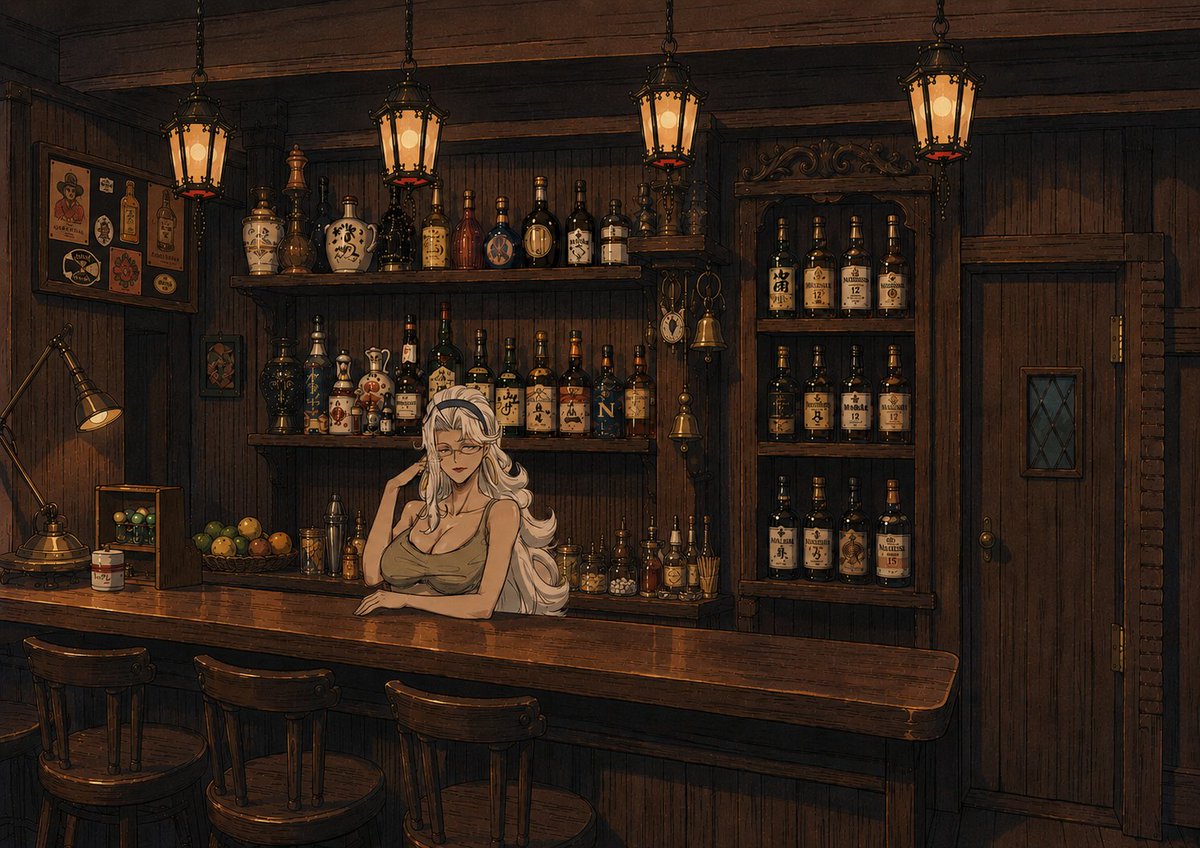
Create a richly detailed anime-style illustration of a cozy vintage wooden bar interior at night, viewed in wide landscape composition from the customer side of the counter. The scene features {argument name="character name" default="an elegant young barmaid"} sitting behind the polished L-shaped wooden bar, leaning on one elbow with one hand near her cheek, wearing a loose olive camisole and a pale headband, with {argument name="hair color" default="long wavy platinum-blonde hair"} cascading over her shoulders; her face is softly obscured and featureless, as if intentionally blurred. Use warm amber lighting from exactly 4 hanging lanterns suspended from dark ceiling beams, creating cohesive golden highlights and shadows across the character, bottles, shelves, counter, and wood-paneled walls. Include exactly 3 round wooden bar stools in the foreground. Behind the character, show a dense back bar with exactly 3 main horizontal bottle shelves on the left, 1 tall ornate bottle cabinet on the right with 3 shelves, and about 55 visible liquor bottles total, mixing whiskey, sake, ceramic flasks, decanters, and small labeled glass bottles. Add bar accessories on the counter and shelves: 1 brass desk lamp on the far left, 1 small gumball or candy box, 1 bowl of citrus fruit with oranges and limes, cocktail shakers, small jars, straws, bells, and hanging utensils. On the left wall include framed vintage alcohol posters and labels; on the right include a closed wooden door with a small diamond-pattern glass window and brass hinges. Render in a hand-drawn cinematic anime background style with intricate linework, dark brown wood grain, realistic perspective, warm reflections on varnished surfaces, nostalgic speakeasy atmosphere, high detail, integrated character-and-background lighting, no modern objects, no text overlays.