Case Media
Case Notes
This page keeps the media, full prompt, and original source together so you can inspect the result first and decide whether the prompt is worth copying, saving, or comparing.
Case Insights
To make this page easier to search, cite, and reuse later, the case is also broken down into practical guidance about usage, visual cues, and prompt structure.
Best Fit Scenarios
- Use this as a character design benchmark when you need a fast style baseline before rewriting your own prompt.
- It is especially helpful if your target overlaps with Fashion, Illustration, Character and you want to judge the image result before tuning wording.
- Keep it as a control sample when you compare nearby prompt variants one variable at a time.
Visual Signals To Notice
- The clearest style signals here are Fashion, Illustration, Character, so those should usually stay in your first rewrite.
- Look at silhouette, costume language, mood styling, and whether the character reads clearly at a glance.
- This case keeps one primary output, so the first image should be treated as the main visual reference.
How The Prompt Is Structured
- The prompt reads as a long, highly specified prompt, which is useful when you want to judge how much specificity this direction needs.
- Its keyword cluster is centered on Fashion, Illustration, Character, so you can usually keep that cluster while swapping subject, camera, layout, or copy details.
- A practical rewrite path is: keep the outcome, keep the strongest style cues, then replace only the subject and environment blocks.
Good Follow-up Questions
- What changes first if you keep Fashion, Illustration, Character but switch the subject matter?
- Which part of the result comes from section-level structure (Character Design) versus tag-level style cues?
- Which related cases in the same section give you a cleaner or more extreme variation of the same direction?
Full Prompt
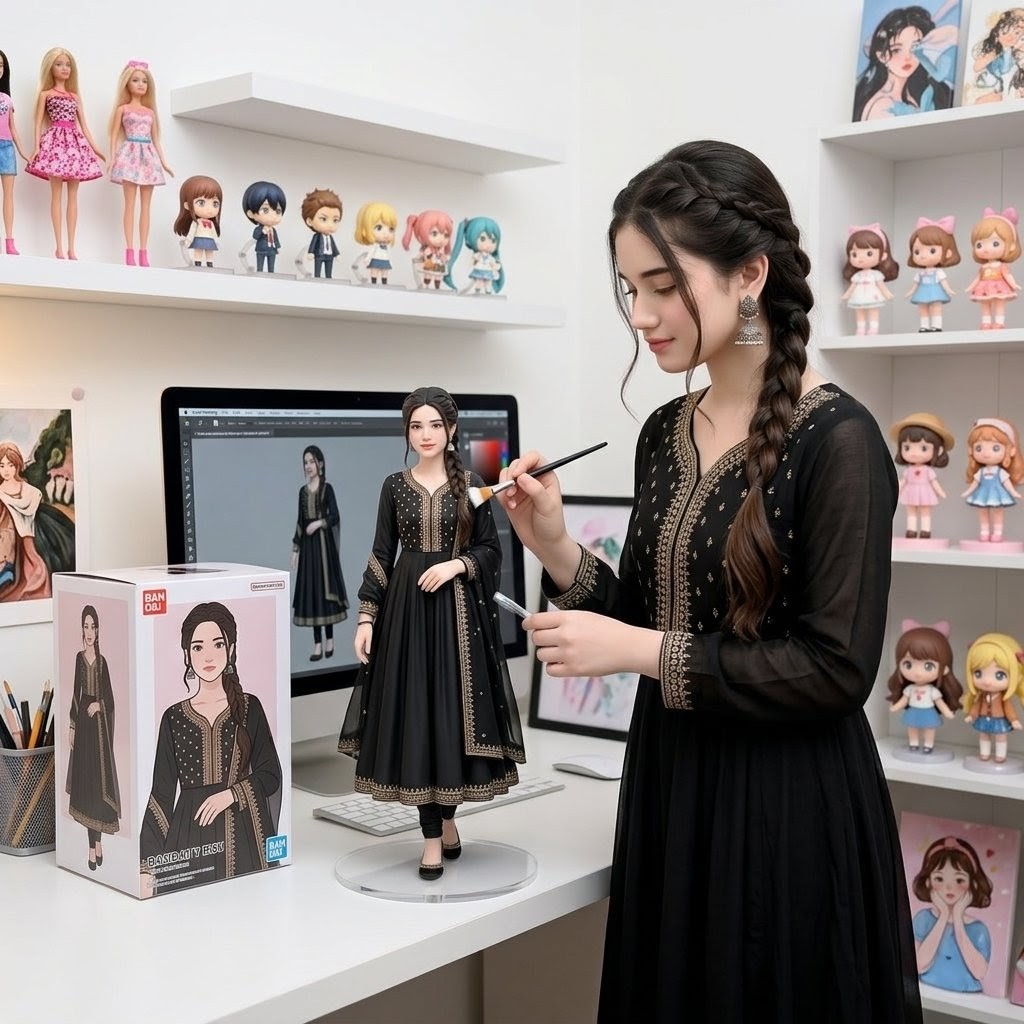
Create a realistic square commercial product-photo scene showing a custom 1/7 scale figurine of {argument name="character name" default="a young woman in a black embroidered traditional dress"} displayed on a white computer desk in a bright collector's studio. The life-size real person stands to the right of the desk, matching the figurine exactly: long dark brown hair in a thick side braid, black ankle-length dress with sheer sleeves, gold embroidered trim, black leggings, black shoes, and dangling earrings; her face is softly privacy-blurred. She holds a thin paintbrush in one hand and a small tool or stylus in the other, posed as if touching up the figurine. The figurine stands centered on a round transparent acrylic base, wearing the same outfit and hairstyle, with a softly blurred face, realistic PVC collectible finish, fine fabric texture, and detailed gold trim. On the desk to the left is a retail figure box with a large front window and printed full-body artwork of the same character, styled like a commercial toy package with small logo blocks and the product name {argument name="box product name" default="BASHEEQA DOLL"}. Behind the figurine is a desktop monitor showing digital character-art software with a full-body reference of the same woman. Include exactly 2 desk art/office objects besides the box, monitor, keyboard, and figurine: a mesh pencil cup filled with pencils and brushes, and a framed illustration leaning near the monitor. The room has white walls, white floating shelves, and a clean pastel collector aesthetic. Count and include exactly 18 visible shelf collectibles/art pieces: on the upper left shelf, 2 tall fashion dolls in pink dresses and 6 small chibi/anime figures; on the upper right wall/shelf area, 2 framed anime-girl prints and 3 small dolls in pastel dresses; on the middle right shelf, 2 small pastel dolls; on the lower right shelf, 2 small dolls with oversized heads; on the bottom right, 1 framed princess-style illustration. Use soft daylight, shallow depth of field, realistic camera perspective, crisp product details, subtle bokeh on background toys, and no extra text beyond the toy-box branding.