Case Media
Case Notes
This page keeps the media, full prompt, and original source together so you can inspect the result first and decide whether the prompt is worth copying, saving, or comparing.
Case Insights
To make this page easier to search, cite, and reuse later, the case is also broken down into practical guidance about usage, visual cues, and prompt structure.
Best Fit Scenarios
- Use this as a character design benchmark when you need a fast style baseline before rewriting your own prompt.
- It is especially helpful if your target overlaps with Poster, Illustration, Character and you want to judge the image result before tuning wording.
- Keep it as a control sample when you compare nearby prompt variants one variable at a time.
Visual Signals To Notice
- The clearest style signals here are Poster, Illustration, Character, so those should usually stay in your first rewrite.
- Look at silhouette, costume language, mood styling, and whether the character reads clearly at a glance.
- This case keeps one primary output, so the first image should be treated as the main visual reference.
How The Prompt Is Structured
- The prompt reads as a long, highly specified prompt, which is useful when you want to judge how much specificity this direction needs.
- Its keyword cluster is centered on Poster, Illustration, Character, so you can usually keep that cluster while swapping subject, camera, layout, or copy details.
- A practical rewrite path is: keep the outcome, keep the strongest style cues, then replace only the subject and environment blocks.
Good Follow-up Questions
- What changes first if you keep Poster, Illustration, Character but switch the subject matter?
- Which part of the result comes from section-level structure (Character Design) versus tag-level style cues?
- Which related cases in the same section give you a cleaner or more extreme variation of the same direction?
Full Prompt
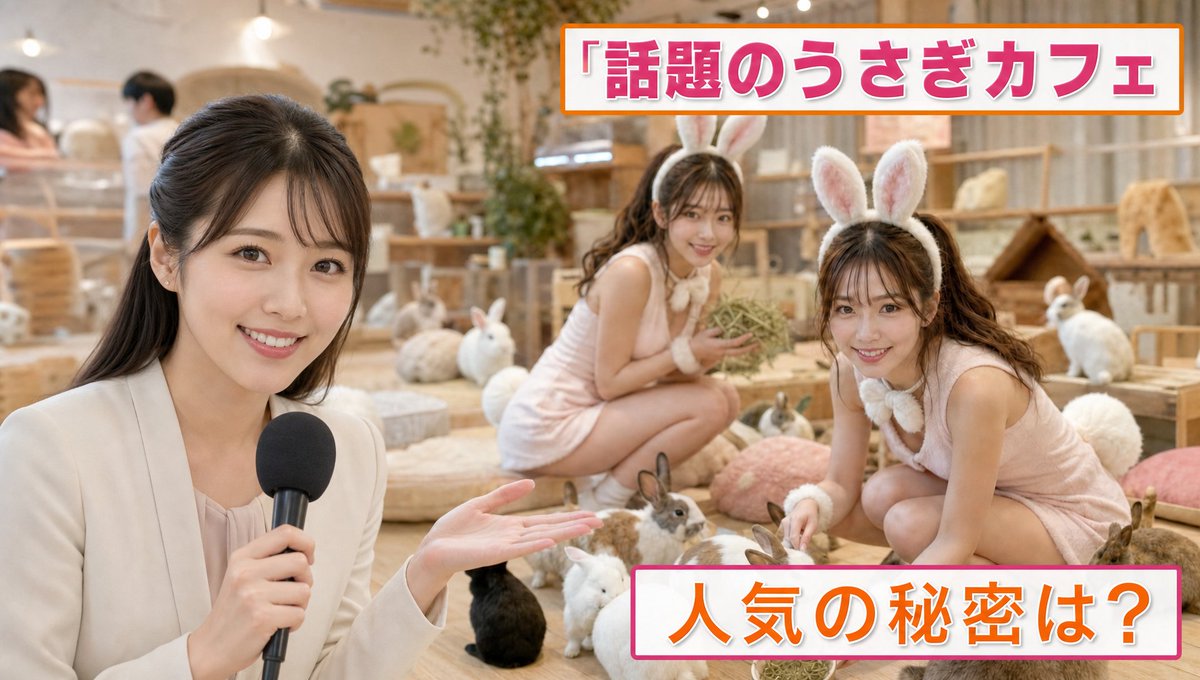
Maintain the twin characters from the reference image, realistic live-action style, a Japanese television information program feature titled "{argument name="special feature name" default="Popular Rabbit Cafe Feature"}." Bright and lovely popular rabbit cafe interior. In the foreground, a reporter is smiling and introducing the shop to the camera. News/information program style telop design. The words "{argument name="title" default="Popular Rabbit Cafe"}" are displayed at the top of the screen, and "{argument name="subtitle" default="What is the secret to its popularity?"}" at the bottom. Soft color scheme of white, pink, and orange, layout like an actual TV broadcast. No corporate logos or real store names. Inside the shop, many real rabbits are spending their time freely. Wooden huts, hay, cushions, soft lighting, a healing space. Among them, the twins from the reference image are naturally mixed in wearing "rabbit cosplay." Light rabbit cosplay such as long rabbit ear headbands, fluffy white tails, and soft rabbit-style costumes. Both are naturally relaxing with the real rabbits on the floor or cushions. One is crouching down surrounded by rabbits, and the other is blending into the surroundings while holding hay. At first, it looks like a normal rabbit cafe introduction, but upon closer inspection, it's a comical composition where the twins, though human, naturally blend in with the rabbits and stand out strangely. The reporter is introducing seriously. Natural video feel of a TV broadcast camera, shallow depth of field, warm interior lighting, realistic rabbit fur, realistic skin texture, documentary style, photoreal, ultra-high definition, realistic TV program quality.