Case Media
Case Notes
This page keeps the media, full prompt, and original source together so you can inspect the result first and decide whether the prompt is worth copying, saving, or comparing.
Case Insights
To make this page easier to search, cite, and reuse later, the case is also broken down into practical guidance about usage, visual cues, and prompt structure.
Best Fit Scenarios
- Use this as a character design benchmark when you need a fast style baseline before rewriting your own prompt.
- It is especially helpful if your target overlaps with Cinematic, Illustration, Character and you want to judge the image result before tuning wording.
- Keep it as a control sample when you compare nearby prompt variants one variable at a time.
Visual Signals To Notice
- The clearest style signals here are Cinematic, Illustration, Character, so those should usually stay in your first rewrite.
- Look at silhouette, costume language, mood styling, and whether the character reads clearly at a glance.
- This case keeps one primary output, so the first image should be treated as the main visual reference.
How The Prompt Is Structured
- The prompt reads as a long, highly specified prompt, which is useful when you want to judge how much specificity this direction needs.
- Its keyword cluster is centered on Cinematic, Illustration, Character, so you can usually keep that cluster while swapping subject, camera, layout, or copy details.
- A practical rewrite path is: keep the outcome, keep the strongest style cues, then replace only the subject and environment blocks.
Good Follow-up Questions
- What changes first if you keep Cinematic, Illustration, Character but switch the subject matter?
- Which part of the result comes from section-level structure (Character Design) versus tag-level style cues?
- Which related cases in the same section give you a cleaner or more extreme variation of the same direction?
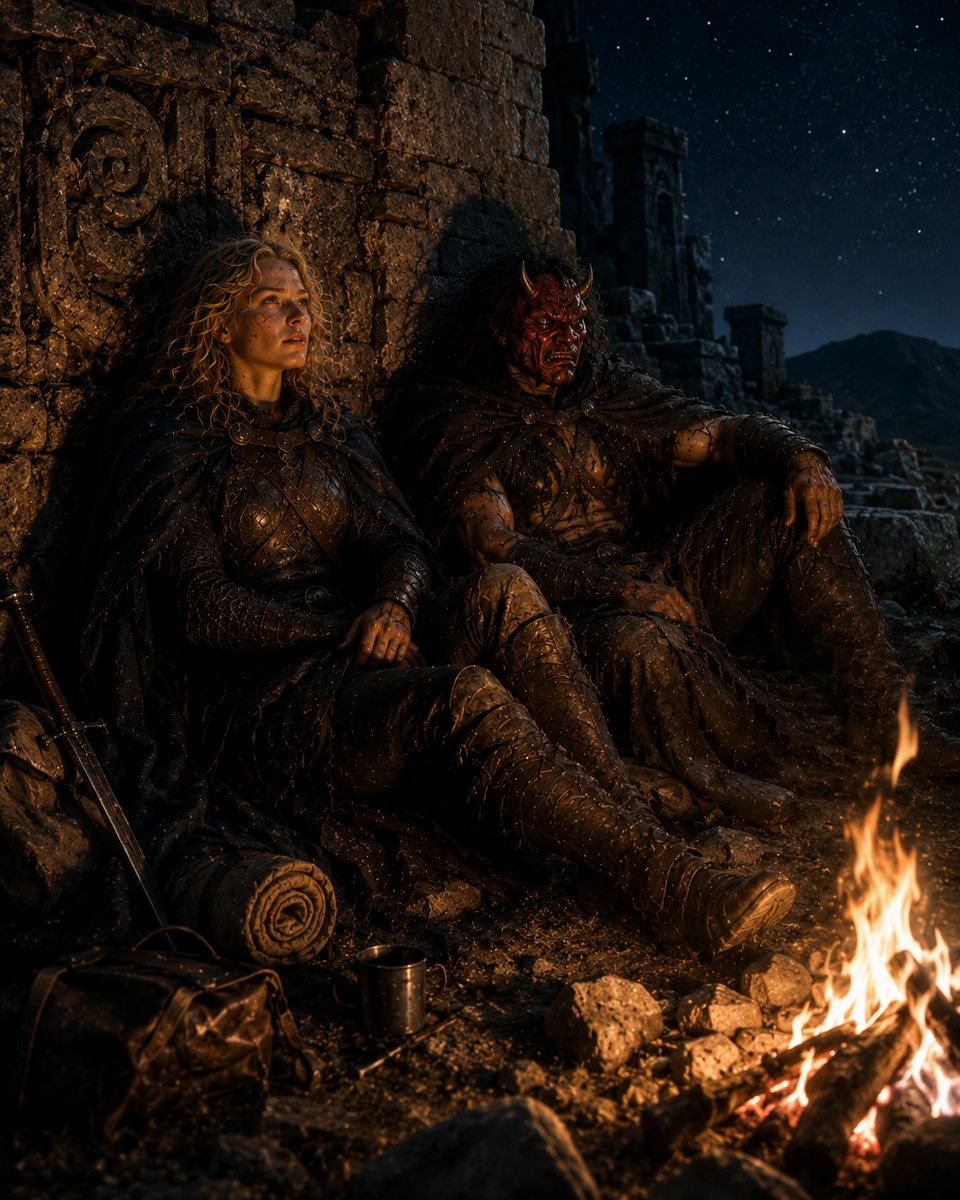
Full Prompt
Create a dark cinematic fantasy travel scene titled by mood only, with {argument name="number of travelers" default="two"} weary adventurers resting at night beside a small campfire in ancient stone ruins. The scene contains exactly two seated figures: on the left, a blond curly-haired female warrior in dark weathered leather armor and a black cloak, leaning against a carved stone wall; on the right, a large rugged barbarian companion with wild dark hair and heavy fur-and-leather armor, reclining with one arm draped over a raised knee. Their faces should be hidden in deep shadow or intentionally obscured, while their armor, hands, boots, and cloaks catch warm orange firelight. Place them against crumbling medieval ruins with rough stacked blocks, spiral stone carvings, broken towers, stairs, and jagged silhouettes. The foreground contains exactly four travel objects: one sheathed sword leaning against the wall at left, one rolled bedroll near the warriors' feet, one dark leather satchel on the ground, and one small metal cup reflecting the fire. In the lower right foreground, show one bright campfire made of burning logs and surrounded by scattered stones, casting sparks and glowing embers across muddy ground. Use a deep blue-black starry sky with distant mountains in the background, strong chiaroscuro lighting, wet gritty textures, ash and dust on the clothing, realistic medieval fantasy costume design, dramatic low-key photography, shallow atmospheric haze, high detail, vertical composition, no modern objects, no readable text.