Case Media
Case Notes
This page keeps the media, full prompt, and original source together so you can inspect the result first and decide whether the prompt is worth copying, saving, or comparing.
Case Insights
To make this page easier to search, cite, and reuse later, the case is also broken down into practical guidance about usage, visual cues, and prompt structure.
Best Fit Scenarios
- Use this as a character design benchmark when you need a fast style baseline before rewriting your own prompt.
- It is especially helpful if your target overlaps with 35mm, Neon, Cinematic and you want to judge the image result before tuning wording.
- Keep it as a control sample when you compare nearby prompt variants one variable at a time.
Visual Signals To Notice
- The clearest style signals here are 35mm, Neon, Cinematic, so those should usually stay in your first rewrite.
- Look at silhouette, costume language, mood styling, and whether the character reads clearly at a glance.
- This case keeps one primary output, so the first image should be treated as the main visual reference.
How The Prompt Is Structured
- The prompt reads as a long, highly specified prompt, which is useful when you want to judge how much specificity this direction needs.
- Its keyword cluster is centered on 35mm, Neon, Cinematic, so you can usually keep that cluster while swapping subject, camera, layout, or copy details.
- A practical rewrite path is: keep the outcome, keep the strongest style cues, then replace only the subject and environment blocks.
Good Follow-up Questions
- What changes first if you keep 35mm, Neon, Cinematic but switch the subject matter?
- Which part of the result comes from section-level structure (Character Design) versus tag-level style cues?
- Which related cases in the same section give you a cleaner or more extreme variation of the same direction?
Full Prompt
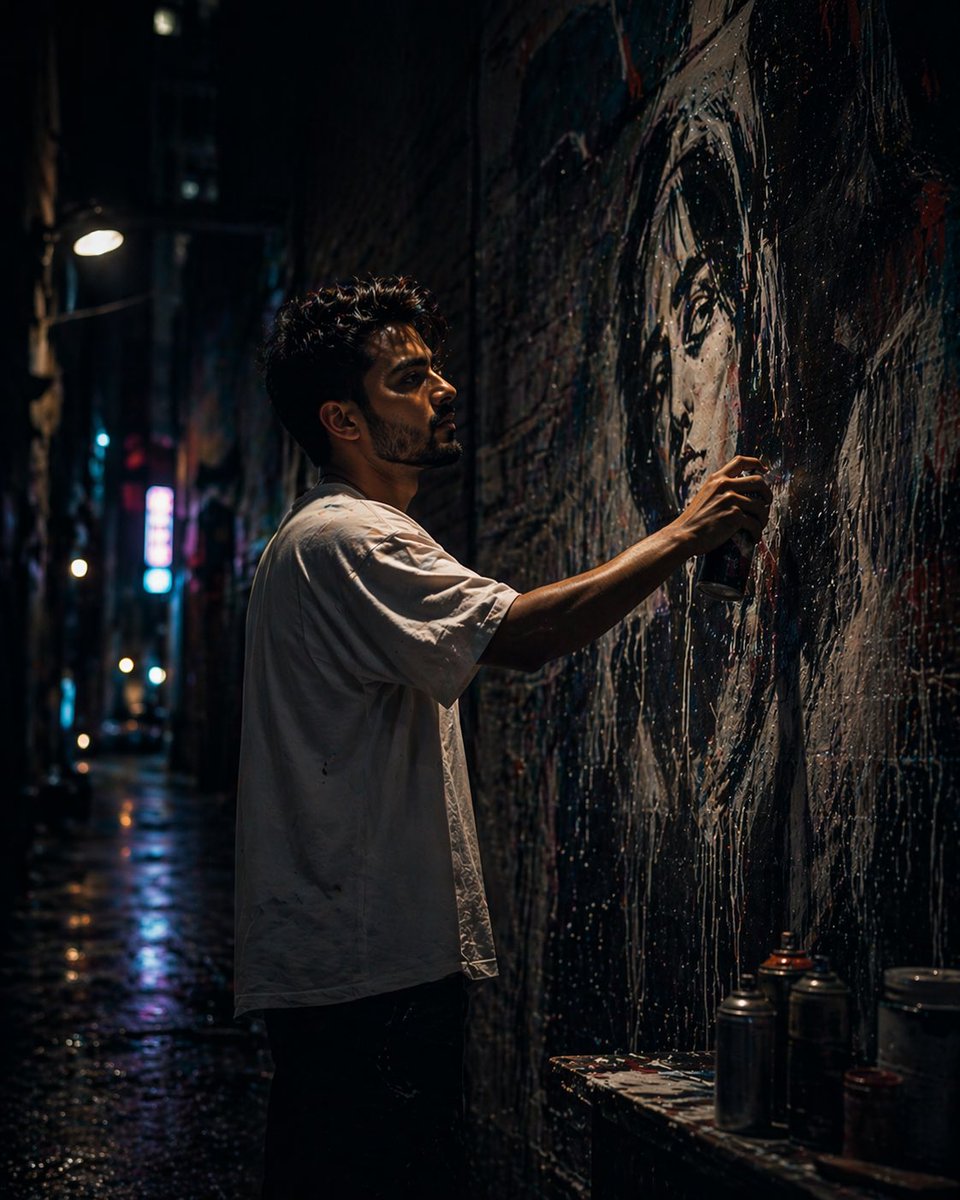
A cinematic, ultra-realistic night scene of a {argument name="artist" default="young male street artist"} painting a large-scale {argument name="mural subject" default="mural of a woman’s face"} in a {argument name="setting" default="narrow urban alley"}. The camera angle is slightly low, creating a dramatic, powerful perspective. The artist has medium-length, slightly messy dark hair and light stubble or a short beard, giving him a rugged, creative look. He wears a loose white t-shirt and casual jeans, slightly oversized, with a relaxed streetwear vibe. His posture is focused and engaged as he stands close to the wall, actively spray-painting. He is creating a massive, hyper-realistic mural of a woman’s face on a textured brick wall. The mural is incredibly detailed—smooth skin tones, realistic lighting, expressive eyes, and glossy lips—appearing almost like a photograph. Fine mist from the spray paint is visible in the air, catching light and adding motion and atmosphere. The setting is a narrow urban alley at night, surrounded by tall buildings. The environment is gritty and textured—aged brick walls, paint splashes, subtle grime, and urban wear. Neon signs and distant streetlights cast vibrant reflections in teal, magenta, and blue tones, creating a cinematic, slightly cyberpunk mood. Lighting is dramatic and layered: cool ambient light fills the alley, while warmer neon highlights create contrast. A subtle rim light outlines the artist’s silhouette, separating him from the dark background. The mural is partially illuminated, acting as a strong focal point. Atmosphere includes light fog or mist, enhancing depth and making the lighting glow softly. The scene feels immersive, quiet, and artistically intense. Depth of field is moderately shallow: the artist and mural are in sharp focus, while the background fades into soft blur with bokeh highlights. Style: hyper-realistic, cinematic photography, street art aesthetic, ultra-detailed textures, high dynamic range, subtle film grain. Camera details: 35mm or 50mm lens, f/1.8–f/2.8 aperture, low-light photography, slight low-angle shot, natural perspective. Composition: vertical frame (4:5 or 9:16), subject slightly off-center, mural dominating the frame for strong visual storytelling. Generate image using uploaded image as reference