Case Media
Case Notes
This page keeps the media, full prompt, and original source together so you can inspect the result first and decide whether the prompt is worth copying, saving, or comparing.
Case Insights
To make this page easier to search, cite, and reuse later, the case is also broken down into practical guidance about usage, visual cues, and prompt structure.
Best Fit Scenarios
- Use this as a character design benchmark when you need a fast style baseline before rewriting your own prompt.
- It is especially helpful if your target overlaps with 35mm, Cinematic, Illustration and you want to judge the image result before tuning wording.
- Keep it as a control sample when you compare nearby prompt variants one variable at a time.
Visual Signals To Notice
- The clearest style signals here are 35mm, Cinematic, Illustration, so those should usually stay in your first rewrite.
- Look at silhouette, costume language, mood styling, and whether the character reads clearly at a glance.
- This case keeps one primary output, so the first image should be treated as the main visual reference.
How The Prompt Is Structured
- The prompt reads as a long, highly specified prompt, which is useful when you want to judge how much specificity this direction needs.
- Its keyword cluster is centered on 35mm, Cinematic, Illustration, so you can usually keep that cluster while swapping subject, camera, layout, or copy details.
- A practical rewrite path is: keep the outcome, keep the strongest style cues, then replace only the subject and environment blocks.
Good Follow-up Questions
- What changes first if you keep 35mm, Cinematic, Illustration but switch the subject matter?
- Which part of the result comes from section-level structure (Character Design) versus tag-level style cues?
- Which related cases in the same section give you a cleaner or more extreme variation of the same direction?
Full Prompt
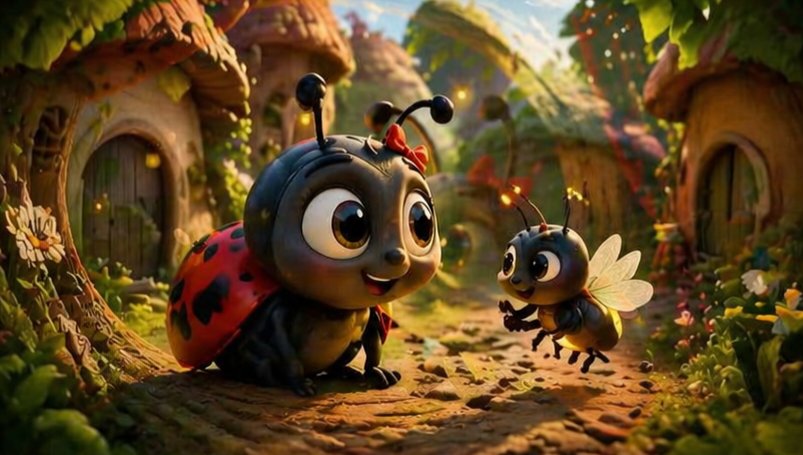
A heartwarming stylized 3D animated forest village scene at golden hour, showing 2 adorable insect characters meeting on a cobblestone path between tiny mushroom-roof cottages. In the left foreground, a cute {argument name="main insect type" default="ladybug"} crouches low with an oversized glossy black head, huge expressive brown eyes, a small smiling mouth, short antennae with rounded tips, and a tiny {argument name="accessory color" default="red"} bow near one antenna. Its shell is bright {argument name="shell color" default="red"} with distinct black spots, and its body is dark charcoal black with soft rounded limbs. In the right midground, a cheerful small {argument name="second insect type" default="bee"} hovers slightly above the ground facing the larger insect, with a similarly oversized head, big sparkling eyes, delicate translucent wings, tiny antennae, and little forelegs lifted as if speaking excitedly. The setting is an enchanted bug-sized woodland hamlet with 3 visible cottages, rounded wooden doors, curved stone walls, moss, vines, flowers, and leafy plants framing the path. Warm cinematic sunlight filters through the trees from the upper right, creating glowing rim light, soft bokeh, and floating firefly-like particles. Use a shallow depth of field, low camera angle at insect eye level, rich autumn-green and golden tones, highly detailed textures, soft global illumination, whimsical family-film mood, Pixar-like stylized realism, and a subtle dreamy double-exposure feel with faint overlapping light or ghosted highlights in parts of the frame.