Case Media
Case Notes
This page keeps the media, full prompt, and original source together so you can inspect the result first and decide whether the prompt is worth copying, saving, or comparing.
Case Insights
To make this page easier to search, cite, and reuse later, the case is also broken down into practical guidance about usage, visual cues, and prompt structure.
Best Fit Scenarios
- Use this as a character design benchmark when you need a fast style baseline before rewriting your own prompt.
- It is especially helpful if your target overlaps with Cinematic, Illustration, Character and you want to judge the image result before tuning wording.
- Keep it as a control sample when you compare nearby prompt variants one variable at a time.
Visual Signals To Notice
- The clearest style signals here are Cinematic, Illustration, Character, so those should usually stay in your first rewrite.
- Look at silhouette, costume language, mood styling, and whether the character reads clearly at a glance.
- This case keeps one primary output, so the first image should be treated as the main visual reference.
How The Prompt Is Structured
- The prompt reads as a long, highly specified prompt, which is useful when you want to judge how much specificity this direction needs.
- Its keyword cluster is centered on Cinematic, Illustration, Character, so you can usually keep that cluster while swapping subject, camera, layout, or copy details.
- A practical rewrite path is: keep the outcome, keep the strongest style cues, then replace only the subject and environment blocks.
Good Follow-up Questions
- What changes first if you keep Cinematic, Illustration, Character but switch the subject matter?
- Which part of the result comes from section-level structure (Character Design) versus tag-level style cues?
- Which related cases in the same section give you a cleaner or more extreme variation of the same direction?
Full Prompt
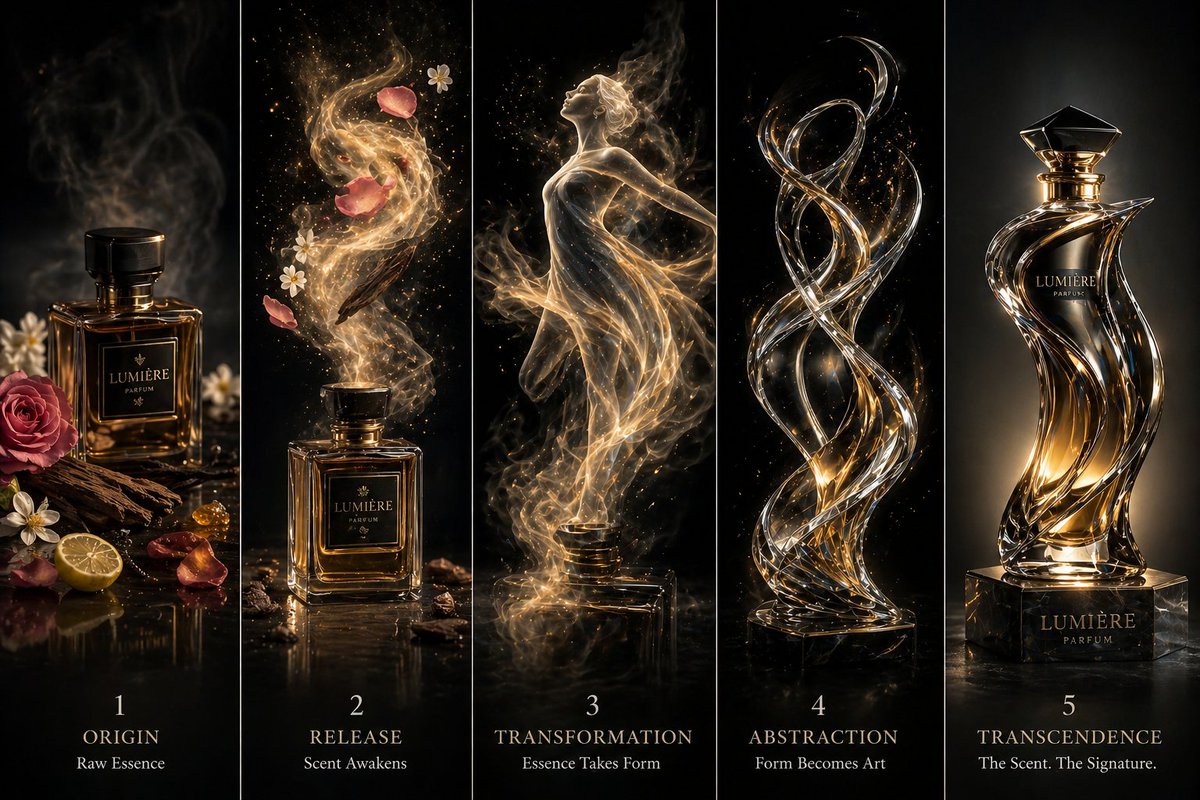
A high-end cinematic transformation artwork displayed in five vertical panels, showing a {argument name="subject" default="luxury perfume"} evolving from raw essence into a sculptural masterpiece, each panel separated by thin black dividers. Panel 1 (Origin): A premium glass perfume bottle resting on a dark reflective surface, surrounded by {argument name="ingredients" default="raw ingredients like rose petals, oud wood, citrus peel, and mist"}, soft studio lighting, elegant shadows. Panel 2 (Release): The perfume begins to diffuse into the air, visible fragrant mist swirling upward in fluid motion, forming soft organic shapes, glowing particles and vapor trails. Panel 3 (Transformation): The mist starts shaping into a semi-formed silhouette (abstract human figure or flowing fabric), blending liquid, vapor, and light, luminous and dreamy. Panel 4 (Abstraction): The form becomes fully abstract — flowing ribbons of scent turning into sleek glass-like curves and fluid geometry, dynamic motion frozen mid-air. Panel 5 (Transcendence): Final form — a luxurious sculptural perfume bottle or abstract glass statue inspired by the scent’s essence, polished, reflective, with glowing highlights, sitting on a minimal pedestal. Style: ultra-detailed, photorealistic to abstract progression, deep black background, {argument name="accents" default="gold and silver accents"}, soft glow, high contrast lighting, glossy reflections, cinematic luxury aesthetic, perfume ad style, 4K quality, sharp focus.