Case Media
Case Notes
This page keeps the media, full prompt, and original source together so you can inspect the result first and decide whether the prompt is worth copying, saving, or comparing.
Case Insights
To make this page easier to search, cite, and reuse later, the case is also broken down into practical guidance about usage, visual cues, and prompt structure.
Best Fit Scenarios
- Use this as a character design benchmark when you need a fast style baseline before rewriting your own prompt.
- It is especially helpful if your target overlaps with Poster, Illustration, Character and you want to judge the image result before tuning wording.
- Keep it as a control sample when you compare nearby prompt variants one variable at a time.
Visual Signals To Notice
- The clearest style signals here are Poster, Illustration, Character, so those should usually stay in your first rewrite.
- Look at silhouette, costume language, mood styling, and whether the character reads clearly at a glance.
- This case keeps one primary output, so the first image should be treated as the main visual reference.
How The Prompt Is Structured
- The prompt reads as a long, highly specified prompt, which is useful when you want to judge how much specificity this direction needs.
- Its keyword cluster is centered on Poster, Illustration, Character, so you can usually keep that cluster while swapping subject, camera, layout, or copy details.
- A practical rewrite path is: keep the outcome, keep the strongest style cues, then replace only the subject and environment blocks.
Good Follow-up Questions
- What changes first if you keep Poster, Illustration, Character but switch the subject matter?
- Which part of the result comes from section-level structure (Character Design) versus tag-level style cues?
- Which related cases in the same section give you a cleaner or more extreme variation of the same direction?
Full Prompt
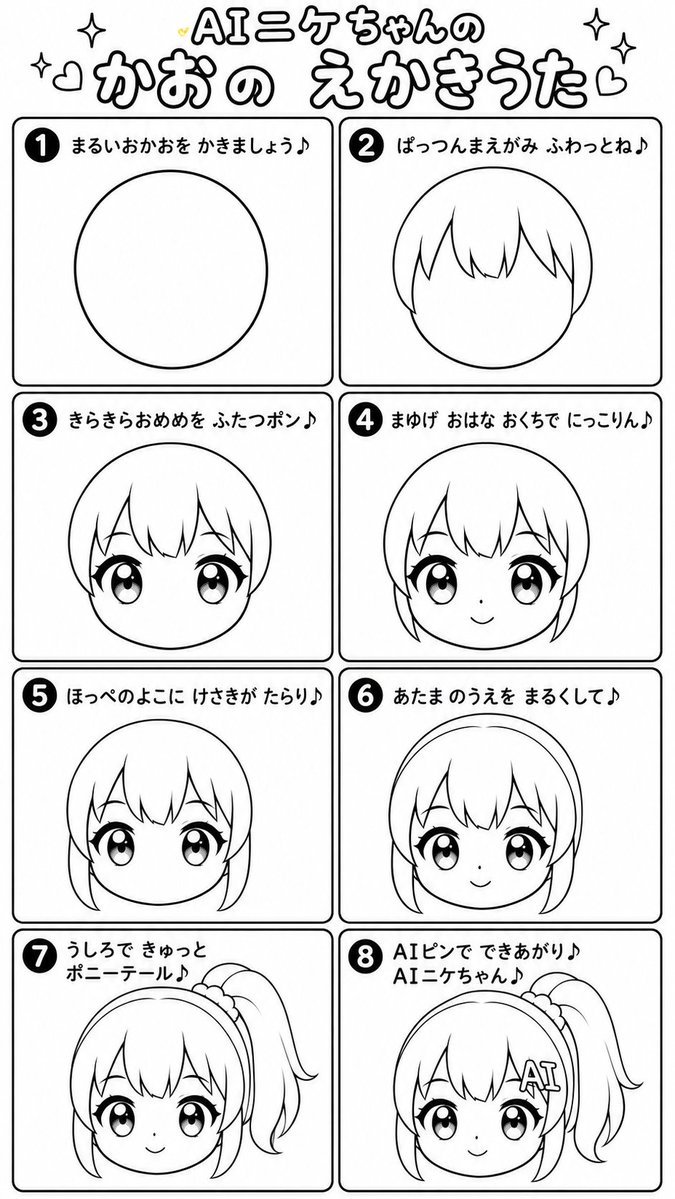
Goal: Create a black-and-white Japanese chibi drawing-song manga worksheet titled {argument name="title text" default="AI Nike-chan's Face Drawing Song"}, showing a step-by-step guide for drawing a cute simplified anime girl face.Canvas: Tall vertical poster, approximately 2:3 aspect ratio, white background, clean monochrome line art. Use thick rounded black outlines, playful handwritten Japanese typography, and a kawaii instructional-comic style. Add small decorative sparkles, hearts, and tiny yellow accent hearts around the title.Layout: Top title area, then an 8-panel grid arranged as 2 columns by 4 rows. Each panel has a rounded rectangle border, a black circular step number badge in the upper-left corner, and a short Japanese lyric caption across the top. The drawing inside each panel gradually becomes more complete.Text content: Use exactly 8 numbered captions:1. {argument name="step 1 caption" default="Let's draw a round face♪"}2. {argument name="step 2 caption" default="Straight bangs, nice and fluffy♪"}3. {argument name="step 3 caption" default="Two sparkling eyes, pop-pop♪"}4. {argument name="step 4 caption" default="Eyebrows, nose, and a smiling mouth♪"}5. {argument name="step 5 caption" default="Hair ends falling by the cheeks♪"}6. {argument name="step 6 caption" default="Make the top of the head round♪"}7. {argument name="step 7 caption" default="Tie it tight in a ponytail at the back♪"}8. {argument name="step 8 caption" default="Finished with an AI pin♪ AI Nike-chan♪"}Panel details: Panel 1 shows only a large simple oval/circle face outline centered. Panel 2 adds rounded bob-like hair with straight bangs and pointed locks over the face circle. Panel 3 adds two large sparkling anime eyes with heavy upper lashes and highlights. Panel 4 shows the same head but the lower central drawing area is covered by a large pale gray vertical rectangular blur, obscuring the facial details; only the upper head outline is visible behind it. Panel 5 shows the face with bangs, big eyes, and two side hair strands falling beside the cheeks. Panel 6 adds a rounded outer head/hair outline above the face plus small eyebrows, tiny nose, and smiling mouth. Panel 7 adds a high side ponytail on the upper right with a scrunchie-like band, but the center and lower face are obscured by a large gray gradient rectangle. Panel 8 shows the near-final head with side ponytail and scrunchie, but the central face/lower area is obscured by a similar large gray gradient rectangle.Visual style: crisp manga coloring-book line art, no color fills except black outlines and minimal yellow heart accents near the title; thick friendly strokes, rounded corners, cute educational worksheet look. Keep the drawings simple, deformed, and childlike, as if for a drawing-song tutorial.Constraints: Use exactly 8 panels and exactly one step number per panel. Preserve the Japanese text as written. Do not add extra panels, extra characters, background scenery, watermarks, or