Case Media
Case Notes
This page keeps the media, full prompt, and original source together so you can inspect the result first and decide whether the prompt is worth copying, saving, or comparing.
Case Insights
To make this page easier to search, cite, and reuse later, the case is also broken down into practical guidance about usage, visual cues, and prompt structure.
Best Fit Scenarios
- Use this as a character design benchmark when you need a fast style baseline before rewriting your own prompt.
- It is especially helpful if your target overlaps with Cinematic, Illustration, Character and you want to judge the image result before tuning wording.
- Keep it as a control sample when you compare nearby prompt variants one variable at a time.
Visual Signals To Notice
- The clearest style signals here are Cinematic, Illustration, Character, so those should usually stay in your first rewrite.
- Look at silhouette, costume language, mood styling, and whether the character reads clearly at a glance.
- This case keeps one primary output, so the first image should be treated as the main visual reference.
How The Prompt Is Structured
- The prompt reads as a long, highly specified prompt, which is useful when you want to judge how much specificity this direction needs.
- Its keyword cluster is centered on Cinematic, Illustration, Character, so you can usually keep that cluster while swapping subject, camera, layout, or copy details.
- A practical rewrite path is: keep the outcome, keep the strongest style cues, then replace only the subject and environment blocks.
Good Follow-up Questions
- What changes first if you keep Cinematic, Illustration, Character but switch the subject matter?
- Which part of the result comes from section-level structure (Character Design) versus tag-level style cues?
- Which related cases in the same section give you a cleaner or more extreme variation of the same direction?
Full Prompt
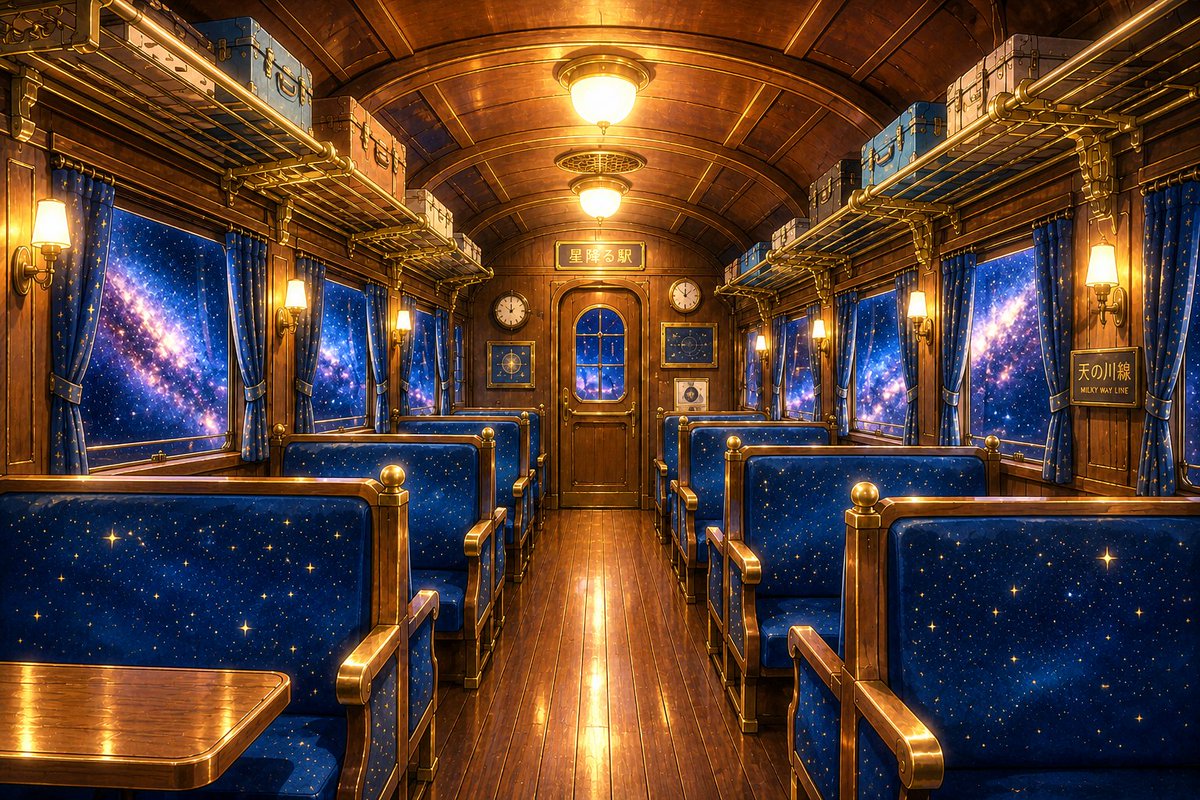
Create a highly detailed anime-style cinematic illustration of the interior of a retro fantasy galaxy train carriage, viewed from the center aisle in perfect one-point perspective looking toward the rear door. The scene is empty of passengers and warmly lit by glowing ceiling lamps and wall sconces, with polished varnished wood floors, curved wooden ceiling panels, brass rails, brass seat frames, and ornate vintage fittings. Use {argument name="seat fabric pattern" default="deep navy blue upholstery filled with tiny golden stars and nebula speckles"} for the seats and curtains, making the carriage feel like a celestial observatory. Show exactly 8 visible high-backed passenger bench seats arranged in two rows along the aisle, each with glossy brass armrests and rounded brass finials, plus 1 small wooden table attached at the front-left seat. Show exactly 8 large side windows, 4 on the left and 4 on the right, revealing a vivid outer-space panorama with a bright purple-blue Milky Way, dense stars, and glowing cosmic dust. Add exactly 2 long overhead luggage racks, one on each side, made of brass piping, holding exactly 9 vintage suitcases and trunks in blue, cream, and tan. At the far end, place a wooden door with a small arched window showing stars beyond it, flanked by exactly 2 round wall clocks and small framed astronomical diagrams. Include a glowing station sign above the rear door reading {argument name="rear station sign text" default="星降る駅"} and a side plaque on the right wall reading {argument name="side line sign text" default="天の川線"} with small English text beneath it reading {argument name="line subtitle" default="MILKY WAY LINE"}. The mood should be nostalgic, magical, and luxurious, like a steam-era sleeper train traveling through the galaxy; use warm amber lighting, rich reflections on wood and brass, crisp linework, elaborate background detail, no people, no modern technology, wide-angle composition, 16:9 aspect ratio.