Case Media
Case Notes
This page keeps the media, full prompt, and original source together so you can inspect the result first and decide whether the prompt is worth copying, saving, or comparing.
Case Insights
To make this page easier to search, cite, and reuse later, the case is also broken down into practical guidance about usage, visual cues, and prompt structure.
Best Fit Scenarios
- Use this as a character design benchmark when you need a fast style baseline before rewriting your own prompt.
- It is especially helpful if your target overlaps with Illustration, Character, Anime and you want to judge the image result before tuning wording.
- Keep it as a control sample when you compare nearby prompt variants one variable at a time.
Visual Signals To Notice
- The clearest style signals here are Illustration, Character, Anime, so those should usually stay in your first rewrite.
- Look at silhouette, costume language, mood styling, and whether the character reads clearly at a glance.
- This case keeps one primary output, so the first image should be treated as the main visual reference.
How The Prompt Is Structured
- The prompt reads as a long, highly specified prompt, which is useful when you want to judge how much specificity this direction needs.
- Its keyword cluster is centered on Illustration, Character, Anime, so you can usually keep that cluster while swapping subject, camera, layout, or copy details.
- A practical rewrite path is: keep the outcome, keep the strongest style cues, then replace only the subject and environment blocks.
Good Follow-up Questions
- What changes first if you keep Illustration, Character, Anime but switch the subject matter?
- Which part of the result comes from section-level structure (Character Design) versus tag-level style cues?
- Which related cases in the same section give you a cleaner or more extreme variation of the same direction?
Full Prompt
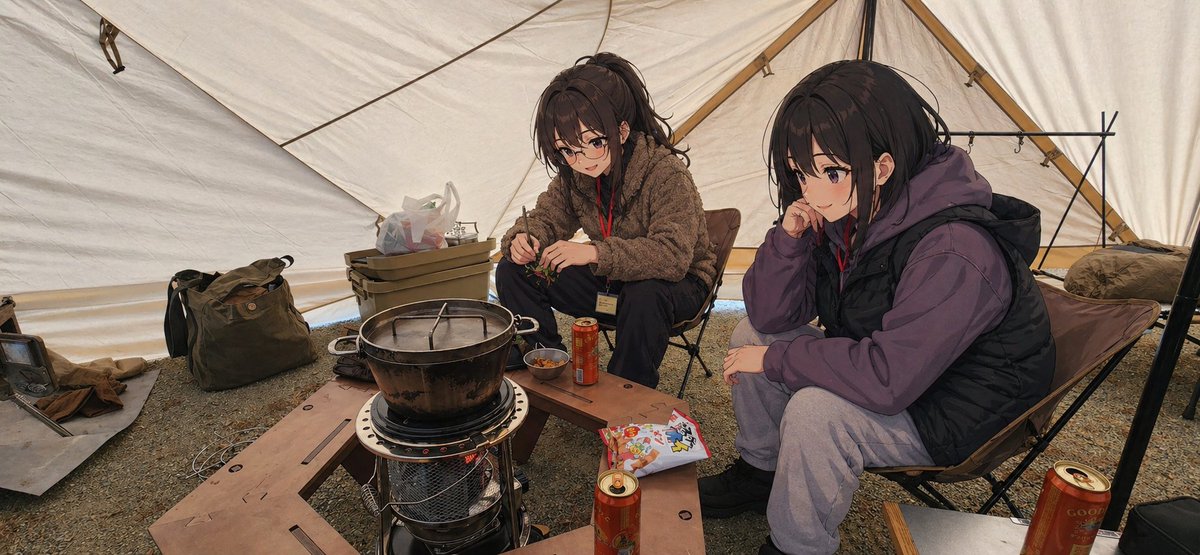
A cozy winter camping scene inside a large beige canvas tent, rendered as a semi-realistic anime illustration with natural lighting and realistic environmental detail. Show exactly 2 seated young women around a compact kerosene heater used as a camp table, with a large black metal pot resting on top. The viewpoint is a candid wide-angle photo composition from slightly above seated height, making the scene feel like a casual snapshot taken inside the tent. The woman on the left has {argument name="hair color" default="dark brown"} hair tied in a high ponytail with loose bangs, and wears a fluffy brown fleece jacket, dark pants, and a red lanyard with an ID card. She sits in a low camping chair and leans forward, using chopsticks over a small bowl or food container in her hands. The woman on the right has {argument name="hair color" default="black"} shoulder-length hair and wears a muted purple hoodie layered under a black puffer vest, light gray sweatpants, and dark shoes. She sits in another low camping chair, resting her cheek on one hand in a relaxed, sleepy pose. Keep both faces obscured by a soft rectangular blur block, as if anonymized in a posted photo. Around them, include exactly 4 red beverage cans visible in the scene: 2 on the wooden table planks near the center, 1 cropped in the lower right foreground, and 1 farther back near the right side. Build a low U-shaped arrangement of 3 wooden bench planks surrounding the heater. Add small camping details: 1 olive duffel bag on the left ground, 1 plastic storage box with supplies behind the left woman, 1 white plastic shopping bag on top of the box, 1 small bowl on the table, 1 colorful snack package on the right-side plank, 1 soft brown cloth on the far left floor, and 1 black metal rack frame standing at the back right. The tent interior should have taut canvas walls, visible seams and support poles, a gravel ground, and a warm muted color palette. Preserve the feeling of a real camping photo where only the people have been turned into anime-style characters while the setting remains highly realistic.