Case Media
Case Notes
This page keeps the media, full prompt, and original source together so you can inspect the result first and decide whether the prompt is worth copying, saving, or comparing.
Case Insights
To make this page easier to search, cite, and reuse later, the case is also broken down into practical guidance about usage, visual cues, and prompt structure.
Best Fit Scenarios
- Use this as a character design benchmark when you need a fast style baseline before rewriting your own prompt.
- It is especially helpful if your target overlaps with Portrait, Cinematic, Illustration and you want to judge the image result before tuning wording.
- Keep it as a control sample when you compare nearby prompt variants one variable at a time.
Visual Signals To Notice
- The clearest style signals here are Portrait, Cinematic, Illustration, so those should usually stay in your first rewrite.
- Look at silhouette, costume language, mood styling, and whether the character reads clearly at a glance.
- This case keeps 2 media outputs, which makes it easier to check whether the style remains stable across multiple results.
How The Prompt Is Structured
- The prompt reads as a long, highly specified prompt, which is useful when you want to judge how much specificity this direction needs.
- Its keyword cluster is centered on Portrait, Cinematic, Illustration, so you can usually keep that cluster while swapping subject, camera, layout, or copy details.
- A practical rewrite path is: keep the outcome, keep the strongest style cues, then replace only the subject and environment blocks.
Good Follow-up Questions
- What changes first if you keep Portrait, Cinematic, Illustration but switch the subject matter?
- Which part of the result comes from section-level structure (Character Design) versus tag-level style cues?
- Which related cases in the same section give you a cleaner or more extreme variation of the same direction?
Full Prompt
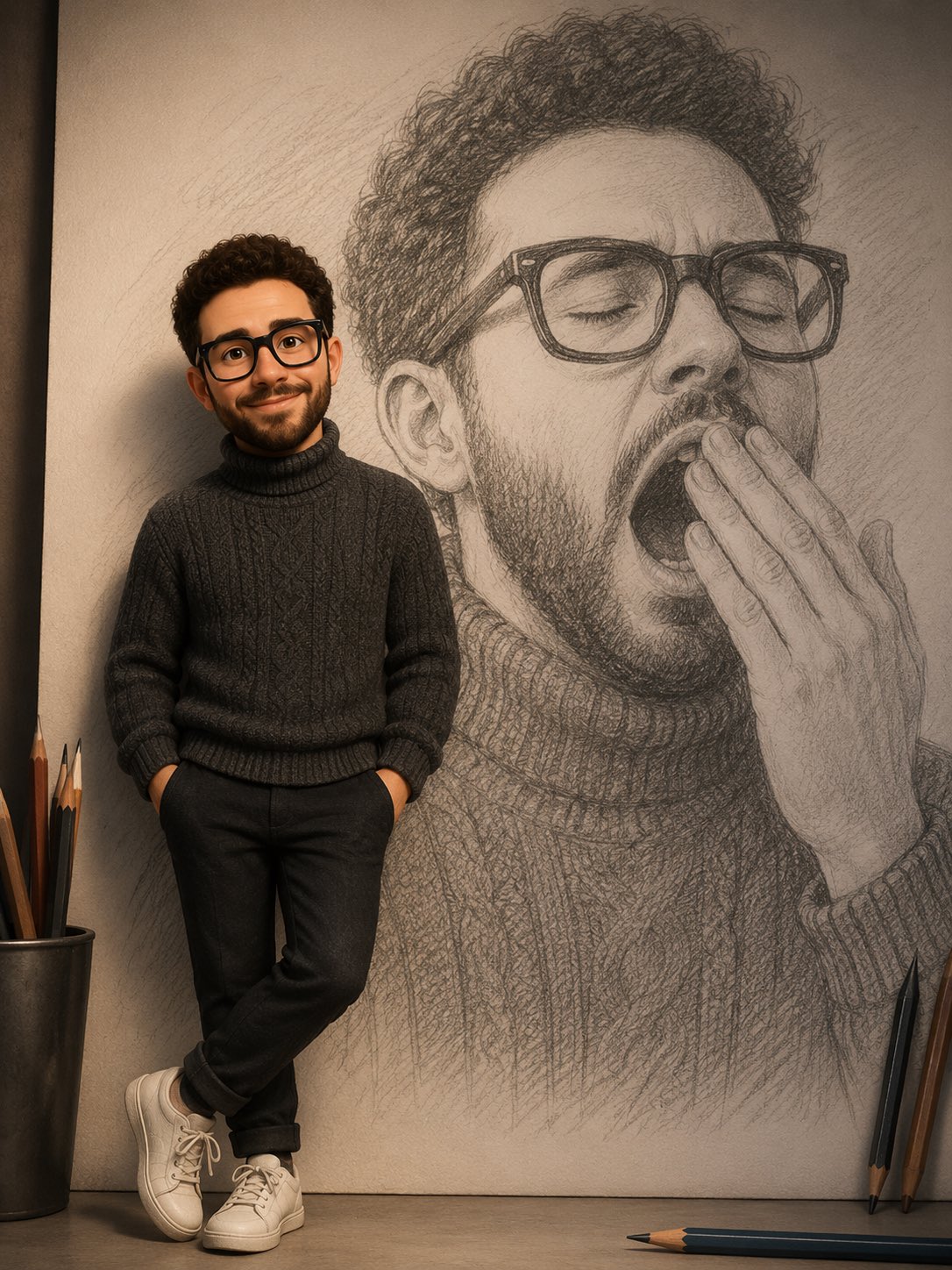
{ "prompt": "Create a premium cinematic composite artwork using the reference photo. In the background, draw a giant hand-drawn pencil illustration of the same person yawning, rendered on textured sketchbook paper with highly detailed graphite shading, realistic pencil strokes, cross-hatching, construction lines, and authentic artist sketch details. The yawning expression should be natural and expressive, with one hand partially covering the mouth. In the foreground, place a full-body 3D Pixar-style character version of the same person standing casually with hands in pockets, smiling gently, wearing the same dark cable-knit turtleneck sweater, black pants, white sneakers, curly dark hair, beard, and large black glasses. The 3D character should closely match the facial features of the reference image while maintaining high-end Pixar animation aesthetics. Soft cinematic lighting, subtle depth of field, warm studio atmosphere, realistic shadows cast onto the paper background, ultra-detailed textures, photorealistic rendering quality, clean composition, professional concept-art presentation. Include a few sketch pencils around the scene for artistic context. 8K resolution, ultra-sharp details, masterpiece quality, highly realistic lighting, vertical composition.", "negative_prompt": "low resolution, blurry, distorted face, extra fingers, extra limbs, cropped body, duplicate character, deformed anatomy, bad proportions, low-quality sketch, messy composition, oversaturated colors, cartoon background, watermark, text, logo, frame, noise, artifacts, unrealistic glasses, incorrect clothing, multiple people", "width": 1024, "height": 1365, "aspect_ratio": "3:4", "style": "Pixar 3D + Hand-Drawn Pencil Illustration", "quality": "8K", "lighting": "Soft cinematic studio lighting", "camera": { "angle": "Eye-level", "lens": "50mm portrait lens", "depth_of_field": "Shallow" } }