Case Media
Case Notes
This page keeps the media, full prompt, and original source together so you can inspect the result first and decide whether the prompt is worth copying, saving, or comparing.
Case Insights
To make this page easier to search, cite, and reuse later, the case is also broken down into practical guidance about usage, visual cues, and prompt structure.
Best Fit Scenarios
- Use this as a character design benchmark when you need a fast style baseline before rewriting your own prompt.
- It is especially helpful if your target overlaps with Illustration, Character, Minimal and you want to judge the image result before tuning wording.
- Keep it as a control sample when you compare nearby prompt variants one variable at a time.
Visual Signals To Notice
- The clearest style signals here are Illustration, Character, Minimal, so those should usually stay in your first rewrite.
- Look at silhouette, costume language, mood styling, and whether the character reads clearly at a glance.
- This case keeps one primary output, so the first image should be treated as the main visual reference.
How The Prompt Is Structured
- The prompt reads as a long, highly specified prompt, which is useful when you want to judge how much specificity this direction needs.
- Its keyword cluster is centered on Illustration, Character, Minimal, so you can usually keep that cluster while swapping subject, camera, layout, or copy details.
- A practical rewrite path is: keep the outcome, keep the strongest style cues, then replace only the subject and environment blocks.
Good Follow-up Questions
- What changes first if you keep Illustration, Character, Minimal but switch the subject matter?
- Which part of the result comes from section-level structure (Character Design) versus tag-level style cues?
- Which related cases in the same section give you a cleaner or more extreme variation of the same direction?
Full Prompt
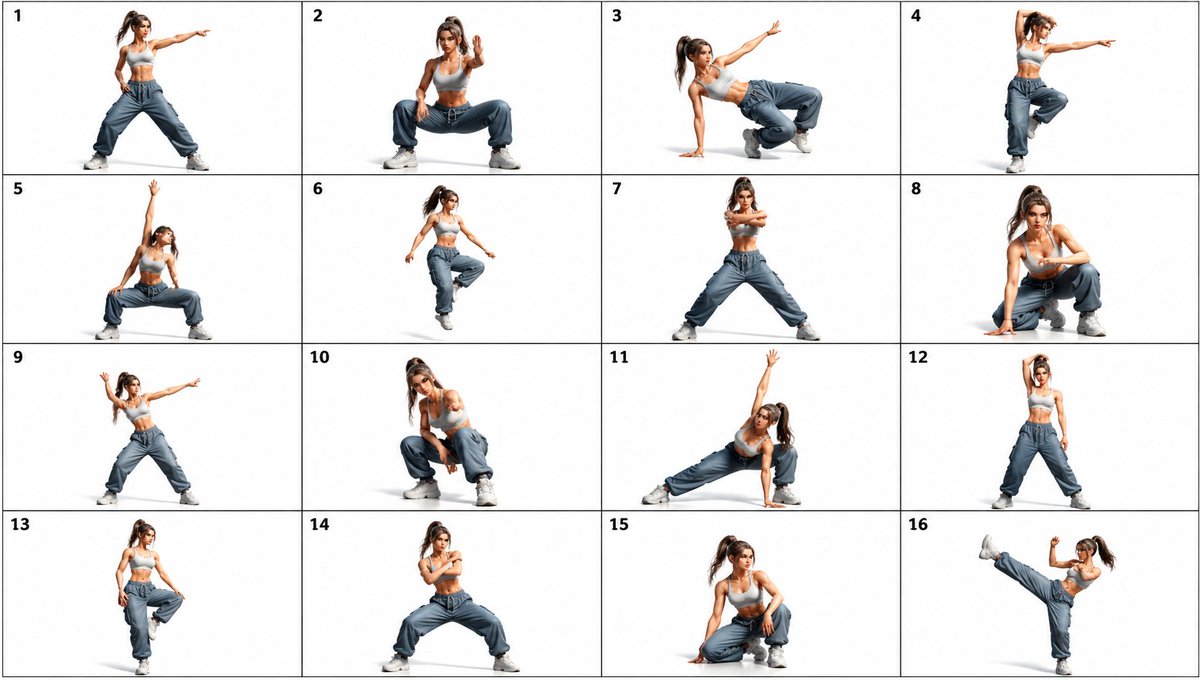
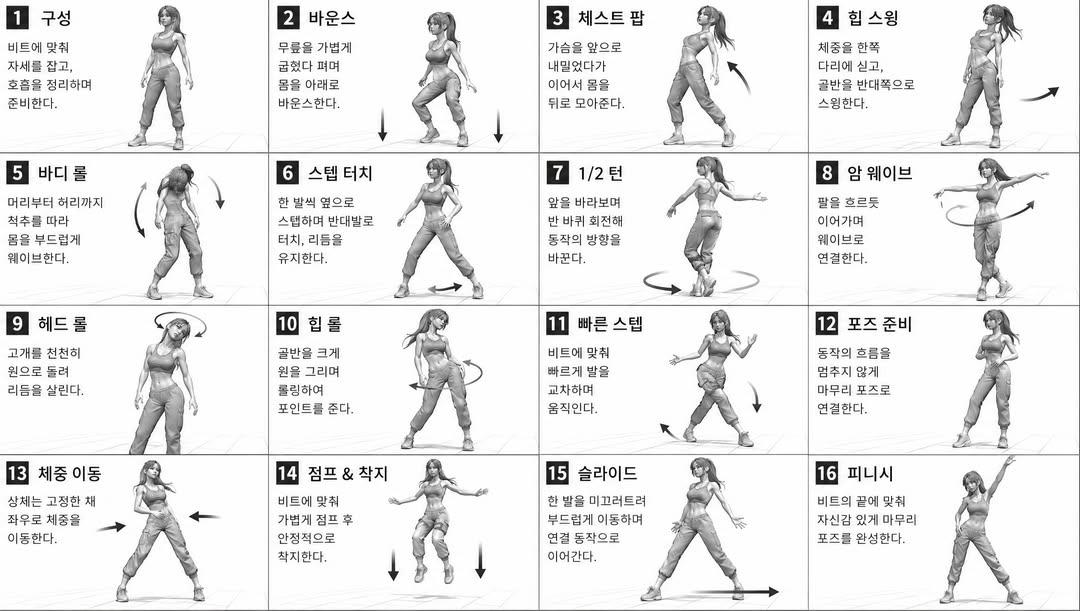
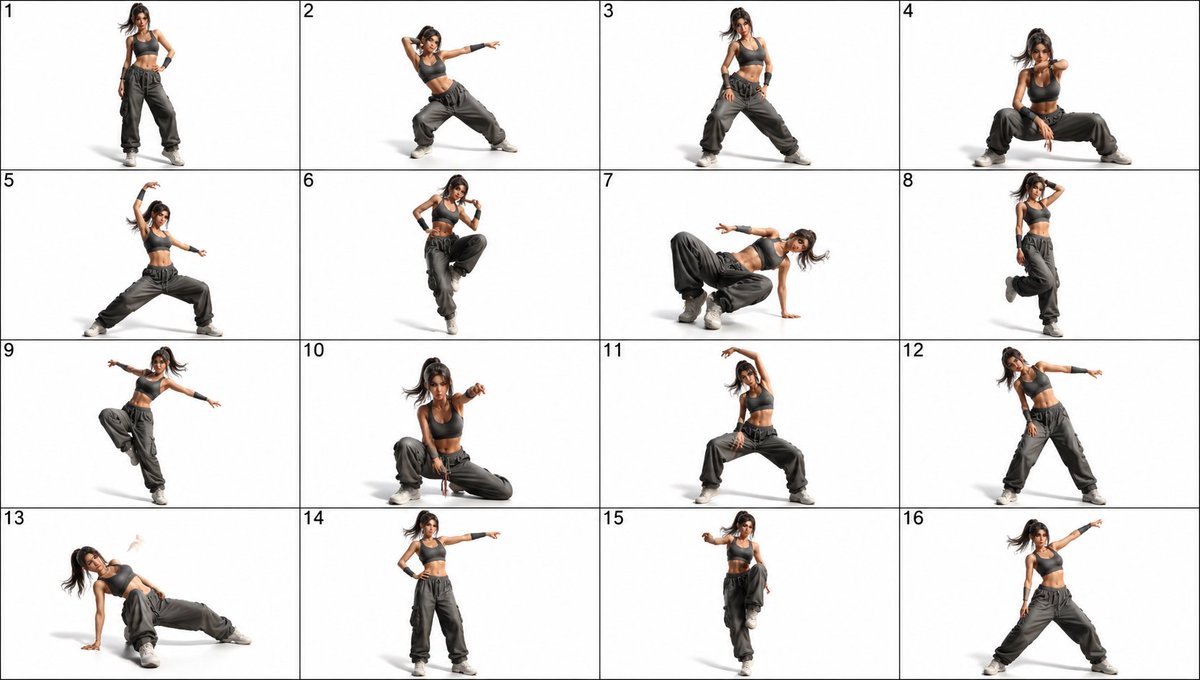
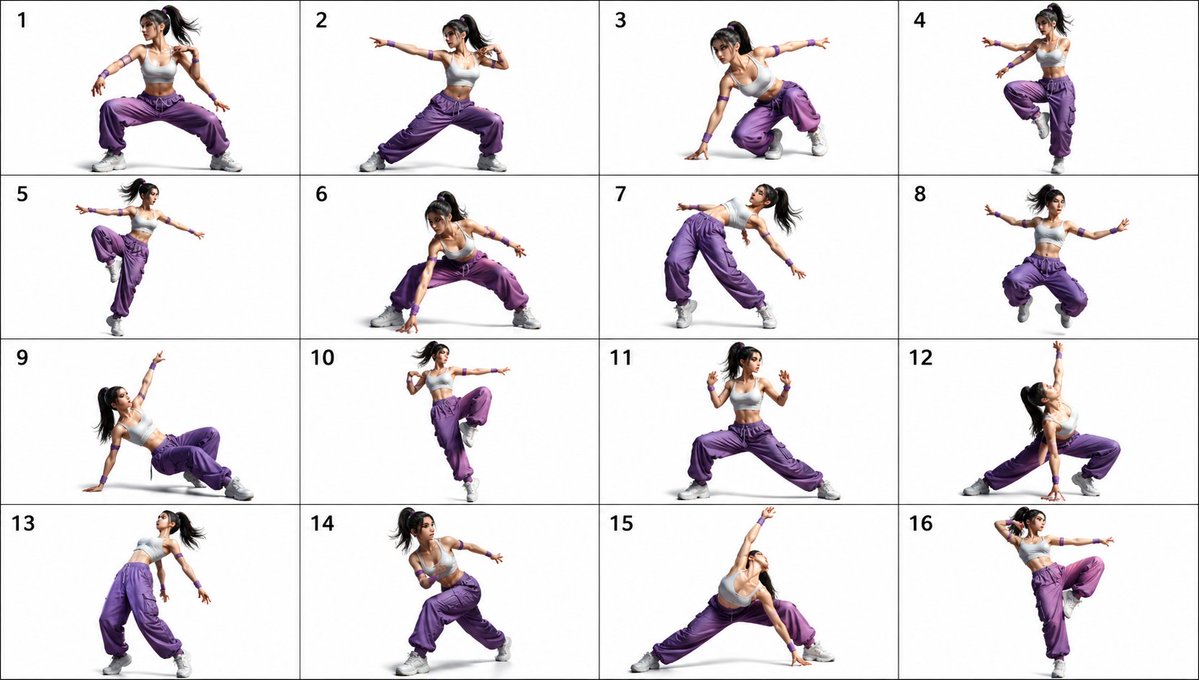
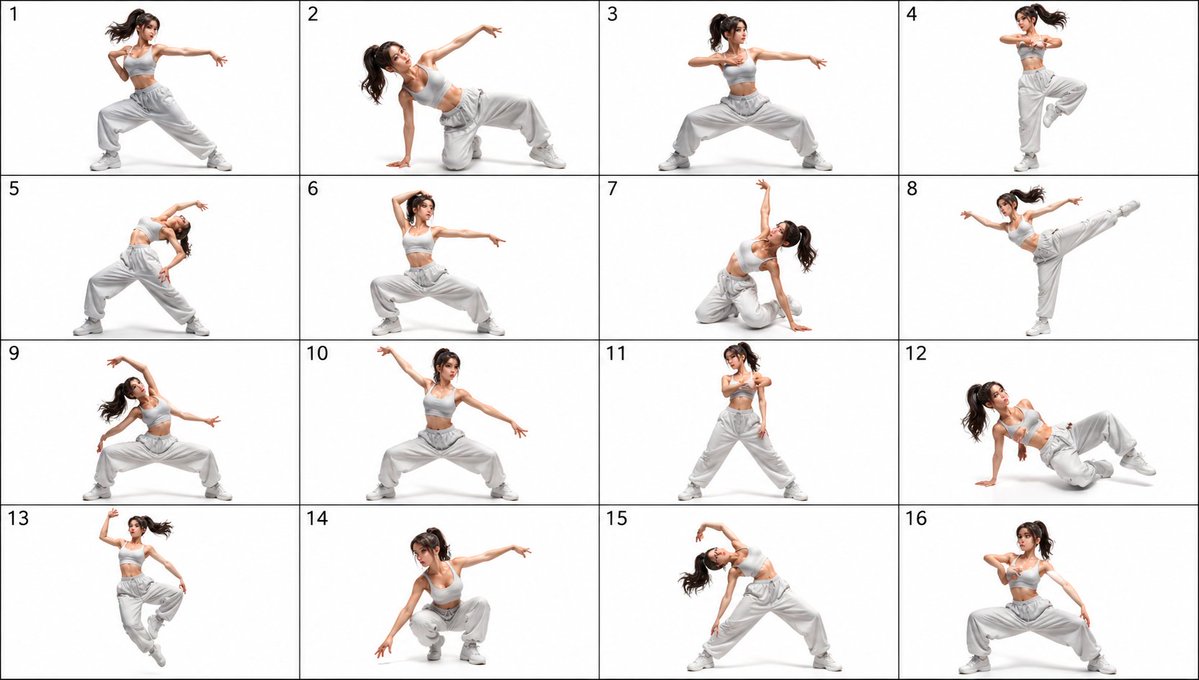
{"type":"pose reference sheet","subject":{"category":"female dancer fitness model","age_appearance":"young adult","build":"slim athletic","hair":{"color":"dark brown","style":"high ponytail"},"outfit":{"top":"light gray or white sports bra crop top","bottom":"baggy light gray sweatpants","shoes":"white sneakers"},"face":"softly blurred or de-emphasized facial features"},"style":{"image_type":"studio dance pose chart","background":"clean seamless white background","lighting":"bright even studio lighting with minimal shadows","color_palette":"neutral whites and light grays","camera":"full-body framing, straight-on view, consistent distance","rendering":"photorealistic"},"layout":{"grid":{"rows":4,"columns":4,"count":16,"border":"thin black dividers between cells"},"numbering":{"count":16,"labels":["1","2","3","4","5","6","7","8","9","10","11","12","13","14","15","16"],"position":"top-left corner of each panel"},"sections":[{"title":"row 1","position":"top","count":4,"labels":["1 side lunge with one arm extended straight sideways and the other bent near chest","2 low floor pose leaning on one hand with one knee down and opposite arm arched upward","3 wide squat facing front with both arms opened in angular dance position","4 standing balance on one leg with opposite knee lifted and forearms crossed near chest"]},{"title":"row 2","position":"upper-middle","count":4,"labels":["5 deep backbend in wide stance with torso arched and one arm curved overhead","6 wide squat with one hand behind head and the other arm pointing outward","7 kneeling side stretch with one hand on floor and opposite arm reaching straight up","8 standing arabesque-style extension with torso tilted forward and one leg lifted high behind/sideways"]},{"title":"row 3","position":"lower-middle","count":4,"labels":["9 wide squat with torso tilted left, one arm curved overhead and one arm extended low","10 front-facing wide squat with both arms stretched diagonally in opposite directions","11 relaxed standing pose with legs apart and both forearms crossing in front of torso","12 floor recline supported on one hand and one knee, torso leaning back with bent legs"]},{"title":"row 4","position":"bottom","count":4,"labels":["13 small jump or lifted balance with one knee raised and one arm bent upward","14 low crouch squat with one hand reaching toward floor and other arm extended sideways","15 dramatic side backbend in wide stance with hair swinging and one arm curved overhead","16 powerful wide squat with one hand at chest and the other lowered to the side"]}],"overall_composition":"all 16 poses shown as separate panels in a uniform contact sheet"},"prompt":"Create a clean studio contact sheet of {argument name=\"pose count\" default=\"16\"} full-body dance or combat-reference poses featuring a {argument name=\"subject type\" default=\"young athletic woman\"} in a {argument name=\"outfit\" default=\"light gray sports bra, loose gray sweatpants, and white sneakers\"}. Use a seamless {argument name=\"background color\" default=\"white\"} background, bright even lighting, and a consistent straight-on camera. Arrange the poses in a 4x4 grid with thin black panel lines and small black numbers 1 through 16 in the top-left of each cell. The poses should mix standing, squatting, kneeling, floorwork, balance, kick-extension, backbend, and angular arm positions suitable for a dance sheet chart or combat movement reference. Keep the styling photorealistic, crisp, minimal, and instructional, with consistent wardrobe and hair across all panels."}