Case Media
Case Notes
This page keeps the media, full prompt, and original source together so you can inspect the result first and decide whether the prompt is worth copying, saving, or comparing.
Case Insights
To make this page easier to search, cite, and reuse later, the case is also broken down into practical guidance about usage, visual cues, and prompt structure.
Best Fit Scenarios
- Use this as a character design benchmark when you need a fast style baseline before rewriting your own prompt.
- It is especially helpful if your target overlaps with Fashion, Poster, Character and you want to judge the image result before tuning wording.
- Keep it as a control sample when you compare nearby prompt variants one variable at a time.
Visual Signals To Notice
- The clearest style signals here are Fashion, Poster, Character, so those should usually stay in your first rewrite.
- Look at silhouette, costume language, mood styling, and whether the character reads clearly at a glance.
- This case keeps 2 media outputs, which makes it easier to check whether the style remains stable across multiple results.
How The Prompt Is Structured
- The prompt reads as a long, highly specified prompt, which is useful when you want to judge how much specificity this direction needs.
- Its keyword cluster is centered on Fashion, Poster, Character, so you can usually keep that cluster while swapping subject, camera, layout, or copy details.
- A practical rewrite path is: keep the outcome, keep the strongest style cues, then replace only the subject and environment blocks.
Good Follow-up Questions
- What changes first if you keep Fashion, Poster, Character but switch the subject matter?
- Which part of the result comes from section-level structure (Character Design) versus tag-level style cues?
- Which related cases in the same section give you a cleaner or more extreme variation of the same direction?
Full Prompt
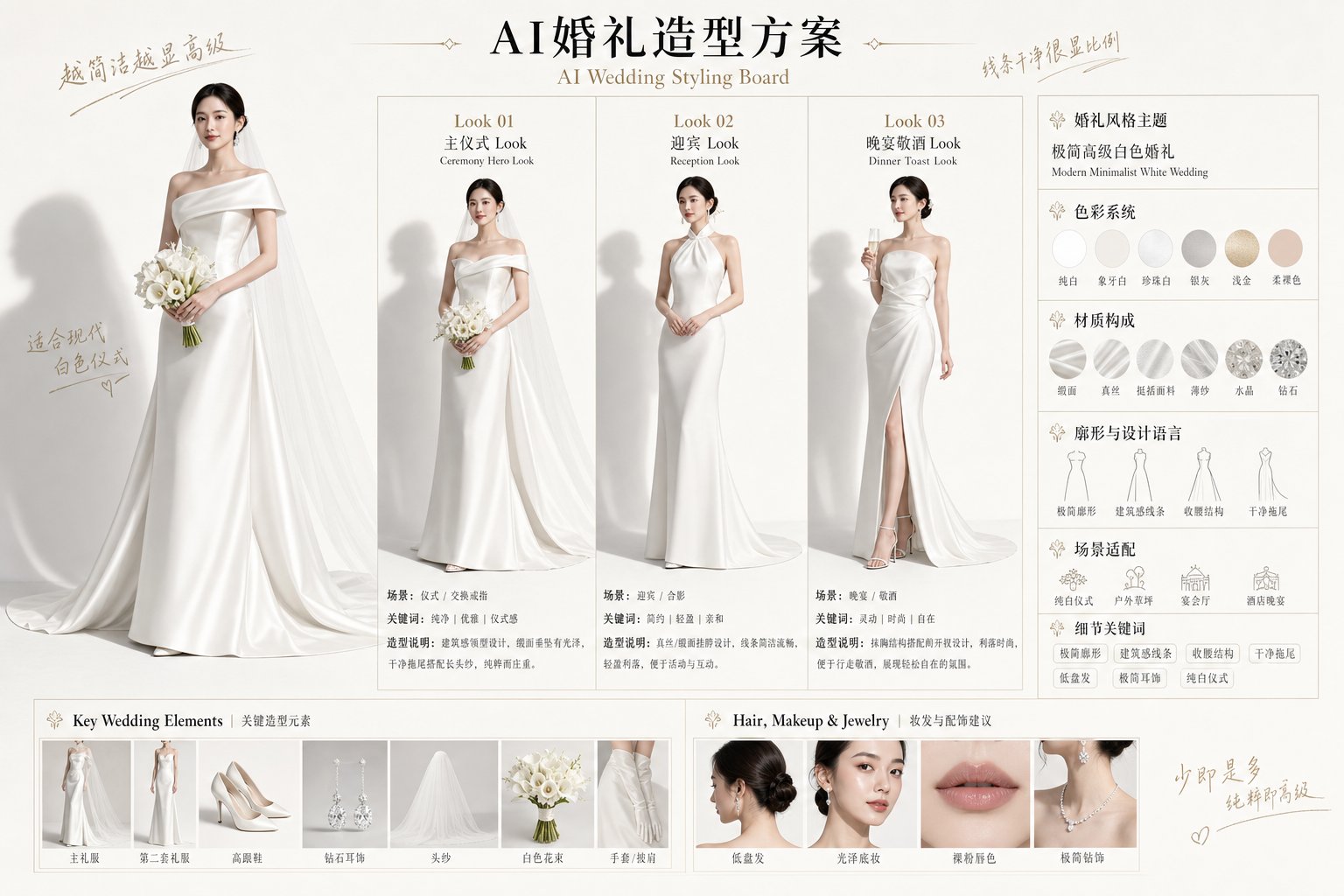
Please generate a high-completion horizontal 4:3 'AI Wedding Styling Board' based on the [Wedding Theme / Role / Style Direction] provided. [User Input Template] Wedding Theme: ________ Role: Bride / Groom Wedding Scenarios: Ceremony / Reception / Toast / Dinner Style Keywords: Sophisticated, Elegant, Restrained, Romantic, Minimalist Luxury, Modern / Chinese / French / Vintage, etc. Main Color Palette: ________ Material Keywords: Satin, Silk, Organza, Lace, Tulle, Beadwork, Pearls, Crystals, Velvet, etc. Additional Requirements: ________ [Task Positioning] This is a comprehensive wedding styling proposal board, not a simple wedding photo or gown poster. The image must simultaneously include: a main visual of the styling, 3 scenario-based looks, a color system, material analysis, silhouette descriptions, hair/makeup advice, jewelry/shoes/bouquet/accessory suggestions, and occasion adaptation notes. The overall aesthetic must be high-end, elegant, and refined, possessing a brand lookbook and fashion magazine proposal feel. Avoid cheap studio styles, tacky wedding posters, over-the-top 'cheap princess' vibes, or low information density. [Important Note] The same wedding theme should generate two separate images: 1. Bride Version: Role is 'Bride'. 2. Groom Version: Role is 'Groom'. Do not merge the bride and groom into the same image. Each image focuses on a single character and generates a complete wedding styling proposal for that role. [Layout Structure] Horizontal 4:3 ratio, high-end light-colored background (e.g., cream white, champagne, ivory, light gray-white, soft mist pink-white). Clear typography with white space, thin line frames, color blocks, material samples, numbered modules, and minimal Chinese handwritten-style annotations. - Top: Title Section. Main title 'AI婚礼造型方案', English subtitle 'AI Wedding Styling Board', along with the theme name, role, and a brief style description. - Left: Main Visual Area. Showcasing the core styling. The character should be an adult Chinese bride or groom with a sophisticated, natural, and elegant temperament. The pose should be formal and ceremonial. Avoid stiff faces or low-quality studio vibes. - Middle: 3 Scenario-based Looks (Look 01: Ceremony Hero Look, Look 02: Reception Look, Look 03: Dinner Look). Each look must include outfit, shoes, accessories, hair/makeup, scenario tags, and a brief styling description. The looks must be cohesive extensions of the same theme. - Right: Professional Analysis Area. Including: 1. Style Theme (summary paragraph), 2. Color Palette (5–6 blocks including primary, secondary, accent, metallic, and floral colors), 3. Material Board (4–6 materials with short functional descriptions), 4. Silhouette & Details (focusing on waistline, hem, neckline, shoulder, embroidery, veil, etc.), 5. Occasion Fit. - Bottom: Key Items Section. 5–8 key elements (e.g., main gown/suit, secondary look, shoes, jewelry, bouquet, gloves, brooch, cufflinks) with brief explanations. [Visual Requirements] Refined, informative yet not crowded. Must look like a high-end fashion magazine editorial or a professional brand proposal. Strictly avoid tacky wedding trends, blurry details, or messy text.