Case Media
Case Notes
This page keeps the media, full prompt, and original source together so you can inspect the result first and decide whether the prompt is worth copying, saving, or comparing.
Case Insights
To make this page easier to search, cite, and reuse later, the case is also broken down into practical guidance about usage, visual cues, and prompt structure.
Best Fit Scenarios
- Use this as a character design benchmark when you need a fast style baseline before rewriting your own prompt.
- It is especially helpful if your target overlaps with Portrait, Illustration, Character and you want to judge the image result before tuning wording.
- Keep it as a control sample when you compare nearby prompt variants one variable at a time.
Visual Signals To Notice
- The clearest style signals here are Portrait, Illustration, Character, so those should usually stay in your first rewrite.
- Look at silhouette, costume language, mood styling, and whether the character reads clearly at a glance.
- This case keeps 2 media outputs, which makes it easier to check whether the style remains stable across multiple results.
How The Prompt Is Structured
- The prompt reads as a long, highly specified prompt, which is useful when you want to judge how much specificity this direction needs.
- Its keyword cluster is centered on Portrait, Illustration, Character, so you can usually keep that cluster while swapping subject, camera, layout, or copy details.
- A practical rewrite path is: keep the outcome, keep the strongest style cues, then replace only the subject and environment blocks.
Good Follow-up Questions
- What changes first if you keep Portrait, Illustration, Character but switch the subject matter?
- Which part of the result comes from section-level structure (Character Design) versus tag-level style cues?
- Which related cases in the same section give you a cleaner or more extreme variation of the same direction?
Full Prompt
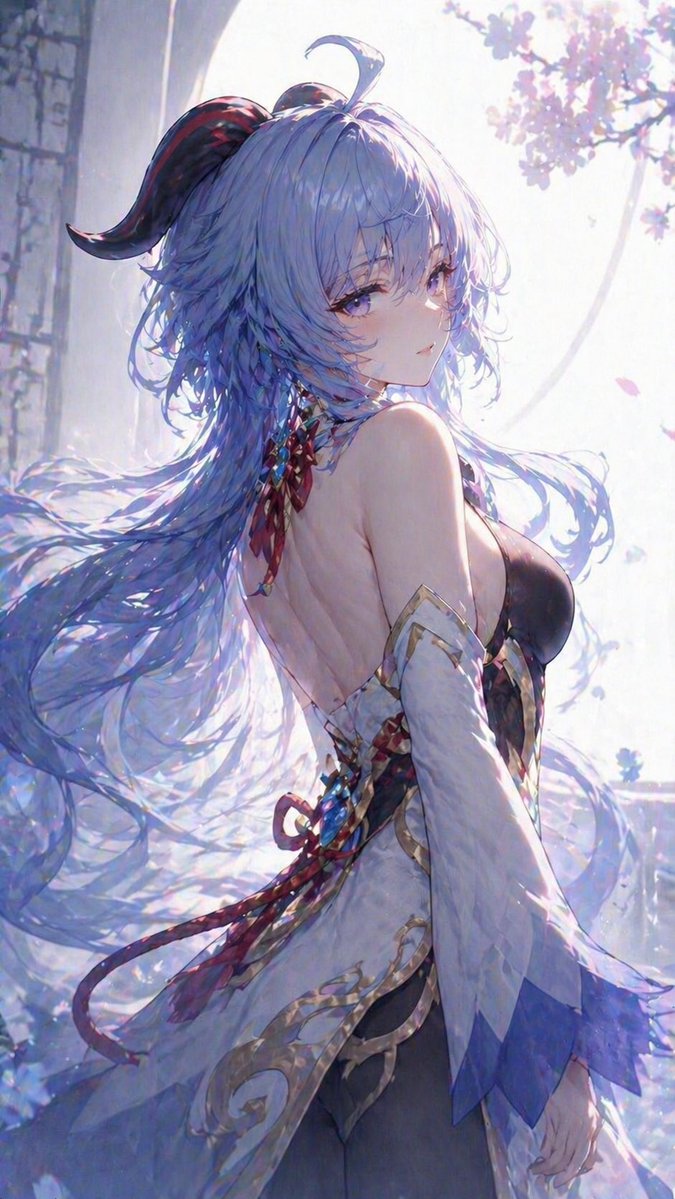
A highly detailed anime fantasy portrait of {argument name="character name" default="an elegant blue-haired fantasy woman"}, shown from the back in a three-quarter pose, turning her head over her shoulder to look at the viewer with calm violet eyes and a soft, slightly distant expression. She has very long, flowing {argument name="hair color" default="icy pastel blue"} hair with layered wispy bangs, loose windblown strands, one small ahoge on top, and 1 dark curved horn with subtle crimson striping emerging from the left side of her head. Her outfit is a refined, backless fantasy gown with 4 visible main pieces: a dark fitted bodice, a white open-backed outer layer with ornate gold trim and pale embroidered patterns, 2 long detached sleeves that fade into translucent blue-violet pointed cuffs, and red-blue ribbon ornaments tied at the neck and waist. Add delicate jewel-like tassel details at the upper back and trailing ribbon ends drifting in the air. The scene is backlit by soft spring sunlight in a pale stone pavilion or arched balcony, with 1 large arch opening behind her and clusters of {argument name="flower type" default="pink cherry blossoms"} glowing in the top right background. Include a few drifting petals, luminous haze, subtle sparkles, and a dreamy pastel atmosphere. Composition is vertical, upper-thigh portrait, character centered slightly right, hair sweeping broadly across the left side of the frame. Render in a polished ethereal anime illustration style with soft bloom, translucent fabrics, glossy eyes, delicate linework, cool lavender and blue tones, gentle rim light, painterly background blur, and an emphasis on smooth elegant surfaces, clean fabric flow, and minimal wrinkling.