Case Media
Case Notes
This page keeps the media, full prompt, and original source together so you can inspect the result first and decide whether the prompt is worth copying, saving, or comparing.
Case Insights
To make this page easier to search, cite, and reuse later, the case is also broken down into practical guidance about usage, visual cues, and prompt structure.
Best Fit Scenarios
- Use this as a character design benchmark when you need a fast style baseline before rewriting your own prompt.
- It is especially helpful if your target overlaps with Illustration, Character, Anime and you want to judge the image result before tuning wording.
- Keep it as a control sample when you compare nearby prompt variants one variable at a time.
Visual Signals To Notice
- The clearest style signals here are Illustration, Character, Anime, so those should usually stay in your first rewrite.
- Look at silhouette, costume language, mood styling, and whether the character reads clearly at a glance.
- This case keeps one primary output, so the first image should be treated as the main visual reference.
How The Prompt Is Structured
- The prompt reads as a long, highly specified prompt, which is useful when you want to judge how much specificity this direction needs.
- Its keyword cluster is centered on Illustration, Character, Anime, so you can usually keep that cluster while swapping subject, camera, layout, or copy details.
- A practical rewrite path is: keep the outcome, keep the strongest style cues, then replace only the subject and environment blocks.
Good Follow-up Questions
- What changes first if you keep Illustration, Character, Anime but switch the subject matter?
- Which part of the result comes from section-level structure (Character Design) versus tag-level style cues?
- Which related cases in the same section give you a cleaner or more extreme variation of the same direction?
Full Prompt
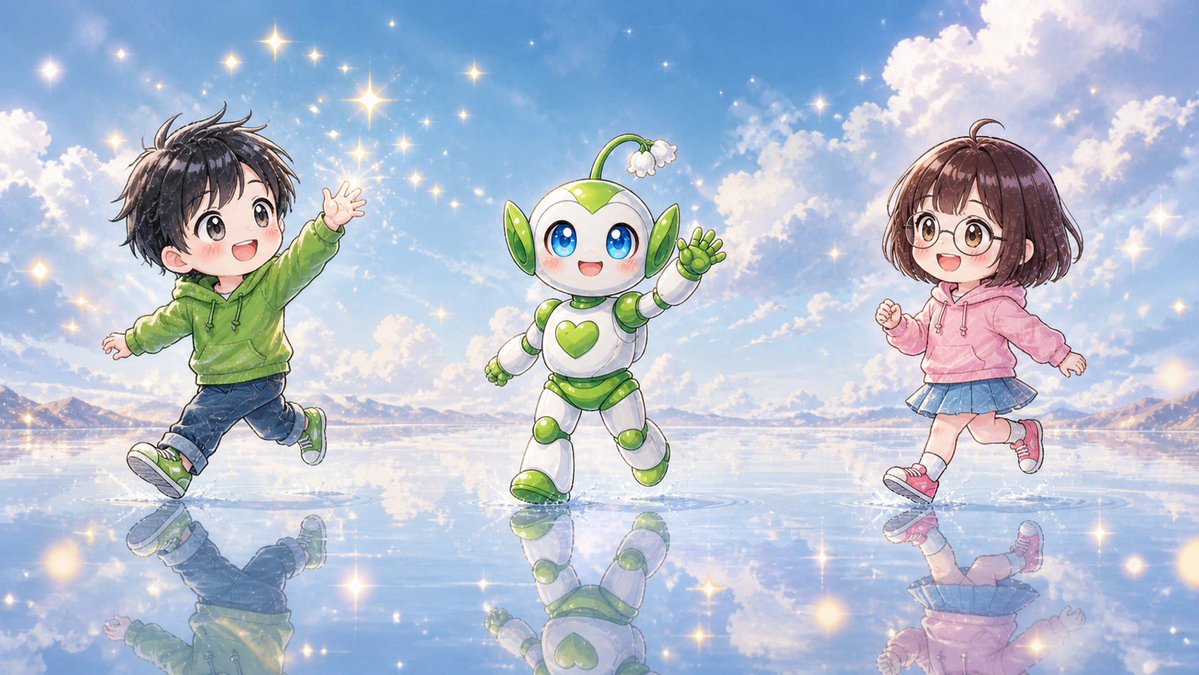
Create a bright whimsical anime-style wide illustration of exactly 3 cute chibi figures running and dancing across a mirror-like shallow water surface under a vivid blue sky: 1 chibi boy on the left, 1 small mascot robot in the center, and 1 chibi girl on the right. The left child is {argument name="left child outfit" default="a green hoodie, dark blue cuffed jeans, and green sneakers"}, with messy short black hair, arms spread as if skipping, one leg lifted, and the face intentionally covered by a soft square blur. The center character is {argument name="mascot design" default="a white and lime-green round robot mascot with big blue eyes, green heart emblem on its chest, leaf-like green ear panels, rounded segmented limbs, and a small sprout antenna ending in a white flower"}, smiling happily and waving while stepping forward. The right child is {argument name="right child outfit" default="a pink hoodie, blue pleated skirt, white socks, and pink sneakers"}, with short brown bobbed hair, running lightly with one fist raised, and the face intentionally covered by a soft square blur. Set the scene on an expansive reflective water plain like a dreamlike salt flat, with crisp reflections of all 3 figures beneath them. Use {argument name="background setting" default="distant low mountains on the horizon, fluffy sunlit clouds, and a radiant blue afternoon sky"}. Fill the air and water with many glowing star-shaped sparkles and warm golden light flares, creating a magical cheerful atmosphere. Use polished Japanese children’s book anime rendering, soft watercolor-like shading, clean line art, pastel colors, luminous highlights, high detail, wide 16:9 composition, no text, no logos.