Case Media
Case Notes
This page keeps the media, full prompt, and original source together so you can inspect the result first and decide whether the prompt is worth copying, saving, or comparing.
Case Insights
To make this page easier to search, cite, and reuse later, the case is also broken down into practical guidance about usage, visual cues, and prompt structure.
Best Fit Scenarios
- Use this as a character design benchmark when you need a fast style baseline before rewriting your own prompt.
- It is especially helpful if your target overlaps with Portrait, Illustration, Character and you want to judge the image result before tuning wording.
- Keep it as a control sample when you compare nearby prompt variants one variable at a time.
Visual Signals To Notice
- The clearest style signals here are Portrait, Illustration, Character, so those should usually stay in your first rewrite.
- Look at silhouette, costume language, mood styling, and whether the character reads clearly at a glance.
- This case keeps one primary output, so the first image should be treated as the main visual reference.
How The Prompt Is Structured
- The prompt reads as a long, highly specified prompt, which is useful when you want to judge how much specificity this direction needs.
- Its keyword cluster is centered on Portrait, Illustration, Character, so you can usually keep that cluster while swapping subject, camera, layout, or copy details.
- A practical rewrite path is: keep the outcome, keep the strongest style cues, then replace only the subject and environment blocks.
Good Follow-up Questions
- What changes first if you keep Portrait, Illustration, Character but switch the subject matter?
- Which part of the result comes from section-level structure (Character Design) versus tag-level style cues?
- Which related cases in the same section give you a cleaner or more extreme variation of the same direction?
Full Prompt
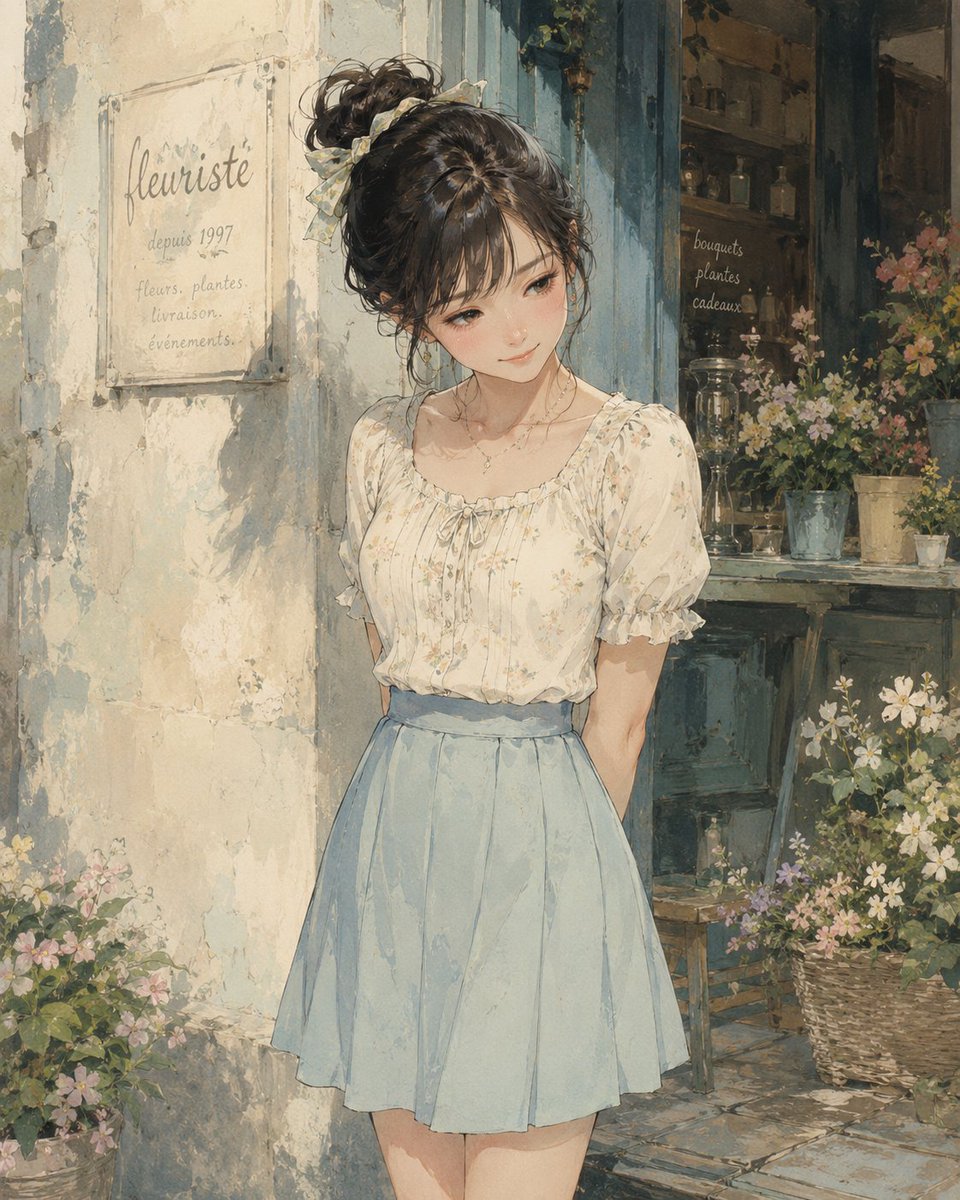
Create a romantic watercolor-style anime illustration of {argument name="character description" default="a young woman with dark brown hair in a messy high bun tied with a pale ribbon"} standing in front of a quaint vintage French flower shop. She wears {argument name="outfit" default="a cream floral puff-sleeve blouse with a gathered neckline and a high-waisted pale blue pleated skirt"}, with a delicate necklace, soft feminine posture, and her hands held behind her back. Her face is intentionally covered by a centered opaque square censor block in a warm brown skin-tone gradient, obscuring all facial features while leaving the hair, neck, outfit, and body visible. The setting is a sunlit, weathered plaster storefront with peeling paint, muted blue wooden trim, an open shop window full of potted flowers, glass bottles, shelves, and rustic decor. On the left wall is a translucent sign reading “fleuriste”, “depuis 1997”, and “fleurs. plantes. livraison. événements.”; inside the shop window, small handwritten text reads “bouquets”, “plantes”, “cadeaux”. Surround the entrance with baskets and pots of wildflowers in soft pink, white, yellow, and green. Use {argument name="art style" default="delicate hand-painted watercolor and gouache anime realism"}, soft natural daylight, warm beige and powder-blue palette, textured paper grain, loose painterly edges, gentle shadows, nostalgic European street atmosphere, vertical portrait composition, highly detailed flowers and fabric folds, no modern objects.