Case Media
Case Notes
This page keeps the media, full prompt, and original source together so you can inspect the result first and decide whether the prompt is worth copying, saving, or comparing.
Case Insights
To make this page easier to search, cite, and reuse later, the case is also broken down into practical guidance about usage, visual cues, and prompt structure.
Best Fit Scenarios
- Use this as a character design benchmark when you need a fast style baseline before rewriting your own prompt.
- It is especially helpful if your target overlaps with Fashion, Illustration, Character and you want to judge the image result before tuning wording.
- Keep it as a control sample when you compare nearby prompt variants one variable at a time.
Visual Signals To Notice
- The clearest style signals here are Fashion, Illustration, Character, so those should usually stay in your first rewrite.
- Look at silhouette, costume language, mood styling, and whether the character reads clearly at a glance.
- This case keeps one primary output, so the first image should be treated as the main visual reference.
How The Prompt Is Structured
- The prompt reads as a long, highly specified prompt, which is useful when you want to judge how much specificity this direction needs.
- Its keyword cluster is centered on Fashion, Illustration, Character, so you can usually keep that cluster while swapping subject, camera, layout, or copy details.
- A practical rewrite path is: keep the outcome, keep the strongest style cues, then replace only the subject and environment blocks.
Good Follow-up Questions
- What changes first if you keep Fashion, Illustration, Character but switch the subject matter?
- Which part of the result comes from section-level structure (Character Design) versus tag-level style cues?
- Which related cases in the same section give you a cleaner or more extreme variation of the same direction?
Full Prompt
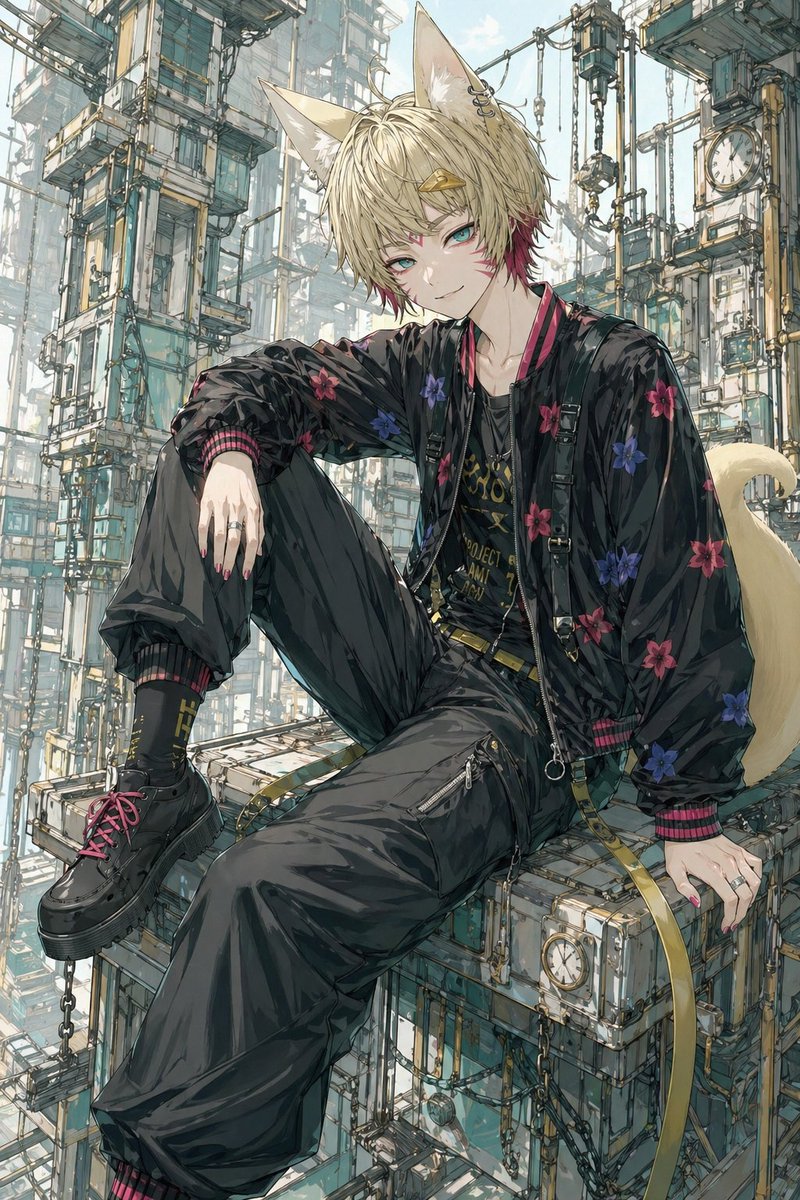
A highly detailed anime-style illustration of a fashionable fox-eared young man sitting casually on the edge of a floating industrial platform in a vast vertical steampunk city. He has messy layered {argument name="hair color" default="light blond"} hair with a small streak of deep magenta near one side, 2 large fox ears with pale inner fur, and a fluffy cream-colored fox tail curling behind him. His face is intentionally obscured by a flat square censor block centered over the face. He wears a glossy black bomber jacket embroidered with scattered floral patterns in 2 colors, red-pink and violet-blue, with ribbed cuffs and collar striped in dark red and black. Under it is a black graphic T-shirt with ornate gold lettering and emblem details, partially hidden by layered straps and necklaces. His outfit includes loose black cargo-style pants with zipper details, black socks with small gold lettering, and chunky black platform shoes with bright magenta laces. Add multiple silver rings, black suspenders or harness straps with metal buckles, and a long olive-gold hanging belt strap draped off the platform. Pose him in a relaxed seated posture with 1 knee raised and 1 leg extended diagonally downward, left arm resting over the raised knee and right hand planted beside him. The mood is cool, urban, and slightly rebellious. The background is an intricate labyrinth of towering pale teal and off-white mechanical structures, stacked platforms, scaffolding, hanging chains, exposed cables, suspended boxes, and several round clocks embedded in the architecture, creating a dense vertical futuristic-steampunk environment fading into atmospheric haze. Use soft daylight, muted pastel industrial colors, fine linework, delicate ink-and-watercolor rendering, crisp fabric highlights, and a polished contemporary anime illustration aesthetic.