Case Media
Case Notes
This page keeps the media, full prompt, and original source together so you can inspect the result first and decide whether the prompt is worth copying, saving, or comparing.
Case Insights
To make this page easier to search, cite, and reuse later, the case is also broken down into practical guidance about usage, visual cues, and prompt structure.
Best Fit Scenarios
- Use this as a character design benchmark when you need a fast style baseline before rewriting your own prompt.
- It is especially helpful if your target overlaps with Portrait, Cinematic, Fashion and you want to judge the image result before tuning wording.
- Keep it as a control sample when you compare nearby prompt variants one variable at a time.
Visual Signals To Notice
- The clearest style signals here are Portrait, Cinematic, Fashion, so those should usually stay in your first rewrite.
- Look at silhouette, costume language, mood styling, and whether the character reads clearly at a glance.
- This case keeps one primary output, so the first image should be treated as the main visual reference.
How The Prompt Is Structured
- The prompt reads as a long, highly specified prompt, which is useful when you want to judge how much specificity this direction needs.
- Its keyword cluster is centered on Portrait, Cinematic, Fashion, so you can usually keep that cluster while swapping subject, camera, layout, or copy details.
- A practical rewrite path is: keep the outcome, keep the strongest style cues, then replace only the subject and environment blocks.
Good Follow-up Questions
- What changes first if you keep Portrait, Cinematic, Fashion but switch the subject matter?
- Which part of the result comes from section-level structure (Character Design) versus tag-level style cues?
- Which related cases in the same section give you a cleaner or more extreme variation of the same direction?
Full Prompt
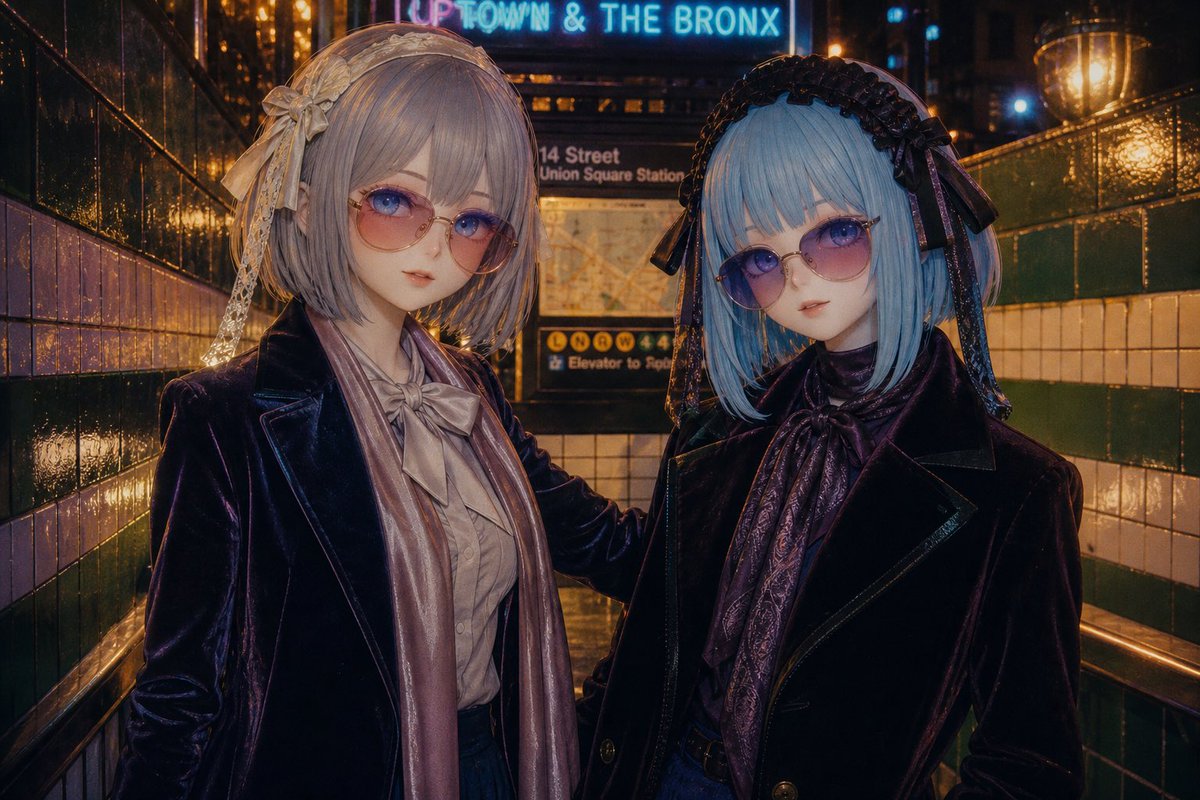
Create a moody cinematic night photograph of two fashionable anime-inspired gothic lolita women standing close together in a wet New York City subway entrance, framed from mid-thigh upward in a 3:2 horizontal composition. The setting is a tiled stairwell corridor with glossy dark green and cream subway tiles, brass handrails, rain-slick reflections, warm amber station lights, and a sign in the background reading “UPTOWN & THE BRONX” above a “14 Street Union Square Station” information board. The left woman has {argument name="left hair color" default="pale lavender silver"} short bob hair with side-swept bangs, a delicate cream lace headband with ribbons and a flower bow, a dark plum velvet tailored jacket, a champagne satin scarf, a pale blouse with a large bow at the neck, and a dark skirt; her arm rests around the other woman’s shoulder. The right woman has {argument name="right hair color" default="icy light blue"} straight bob hair with blunt bangs, a black lace headdress with long ribbon tails, small dark glasses, a black velvet coat with sharp lapels, and a dark purple patterned scarf tied at the neck. Both figures should look like realistic cosplay fashion models with porcelain doll styling, but their faces are intentionally hidden by flat opaque muted taupe rectangular censor blocks centered over each face. Use rich nocturnal color grading, high contrast, cinematic street photography realism, shallow depth of field, wet reflective surfaces, glowing bokeh, detailed velvet and satin textures, and an atmospheric urban gothic fashion editorial mood.