Case Media
Case Notes
This page keeps the media, full prompt, and original source together so you can inspect the result first and decide whether the prompt is worth copying, saving, or comparing.
Case Insights
To make this page easier to search, cite, and reuse later, the case is also broken down into practical guidance about usage, visual cues, and prompt structure.
Best Fit Scenarios
- Use this as a character design benchmark when you need a fast style baseline before rewriting your own prompt.
- It is especially helpful if your target overlaps with 35mm, Cinematic, Illustration and you want to judge the image result before tuning wording.
- Keep it as a control sample when you compare nearby prompt variants one variable at a time.
Visual Signals To Notice
- The clearest style signals here are 35mm, Cinematic, Illustration, so those should usually stay in your first rewrite.
- Look at silhouette, costume language, mood styling, and whether the character reads clearly at a glance.
- This case keeps one primary output, so the first image should be treated as the main visual reference.
How The Prompt Is Structured
- The prompt reads as a long, highly specified prompt, which is useful when you want to judge how much specificity this direction needs.
- Its keyword cluster is centered on 35mm, Cinematic, Illustration, so you can usually keep that cluster while swapping subject, camera, layout, or copy details.
- A practical rewrite path is: keep the outcome, keep the strongest style cues, then replace only the subject and environment blocks.
Good Follow-up Questions
- What changes first if you keep 35mm, Cinematic, Illustration but switch the subject matter?
- Which part of the result comes from section-level structure (Character Design) versus tag-level style cues?
- Which related cases in the same section give you a cleaner or more extreme variation of the same direction?
Full Prompt
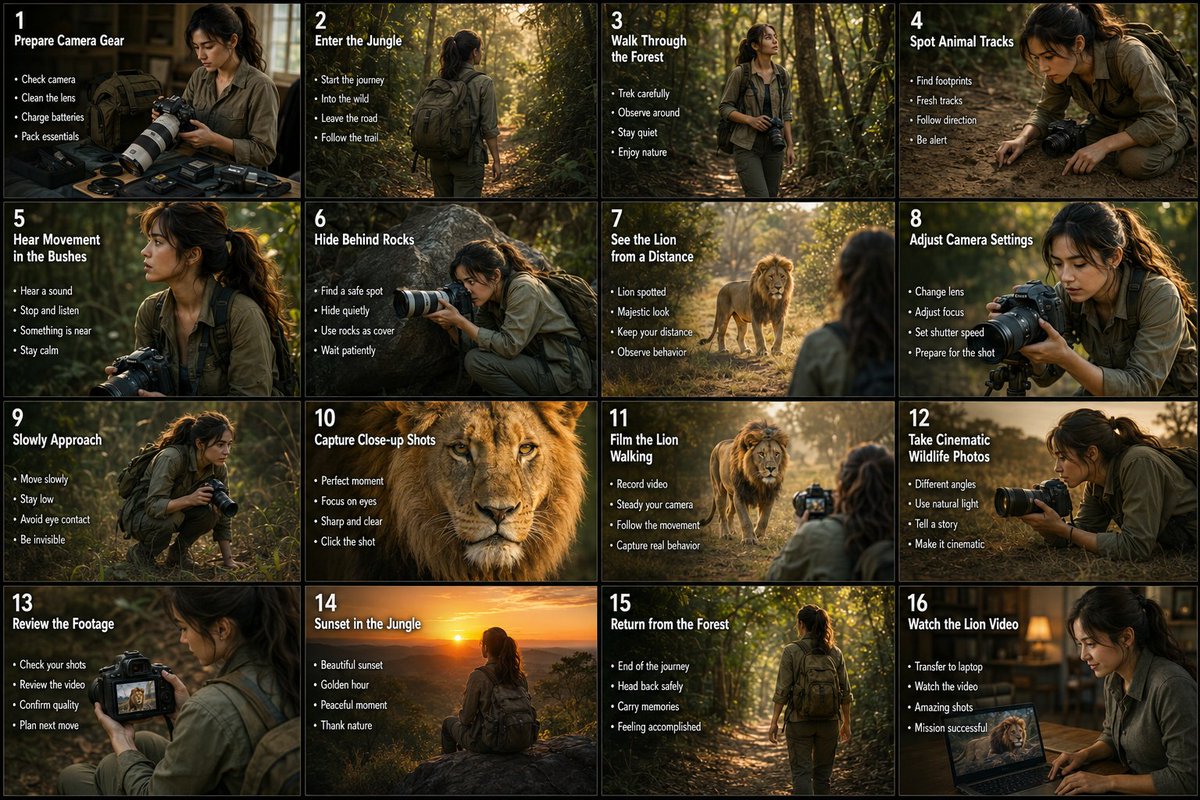
Create a cinematic 16-panel storyboard infographic showing the adventure of a young female wildlife photographer traveling into a deep forest to photograph a majestic lion. Use a realistic movie-storyboard style with warm natural colors, dramatic sunlight, jungle atmosphere, cinematic camera angles, and professional wildlife documentary aesthetics. The same realistic young woman should appear consistently in every panel wearing outdoor explorer clothing, hiking boots, backpack, and carrying a professional DSLR camera with a telephoto lens. Arrange the storyboard in a clean 4x4 grid with numbered scenes, bold titles, small bullet points, and visual motion arrows. Scenes should include: preparing camera gear, entering the jungle, walking through trees, spotting animal tracks, hearing movement in bushes, carefully hiding behind rocks, seeing the lion from a distance, adjusting camera settings, slowly approaching, capturing close-up lion shots, filming the lion walking, taking cinematic wildlife photos, reviewing footage on the camera screen, sunset in the jungle, returning safely from the forest, and finally showing the captured lion video proudly on a laptop or camera display. Include realistic forest lighting, dust particles, leaves moving, cinematic shadows, wildlife atmosphere, dramatic expressions, camera close-ups, and emotional storytelling. Ultra-realistic photography style, nature documentary mood, high-detail jungle environment, realistic human appearance, premium cinematic composition, 4K quality, no anime, no cartoon, no CGI look.